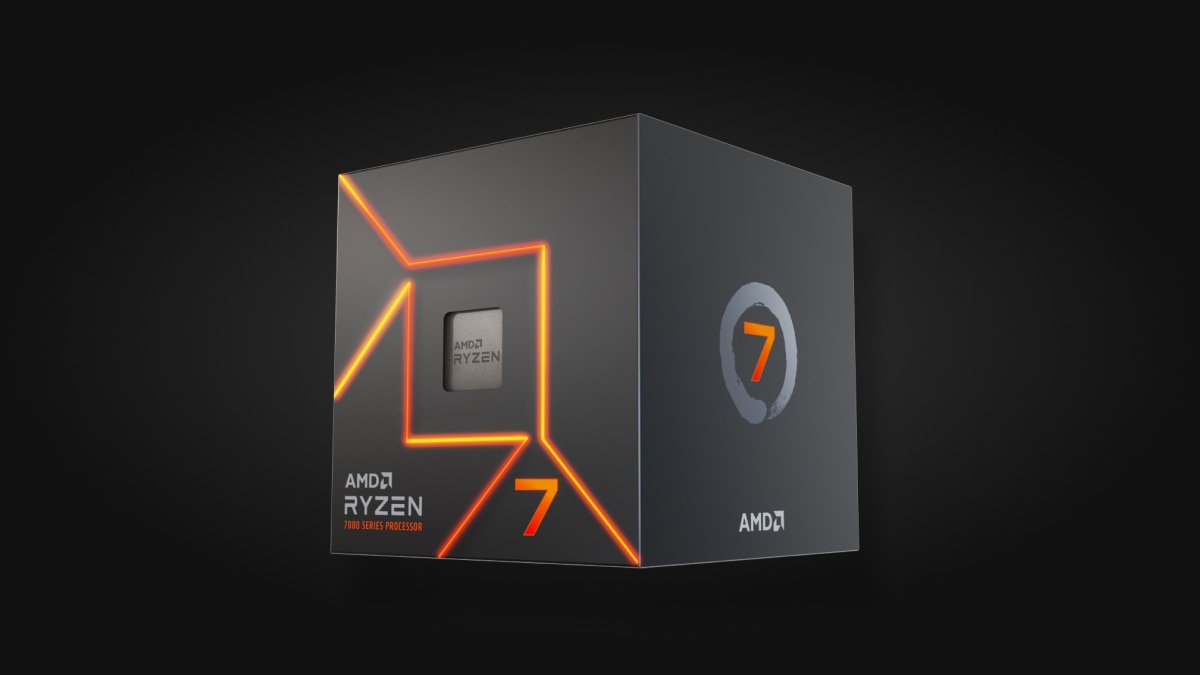
AMD Ryzen 7 7700
An 8-core, 16-thread Zen 4 processor for socket AM5 with a 65 W default TDP, up to 5.3 GHz boost, 32 MB of L3 cache, DDR5, PCIe 5.0 and an unlocked multiplier.
Full Specification Sheet
| Architecture | Zen 4 (codename Raphael) |
|---|---|
| Cores / Threads | 8 / 16 |
| Base Clock | 3.8 GHz |
| Max Boost Clock | Up to 5.3 GHz |
| L1 Cache | 512 KB |
| L2 Cache | 8 MB |
| L3 Cache | 32 MB |
| Default TDP | 65 W |
| Process | TSMC 5nm FinFET (CPU cores), TSMC 6nm FinFET (I/O die) |
| Die Sizes | CCD 71 mm2, I/O die 122 mm2 (2 dies in package) |
| Socket | AM5 |
| Memory | DDR5, 2 channels, up to 128 GB, DDR5-5200 (2 x 1R or 2 x 2R), DDR5-3600 with four modules |
| PCIe | PCIe 5.0, 28 lanes (24 usable) |
| USB | 4 x native USB 3.2 Gen 2 (10 Gbps), 1 x USB 2.0 |
| Integrated Graphics | AMD Radeon Graphics, 2 cores, 2200 MHz |
| Unlocked | Yes (Precision Boost Overdrive, Curve Optimizer, AMD EXPO) |
| Max Operating Temperature | 95 C |
| Cooler | AMD Wraith Prism per product page; boxed models updated to no longer include a cooler from 1 August 2025 (AMD footnote) |
| Product ID | 100-100000592SBX / 100-100000592WOZ (boxed), 100-000000592 (tray) |
The AMD Ryzen 7 7700 is an eight-core desktop processor from the Ryzen 7000 Series, based on the Zen 4 architecture and the former codename Raphael. AMD's headline for it is the exceptional gaming processor: leading your team to victory should not cost a fortune, and this chip is positioned as the value choice on the AM5 platform, with overclocking support and, according to the page text, the AMD Wraith Prism cooler with RGB lighting. The page gives a launch date of 14 January 2023 and no price, so this entry records the date and leaves the price empty. What follows is a reading of AMD's published specification table, with a few labelled calculations and one important caveat about the cooler. We have not benchmarked the processor ourselves.
Cores, clocks and cache
AMD lists 8 CPU cores with simultaneous multithreading, so 16 threads. The maximum boost clock is up to 5.3 GHz and the base clock is 3.8 GHz. As AMD explains in its footnotes, the maximum boost is the highest frequency a single core can reach on a bursty single-threaded workload and it varies with thermal paste, cooling, motherboard design, BIOS, the chipset driver and operating-system updates, and the base clock is the average effective base frequency of all cores. The caches are 512 KB of L1, 8 MB of L2 and 32 MB of L3, which is 1 MB of L2 and 4 MB of L3 per core. That is a modest amount of L3 by current standards, and it is the main thing that separates this chip from the 3D V-Cache models in the same family. If you are still deciding how many cores you really need, our explainer on core count versus clock speed walks through the common workloads.
Process technology and die sizes
The CPU cores use TSMC 5nm FinFET technology and the I/O die uses TSMC 6nm FinFET. Unlike many pages, this one publishes die sizes: the CPU compute die (CCD) measures 71 mm2 and the I/O die 122 mm2, and the package contains two dies. Adding the two gives 193 mm2 of silicon in total, which is our arithmetic and not a figure AMD states. The processor is unlocked for overclocking. AMD's footnote reminds buyers that the product warranty does not cover damage caused by overclocking, even when it is enabled through AMD hardware or software. Supported tuning tools are AMD EXPO memory overclocking, Precision Boost Overdrive, Curve Optimizer voltage offsets and Ryzen Master.
Power and the cooler question
The default TDP is 65 W and the maximum operating temperature (Tjmax) is 95 C. Against a 105 W part such as the Ryzen 7 7700X, which lists the same cache and core count, that is a default power limit about 38 percent lower, which is arithmetic from the two pages. The product description says the processor includes the AMD Wraith Prism cooler with RGB lighting, and the page's own title text says the same. However, a footnote in the product IDs section says that, because the AMD SR4 cooler has reached end of life, select Ryzen 7000 and 5000 boxed models are updated to no longer include a cooler starting 1 August 2025, and it tells readers to contact their local AMD sales representative for more information. The boxed IDs are listed with asterisks (100-100000592SBX and 100-100000592WOZ), so we cannot say from the page whether the box you buy contains a cooler. Treat it as unconfirmed, check the retailer's listing, and keep a cooler in the budget. Our guide to air versus liquid cooling helps with that choice.
Memory and platform
The processor uses socket AM5 and DDR5 only, in two channels, with unbuffered DIMMs and up to 128 GB. The listed maximum speeds are DDR5-5200 for two single-rank or two dual-rank modules and DDR5-3600 for four modules of either type. As arithmetic, two channels of DDR5-5200 give 5200 million transfers per second times 8 bytes times two channels, or 83.2 GB/s of theoretical peak bandwidth. ECC is supported when the motherboard supports it. The supporting chipsets are A620, B650, B650E, X670, X670E, B840, B850, X870 and X870E, so the chip is not tied to the older boards it launched with. If you are weighing DDR5 against an older platform, our DDR5 versus DDR4 buying guide covers the cost and performance trade-off, and our platform guide to AM4, AM5 and LGA1700 explains how AM5 fits into the bigger picture.
Connectivity and graphics
The processor provides PCIe 5.0 with 28 native lanes, 24 of them usable. Additional usable lanes come from the motherboard chipset, and the page lists twelve PCIe 4.0 lanes on X670E and X670 and eight on B650E and B650. Native USB is four ports of USB 3.2 Gen 2 at 10 Gbps, no USB 3.2 Gen 1 ports and one USB 2.0 port, and there are no native SATA ports on the processor itself. NVMe boot is supported with RAID 0, RAID 1 and RAID 10. The integrated graphics are AMD Radeon Graphics with two graphics cores running at 2200 MHz, with USB Type-C DisplayPort Alternate Mode support. That is enough for desktop work and for getting a system running before a graphics card arrives, but it is not designed for games. Supported operating systems are Windows 11 and Windows 10 in 64-bit editions, Red Hat Enterprise Linux and Ubuntu in 64-bit builds.
Instruction set and identifiers
The instruction set is x86-64 with AES, AMD-V, AVX, AVX2, AVX512, FMA3, MMX-plus, SHA, SSE, SSE2, SSE3, SSE4.1, SSE4.2, SSE4A and SSSE3, and the boost technology is Precision Boost 2. The tray product ID is 100-000000592; the boxed IDs carry the same base number with the SBX and WOZ suffixes and a multi-pack ID ends in SPK. When you compare listings, those suffixes are the quickest way to tell which packaging variant you are looking at.
Where it sits in our database
Two entries are the natural comparison. The Ryzen 7 7700X lists a 105 W TDP, a 4.5 GHz base clock and a boost of up to 5.4 GHz on the same 8 cores and 32 MB of L3, while the Ryzen 7 9700X lists a Zen 5 design, a 65 W TDP, a 3.8 GHz base clock and a boost of up to 5.5 GHz. So the 7700 matches the 9700X on core count, base clock and power limit, and gives up 200 MHz of boost ceiling and the newer architecture in exchange for an older and usually cheaper generation, a statement about specifications and not about price, which we do not list. You can put the two side by side in our comparison of the 7700 and the 9700X, and you can browse every processor in the processor category.
What the page does not say
The page does not list a price, does not tell us how the Wraith Prism situation resolves for current boxes, and carries no independent performance data. It also does not say how much of the 5.3 GHz boost a typical cooler lets the chip hold, which depends on the factors AMD lists. Use this entry to check the compatibility facts that matter before buying: socket AM5, DDR5-only memory with a 128 GB limit, the chipset list, the 65 W default power budget and the unconfirmed cooler. Then look for independent testing in the games and applications you actually run before deciding whether an eight-core part is the right size for you.