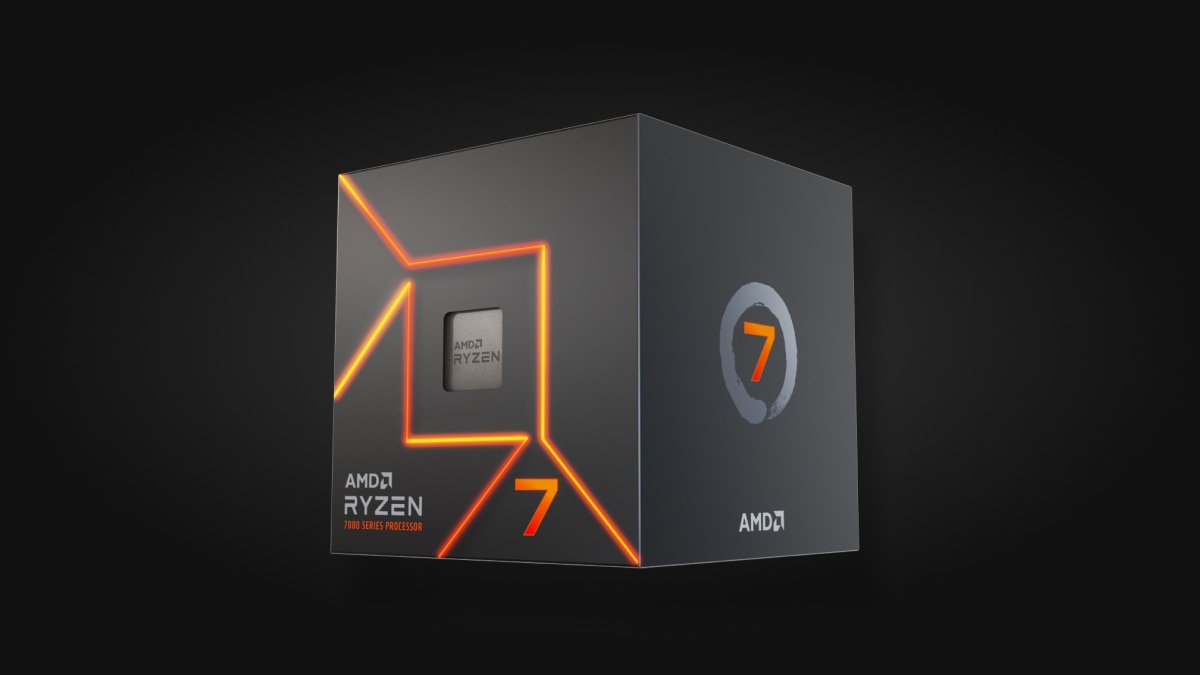
AMD Ryzen 7 7700X
An 8-core, 16-thread AM5 processor with a 4.5 GHz base clock, up to 5.4 GHz boost, 32 MB of L3 cache and a 105 W default TDP, launched by AMD on 27 September 2022.
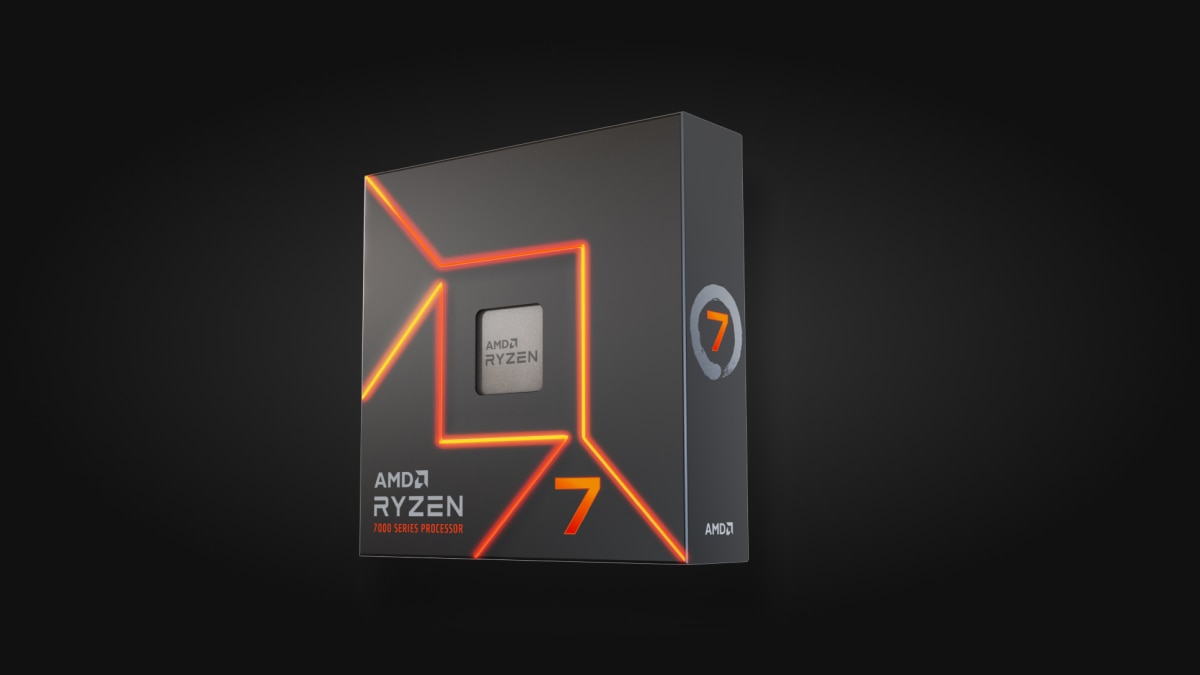
Full Specification Sheet
| Architecture | Zen 4 (codename Raphael) |
|---|---|
| Cores / Threads | 8 / 16 |
| Base Clock | 4.5 GHz |
| Max Boost Clock | Up to 5.4 GHz |
| L1 Cache | 512 KB |
| L2 Cache | 8 MB |
| L3 Cache | 32 MB |
| Default TDP | 105 W |
| Process | TSMC 5nm FinFET (CPU cores), TSMC 6nm FinFET (I/O die) |
| Socket | AM5 |
| Memory | DDR5, 2 channels, up to 128 GB, DDR5-5200 (2 x 1R) |
| PCIe | PCIe 5.0, 28 lanes (24 usable) |
| Integrated Graphics | AMD Radeon Graphics, 2 cores, 2200 MHz |
| Max Operating Temperature | 95 C |
| Cooler Included | No |
The AMD Ryzen 7 7700X is an eight-core desktop processor for the AM5 socket. It belongs to the Ryzen 7000 Series, is built on the Zen 4 architecture (former codename Raphael) and has a launch date of 27 September 2022 on AMD's product page, which makes it one of the first processors of the AM5 generation. AMD describes it as a dominant gaming desktop processor and as the top 8-core AMD gaming processor, and files it under the enthusiast desktop market segment as a boxed product. This page walks through the specification AMD publishes, explains what each figure means for someone choosing parts, and leaves out anything the manufacturer page does not state. There are no benchmarks and no test results here, and every number is a manufacturer specification unless it is marked as simple arithmetic.
Cores, threads and clocks
AMD lists eight CPU cores with simultaneous multithreading, so the operating system sees sixteen threads. The base clock is 4.5 GHz, which AMD defines as the average effective base frequency of all cores, and the maximum boost clock is up to 5.4 GHz. AMD is careful about the boost figure: it is the highest frequency a single core can reach on a bursty single-threaded workload, and it varies with thermal paste, system cooling, motherboard design and BIOS, the current chipset driver and operating-system updates. The gap between base and boost is 0.9 GHz (arithmetic from AMD's two figures), so the chip has plenty of room between its guaranteed and its peak frequency, but 5.4 GHz is a ceiling for a single core and not a promise for all eight at once. The processor uses Precision Boost 2 to choose frequencies. For a wider look at when cores matter more than clock speed, see our guide to core count versus clock speed, and for what the extra threads do, our explainer on SMT and Hyper-Threading.
Cache
The cache figures are 512 KB of L1, 8 MB of L2 and 32 MB of L3. Dividing the L2 total across eight cores gives 1 MB per core, and the L3 total gives 4 MB per core (arithmetic from AMD's totals). AMD does not state here how the L3 is shared, so this page does not describe the topology. For comparison, AMD's X3D models such as the Ryzen 7 7800X3D add stacked cache on top, but that is a separate product and not part of this one.
Power, thermals and cooling
The default TDP is 105 W and the maximum operating temperature (Tjmax) is 95 degrees Celsius. The page states that a thermal solution is not included in the box and that a premium air cooler is recommended for optimal performance. That recommendation is worth taking at face value: a 105 W processor that boosts to 5.4 GHz will use whatever cooling headroom it is given. The processor is unlocked for overclocking, and AMD lists support for Precision Boost Overdrive, Curve Optimizer voltage offsets and AMD Ryzen Master. AMD adds that its product warranty does not cover damage caused by overclocking, even when overclocking is enabled through AMD hardware or software. To understand how AMD's automatic boost tools differ from Intel's power limits, see our guide to PL1, PL2 and AMD PBO.
Process and package
The CPU cores are made on TSMC's 5nm FinFET process and the I/O die on TSMC 6nm FinFET. The package has two dies, which AMD sizes at 71 mm squared for the CPU compute die (CCD) and 122 mm squared for the I/O die (IOD). The I/O die carries the memory controller, the PCIe lanes and the small integrated graphics unit, which is why an AM5 processor of this generation can drive a display without a graphics card. Splitting the compute and I/O functions across two dies is a design AMD has used for several generations, and the process figures above are AMD's own.
Memory
The processor supports DDR5 in two channels, up to 128 GB, with UDIMM modules. AMD's maximum memory speeds are DDR5-5200 with two modules of one rank each, DDR5-5200 with two modules of two ranks each, and DDR5-3600 with four modules of either rank. The pattern matters: filling all four slots lowers the officially supported speed, so a two-module kit is the natural choice. As arithmetic, DDR5-5200 moves 5,200 million transfers per second on a 64-bit-wide channel, about 41.6 GB/s per channel and 83.2 GB/s across two channels as a theoretical peak, not a measured figure. ECC support is listed as yes, with the condition that the motherboard supports it. The processor supports AMD EXPO memory overclocking profiles, which lets a kit run above the official speed if the board and kit allow it. For the difference between EXPO and Intel's XMP, see our guide to XMP versus EXPO.
Platform, chipsets and connectivity
The socket is AM5, and AMD lists supporting chipsets A620, X670E, X670, B650E, B650, X870E, X870, B840 and B850. The processor provides PCIe 5.0 with 28 native lanes, of which 24 are usable, and the extra lanes a motherboard adds depend on the chipset: 12 PCIe Gen4 lanes on X670E and X670, and 8 on B650E and B650. Native USB is four USB 3.2 Gen 2 (10 Gbps) ports and one USB 2.0 port, and there are no native SATA ports, so SATA storage comes from the chipset. NVMe support includes boot, RAID 0, RAID 1 and RAID 10. AMD's stated operating systems are Windows 11 and Windows 10 64-bit, RHEL and Ubuntu. To choose among those platforms, see our platform guide covering AM4, AM5 and LGA1700.
Integrated graphics and instructions
The processor includes AMD Radeon Graphics with two graphics cores at 2,200 MHz, and USB Type-C DisplayPort Alternate Mode is listed as supported. This is a basic display output for setup, troubleshooting or office work and is not a substitute for a graphics card. The instruction set is x86-64 with extensions that AMD lists as AES, AMD-V, AVX, AVX2, AVX512, FMA3, MMX-plus, SHA, SSE, SSE2, SSE3, SSE4.1, SSE4.2, SSE4A and SSSE3. The boxed product ID is 100-100000591WOF and the tray product ID is 100-000000591, useful when you need to match the exact listing.
How to place it
Inside AMD's Ryzen 7000 lineup, the 7700X sits between six-core parts such as the Ryzen 5 7600X and the higher-core-count Ryzen 9 chips, and among the other Ryzen 7 processors in our database it is the older, Zen 4 generation. To see it next to the newer Zen 5 Ryzen 7 9700X, open our side-by-side comparison of the two processors, or browse the full processor category. Every value on this page comes from AMD's product page and is a specification and not a measurement. The page gives no price, so none is shown here, and real-world performance depends on the cooler, the memory and the game or application, none of which this page can tell you.
What the page does not say
AMD's page does not state a price, does not publish any test results for this model, does not list the number of PCIe 5.0 lanes reserved for graphics beyond the totals above, and gives no memory latency figures. If you are building around this chip, plan for a separate cooler, a two-module DDR5 kit, and an AM5 board whose BIOS supports the processor out of the box; the ASUS PRIME B650M-A WIFI in our database, for example, offers a BIOS FlashBack button for exactly that situation.