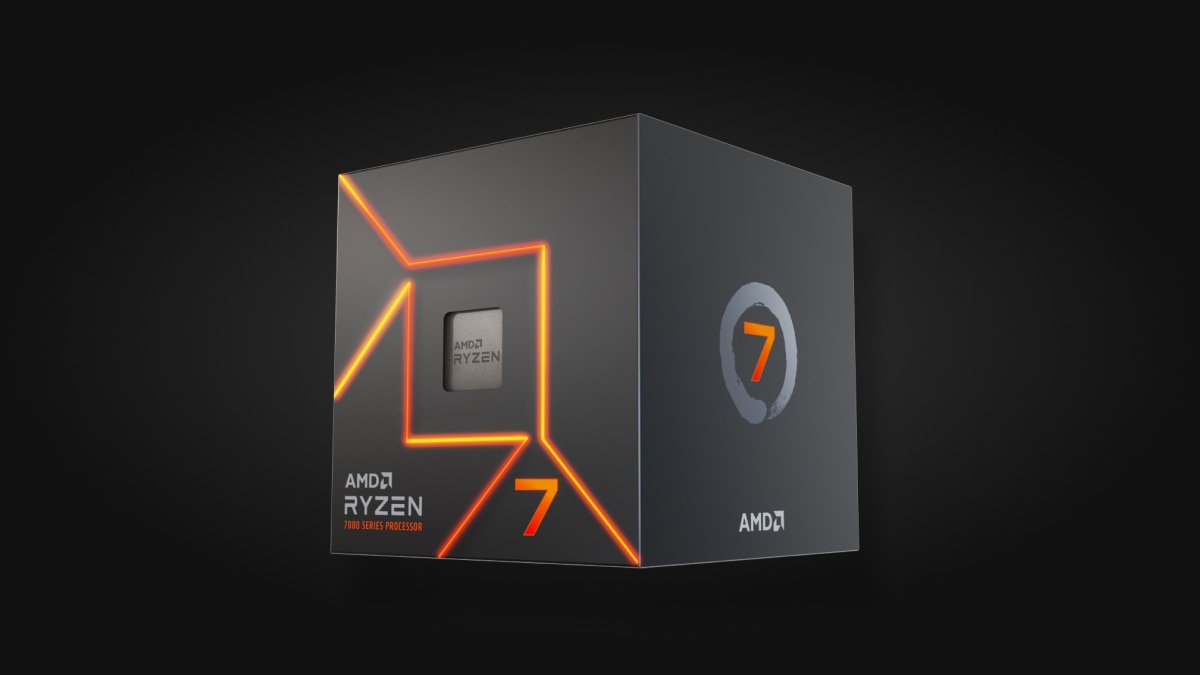
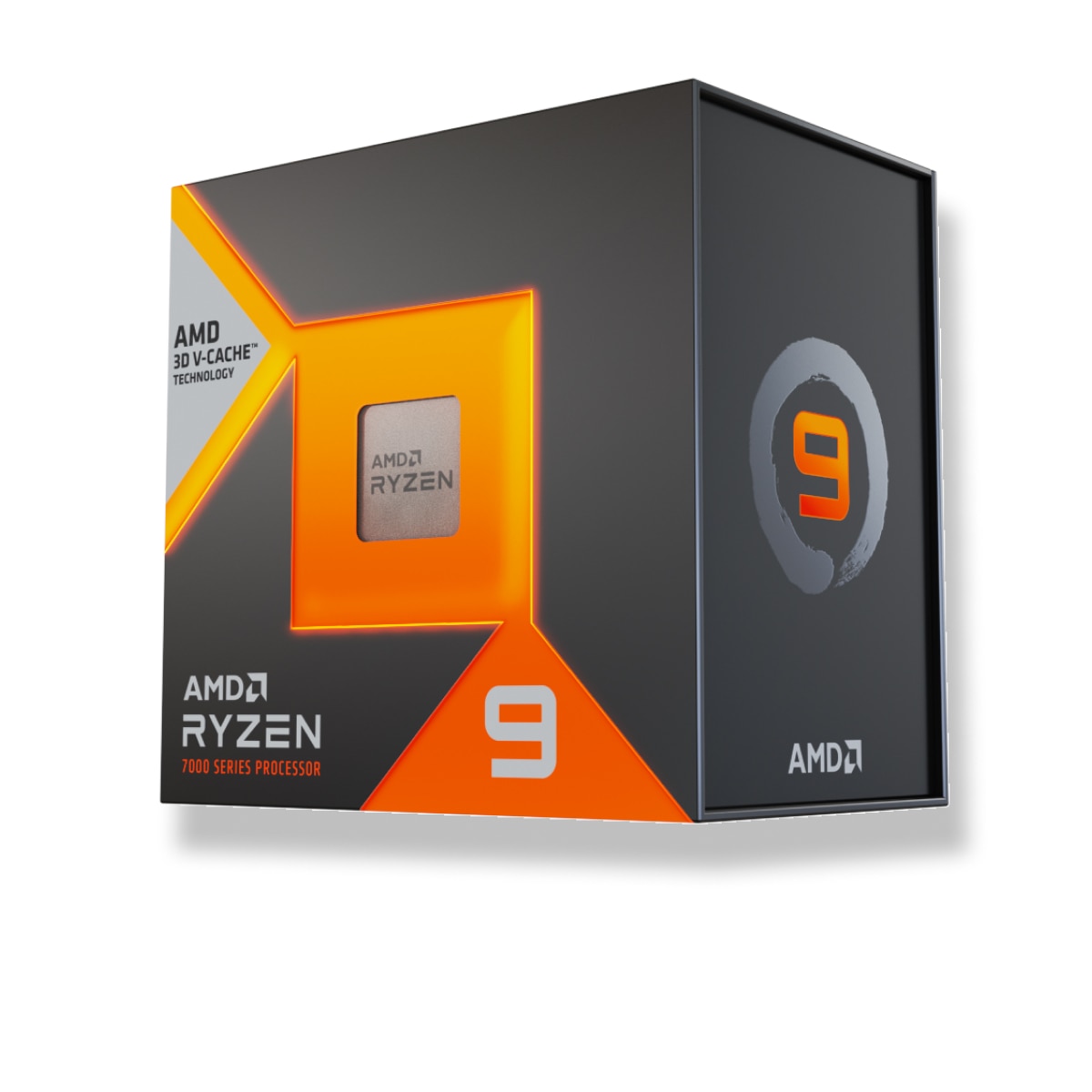
AMD Ryzen 7 7800X3D
An 8-core, 16-thread AM5 processor with 96 MB of L3 cache through AMD 3D V-Cache, a 4.2 GHz base clock, up to 5.0 GHz boost and a 120 W default TDP.
Full Specification Sheet
| Architecture | Zen 4 (codename Raphael) |
|---|---|
| Cores / Threads | 8 / 16 |
| Base Clock | 4.2 GHz |
| Max Boost Clock | Up to 5.0 GHz |
| L1 Cache | 512 KB |
| L2 Cache | 8 MB |
| L3 Cache | 96 MB (AMD 3D V-Cache) |
| Default TDP | 120 W |
| Process | TSMC 5nm FinFET (CPU cores), TSMC 6nm FinFET (I/O die) |
| Socket | AM5 |
| Memory | DDR5, 2 channels, up to 128 GB, DDR5-5200 (2 x 1R) |
| PCIe | PCIe 5.0, 28 lanes (24 usable) |
| Integrated Graphics | AMD Radeon Graphics, 2 cores, 2200 MHz |
| Max Operating Temperature | 89 C |
| Cooler Included | No |
The AMD Ryzen 7 7800X3D is an eight-core desktop processor for the AM5 socket that AMD positions as a gaming part. It belongs to the Ryzen 7000 Series, uses the Zen 4 architecture (former codename Raphael) and is distinguished from a plain Ryzen 7 by its 96 MB of L3 cache, which AMD provides through its 3D V-Cache technology. The company's launch date for the chip is 6 April 2023. AMD's own headline for the product is that it is the dominant gaming processor and that 3D V-Cache brings low latency and more game performance; that is a manufacturer claim resting on AMD's own game testing, and this page does not repeat or extend it. What follows is the specification AMD publishes, explained in plain terms, with anything the manufacturer page does not state left out.
Cores, threads and clocks
The processor has eight CPU cores and simultaneous multithreading, which gives sixteen threads. AMD lists a base clock of 4.2 GHz, described as the average effective base frequency of all cores, and a maximum boost clock of up to 5.0 GHz. AMD is explicit that the boost figure is the highest frequency a single core can reach on a bursty single-threaded workload, and that it varies with thermal paste, system cooling, motherboard design and BIOS, the current chipset driver and operating-system updates. In other words, 5.0 GHz is a ceiling that one core may touch briefly, not a sustained all-core figure. The boost behaviour is handled by Precision Boost 2, and the chip also supports Precision Boost Overdrive, Curve Optimizer voltage offsets and control through the Ryzen Master utility, all of which AMD lists as supported. If you want to understand how a core count differs from a clock speed when choosing a processor, our guide to core count versus clock speed walks through the trade-off.
The 96 MB cache and what 3D V-Cache means
The cache table is the reason this model exists. AMD lists 512 KB of L1 cache, 8 MB of L2 cache and 96 MB of L3 cache. The L3 figure is unusually large for an eight-core desktop chip, and AMD attributes it to 3D V-Cache technology, a stacked cache design. A cache is small, very fast memory that sits close to the cores and holds data they are likely to need again; the larger the last-level cache, the more of a program's working set can be kept on the chip rather than fetched from main memory. Whether that helps depends entirely on the software, and AMD's framing is that the extra cache is aimed at games. Our explainer on AMD X3D processors and 3D V-Cache covers the concept in more depth without making performance claims about this specific chip.
Silicon and packaging
AMD states that the CPU cores are made on TSMC 5nm FinFET technology and the I/O die on TSMC 6nm FinFET. The CPU compute die (CCD) is listed at 71 mm squared and the I/O die (IOD) at 122 mm squared, and the package die count is two. That means the eight cores sit on one compute die that is paired with a separate I/O die, which holds the memory controller, the PCI Express interface and the integrated graphics. Splitting a processor into chiplets in this way is what allows AMD to attach the additional cache to the compute die without changing the I/O die.
Socket, chipsets and platform
The Ryzen 7 7800X3D fits the AM5 socket. AMD's compatibility list names the A620, B650, B650E, X670, X670E, B840, B850, X870 and X870E chipsets, so the processor works across a broad range of AM5 motherboards, from budget boards to enthusiast ones, subject to a suitable BIOS. As an example of a current board in this database, the ASUS TUF GAMING B650-PLUS WIFI uses one of the listed chipsets. The processor supports PCI Express 5.0 with 28 native lanes, of which 24 are usable, and AMD lists additional usable lanes that the motherboard chipset provides: twelve Gen 4 lanes on X670E and X670, and eight Gen 4 lanes on B650E and B650. Native connectivity includes four USB 3.2 Gen 2 (10 Gbps) ports and one USB 2.0 port, and there are no native SATA ports. NVMe boot is supported, along with RAID 0, RAID 1 and RAID 10.
Memory support
The chip is a DDR5-only design with two memory channels and UDIMM support. AMD gives a maximum capacity of 128 GB and lists the maximum memory speed by configuration: DDR5-5200 with two single-rank or two dual-rank modules, and DDR5-3600 with four modules of either kind. These are the officially listed speeds, and AMD EXPO memory overclocking technology is supported as a way to run faster kits. ECC memory is listed as supported, but only when the motherboard supports it. The figures show a familiar pattern: populating all four slots lowers the guaranteed speed, which is why two-module kits are the usual choice for high-frequency memory. For how latency and frequency interact, see our explanation of RAM speed versus latency.
Integrated graphics and display output
Unlike many processors with the X suffix on earlier platforms, this one includes AMD Radeon Graphics on the I/O die. AMD lists two graphics cores running at 2200 MHz, and USB Type-C DisplayPort Alternate Mode is supported. The integrated graphics are meant for basic display output, troubleshooting and non-gaming use; a gaming build would normally add a discrete graphics card. Whether a particular motherboard exposes the video outputs depends on the board, so check its rear panel before relying on them.
Thermals, cooling and power
The default TDP is 120 W and the maximum operating temperature (Tjmax) is 89 degrees Celsius. AMD states that no thermal solution is included in the box and recommends a liquid cooler for optimal performance. Buyers should therefore budget for a cooler, and our air versus liquid cooling guide helps in choosing one. The stated TDP is a design figure for cooler selection rather than a measurement of the power the chip will draw in every workload.
Instruction set, software and identifiers
The processor implements x86-64 with AES, AMD-V, AVX, AVX2, AVX-512, FMA3, SHA, the SSE family up to SSE4.2 and SSE4A, and MMX-plus. AMD lists operating-system support for Windows 11 64-bit, Windows 10 64-bit, RHEL x86 64-bit and Ubuntu x86 64-bit. The boxed product ID is 100-100000910WOF and the tray product ID is 100-000000910, which is useful when matching a retail listing to the correct model. AMD's product page lists no price, so we show none.
Where it fits
The Ryzen 7 7800X3D sits in AMD's enthusiast desktop segment and is one of the models most directly aimed at gaming. If you want the newest generation and a different cache design, compare it against the Ryzen 7 9800X3D in our side-by-side comparison, or browse the whole processor category. Nothing on this page is a benchmark result; every figure above is a specification published by the manufacturer.