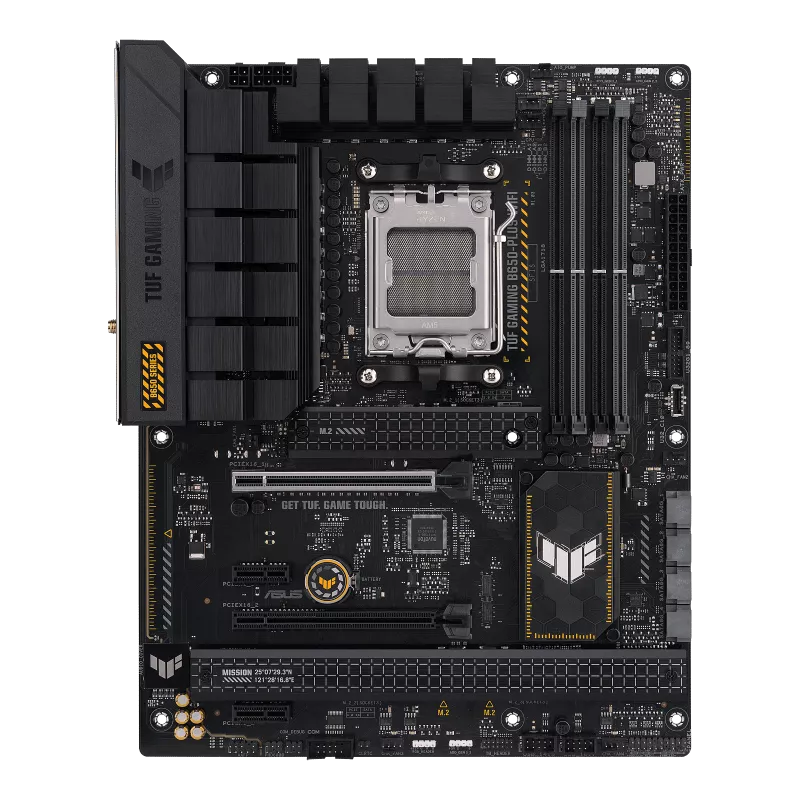
ASUS TUF GAMING B650-PLUS WIFI
An ATX AM5 board on the AMD B650 chipset with DDR5 up to 7600+ (OC), a PCIe 5.0 M.2 slot, three M.2 slots, Wi-Fi 6, 2.5 Gb Ethernet and the TUF Protection feature set.
Full Specification Sheet
| Socket | AMD Socket AM5 |
|---|---|
| Chipset | AMD B650 |
| CPU Support | AMD Ryzen 9000, 8000 and 7000 Series desktop processors |
| Memory | 4 x DIMM, up to 256 GB, DDR5 up to 7600+ (OC), ECC and non-ECC, AMD EXPO |
| Expansion | 1 x PCIe 4.0 x16 (CPU), 1 x PCIe 4.0 x16 (x4, chipset), 2 x PCIe 4.0 x1 |
| Storage | 3 x M.2 (M.2_1 PCIe 5.0 x4 with Ryzen 9000/7000) and 4 x SATA 6Gb/s |
| Networking | Realtek 2.5Gb Ethernet, Wi-Fi 6, Bluetooth 5.2 |
| USB (rear) | 8 ports incl. 1 x USB 3.2 Gen 2x2 Type-C, 3 x USB 3.2 Gen 2, 4 x USB 2.0 |
| Audio | Realtek 7.1 codec, up to 24-bit / 192 kHz |
| Form Factor | ATX (30.5 x 24.4 cm) |
The ASUS TUF GAMING B650-PLUS WIFI is an ATX motherboard for the AMD AM5 socket, built around the B650 chipset. It belongs to ASUS's TUF Gaming line, which is the durability-focused, mainstream-priced counterpart to the ROG range, and it is aimed at gamers and general builders who want a current AM5 platform without paying for a flagship board. The board supports DDR5 memory, offers a PCIe 5.0 M.2 slot with the newer Ryzen processors, and includes Wi-Fi 6 and 2.5 Gb Ethernet on board. This page collects the specification ASUS publishes on its technical-specification page, explains what each entry means and leaves out anything the manufacturer does not state, including the price.
Processor and chipset support
The socket is AMD AM5, and ASUS lists support for the AMD Ryzen 9000, 8000 and 7000 Series desktop processors, with the usual note that the ASUS website holds the definitive CPU support list. The board therefore covers the current Zen 5 generation as well as the Zen 4 chips that launched the socket, though older BIOS versions may need an update before a newer processor boots. The chipset is the AMD B650, the mainstream tier of the AM5 platform, which offers PCIe 5.0 storage support and enough connectivity for most builds while leaving out some of the extra lanes and features of the premium X-series chipsets. Our guide to the AM4, AM5 and LGA1700 platforms explains where AM5 sits in the market. Typical partners on this site are the AMD Ryzen 7 9800X3D and the AMD Ryzen 9 7900X.
Memory
There are four DIMM slots supporting up to 256 GB of DDR5 in a dual-channel architecture. ASUS lists ECC and non-ECC unbuffered memory, with speeds from 4800 up to 7600+ MT/s, where 5200 and below are standard and speeds from 5400 upwards are marked as overclocking (OC). The board supports AMD EXPO memory profiles and ASUS's OptiMem II routing. Footnotes explain that supported memory types, data rates and module counts vary depending on the processor and memory configuration, and that non-ECC DDR5 includes on-die ECC. To understand the difference between the two profile standards, our explanation of XMP versus EXPO memory profiles is a useful starting point, and it is worth checking the memory support list before you pick a kit, particularly if you plan to use four modules.
Expansion slots
The processor's graphics slot depends on the processor family. With Ryzen 9000 and 7000 Series processors, ASUS lists one PCIe 4.0/3.0 x16 slot, and with Ryzen 8000 Series it lists one PCIe 4.0 x16 slot that supports x8 or x4 mode. The B650 chipset adds a second x16-length slot that runs at x4 in PCIe 4.0 and 3.0 mode and two PCIe x1 slots. The board therefore prioritises a single graphics card, with the chipset slots suited to a capture card, a network adapter or an additional storage card. ASUS also links a PCIe bifurcation table on its support site for people who plan to split lanes.
Storage
The board supports three M.2 slots and four SATA 6 Gb/s ports. With Ryzen 9000 and 7000 Series processors, M.2_1 is a Key M slot supporting 2242, 2260 and 2280 drives at PCIe 5.0 x4 speed, and M.2_2 supports 2242, 2260, 2280 and 22110 drives at PCIe 4.0 x4. With Ryzen 8000 Series processors, M.2_1 runs at PCIe 4.0 x4 and M.2_2 at PCIe 4.0 x4 or x2. The chipset supplies M.2_3 at PCIe 4.0 x4, and ASUS warns that it shares bandwidth with the second x16-length slot, which is suspended once M.2_3 is populated. AMD RAIDXpert2 technology supports RAID 0, 1 and 10 for both PCIe and SATA drives. Only the first slot has PCIe 5.0 lanes, so that is where a fast PCIe 5.0 drive belongs.
Networking, USB and audio
Networking is provided by a Realtek 2.5 Gb Ethernet controller with TUF LANGuard protection and a 2x2 Wi-Fi 6 module for the 2.4 and 5 GHz bands, with Bluetooth 5.2. The rear panel offers eight USB ports in total: one USB 3.2 Gen 2x2 Type-C, three USB 3.2 Gen 2 (two Type-A and one Type-C) and four USB 2.0 Type-A. Internally there are seven front USB ports made up of a USB 3.2 Gen 1 connector with Type-C support, a header for two additional USB 3.2 Gen 1 ports and two headers for four USB 2.0 ports, plus a Thunderbolt (USB4) header. Audio uses a Realtek 7.1 surround codec supporting playback up to 24-bit and 192 kHz, with audio shielding, a power pre-regulator that reduces input noise, premium capacitors, dedicated audio PCB layers, an audio cover and a de-pop circuit. ASUS notes that 32-bit 192 kHz is not supported for 7.1 output because of HD audio bandwidth limits.
Display outputs
For processors with integrated graphics, the board provides one DisplayPort and one HDMI port on the back panel. ASUS states that DisplayPort supports up to 8K at 60 Hz according to DisplayPort 1.4 and HDMI supports 4K at 60 Hz according to HDMI 2.1, and that the actual resolution depends on the processor or graphics card.
TUF Protection and build quality
TUF Protection is the name ASUS gives to the board's durability features. The list includes a digital VRM power design with DrMOS, enhanced DRAM overcurrent protection, ESD guards, TUF LANGuard, overvoltage protection, SafeSlot Core+ reinforcement for the graphics slot and a stainless-steel back I/O plate. Beyond durability, the board carries ASUS Q-Design features including the M.2 Q-Latch, Q-DIMM, the four-light Q-LED diagnostic display for CPU, DRAM, VGA and boot device and Q-Slot, along with an M.2 heatsink and a VRM heatsink design for cooling. EZ DIY helpers include a BIOS FlashBack button with its own LED, ProCool power connectors, a pre-mounted I/O shield and SafeDIMM. Aura Sync headers, both an Aura RGB header and three addressable Gen 2 headers, cover lighting.
Connectors, software and BIOS
Cooling headers are a CPU fan, a CPU optional fan, an AIO pump and four chassis fans. Power comes through a 24-pin main connector, one 8-pin and one 4-pin +12 V connector. Other headers include a Clear CMOS header, a COM port header, a front-panel audio header and a system panel header with chassis intrusion. Software includes Armoury Crate with Aura Creator, Aura Sync, Fan Xpert 4, power saving and two-way AI noise cancellation, AI Suite 3 with TurboV EVO, DIGI+ VRM and PC Cleaner, TUF GAMING CPU-Z, DTS audio processing, MyAsus, a Norton trial and WinRAR. The 256 Mb flash ROM UEFI BIOS provides CrashFree BIOS 3, EZ Flash 3 and EZ Mode. The board supports Windows 11 and 64-bit Windows 10, and its ATX form factor is 12 by 9.6 inches or 30.5 by 24.4 centimetres.
Positioning
On paper the TUF GAMING B650-PLUS WIFI is a sensible mid-range AM5 board: it has a PCIe 5.0 M.2 slot, three M.2 slots in total, 2.5 Gb Ethernet and Wi-Fi, and a durability-oriented feature set. Set against the ROG Strix Z790-E Gaming WiFi listed on this site, it has fewer M.2 slots (three against five), fewer rear USB ports (eight against twelve) and Wi-Fi 6 instead of Wi-Fi 6E, though the two boards are for different platforms. To see what the next tier offers, compare it with the TUF B650-PLUS versus ROG Strix B850-F comparison, and browse the whole motherboard category. None of the statements above is a test result; all values are the manufacturer's.
Product image: ASUS product image.