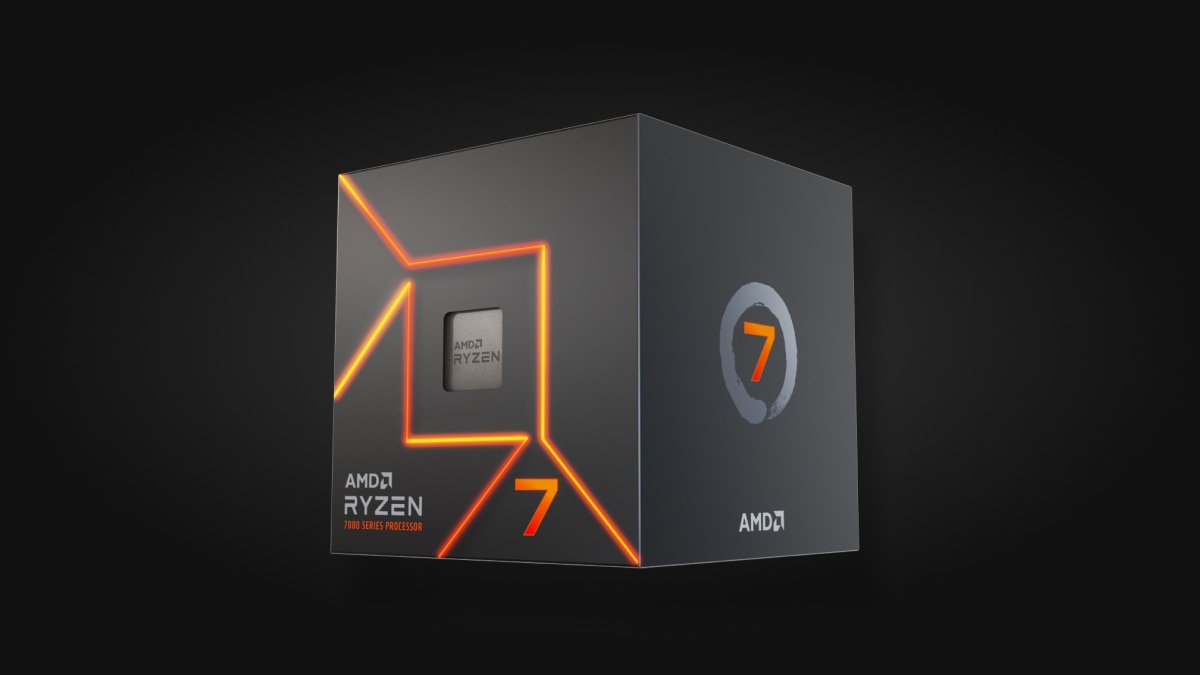
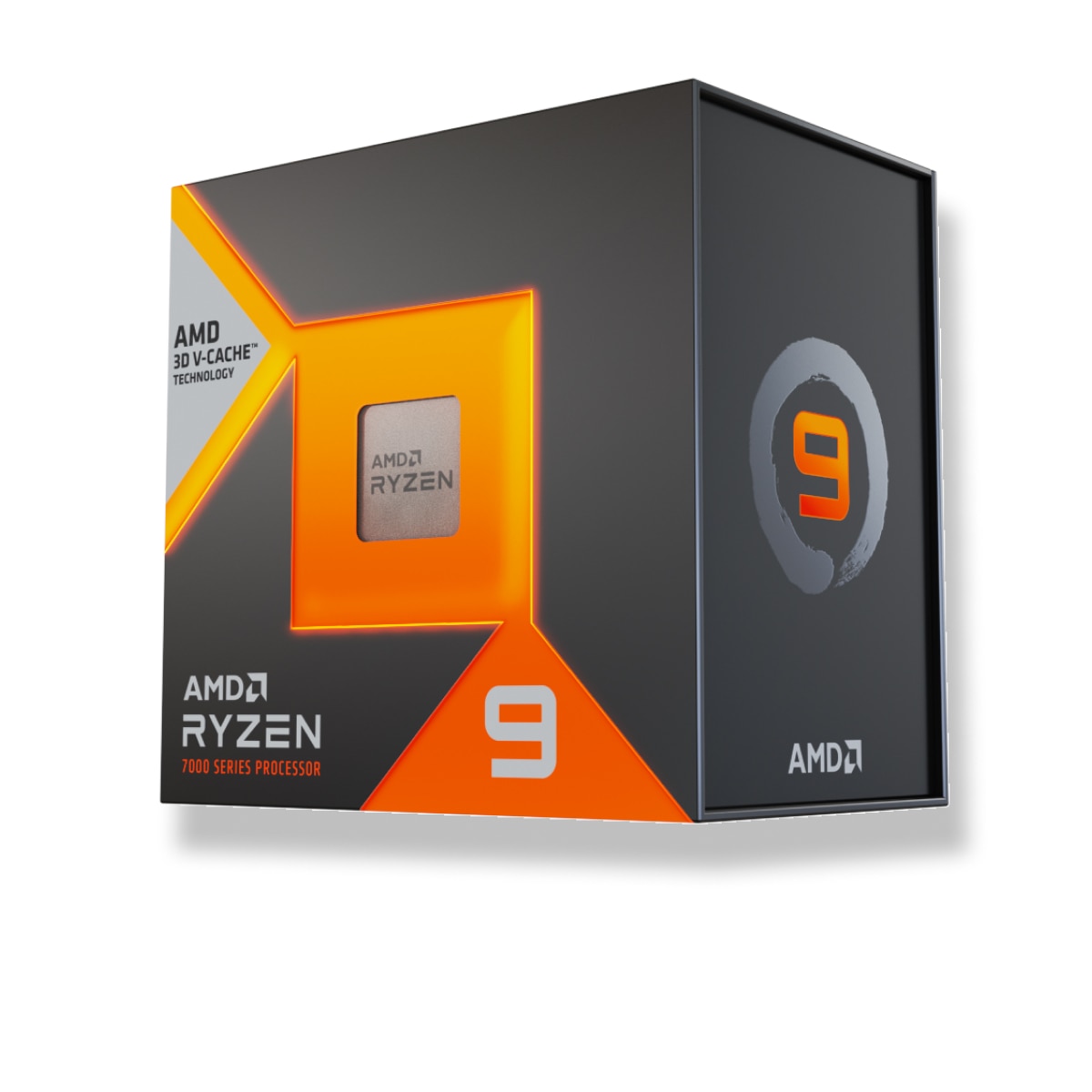
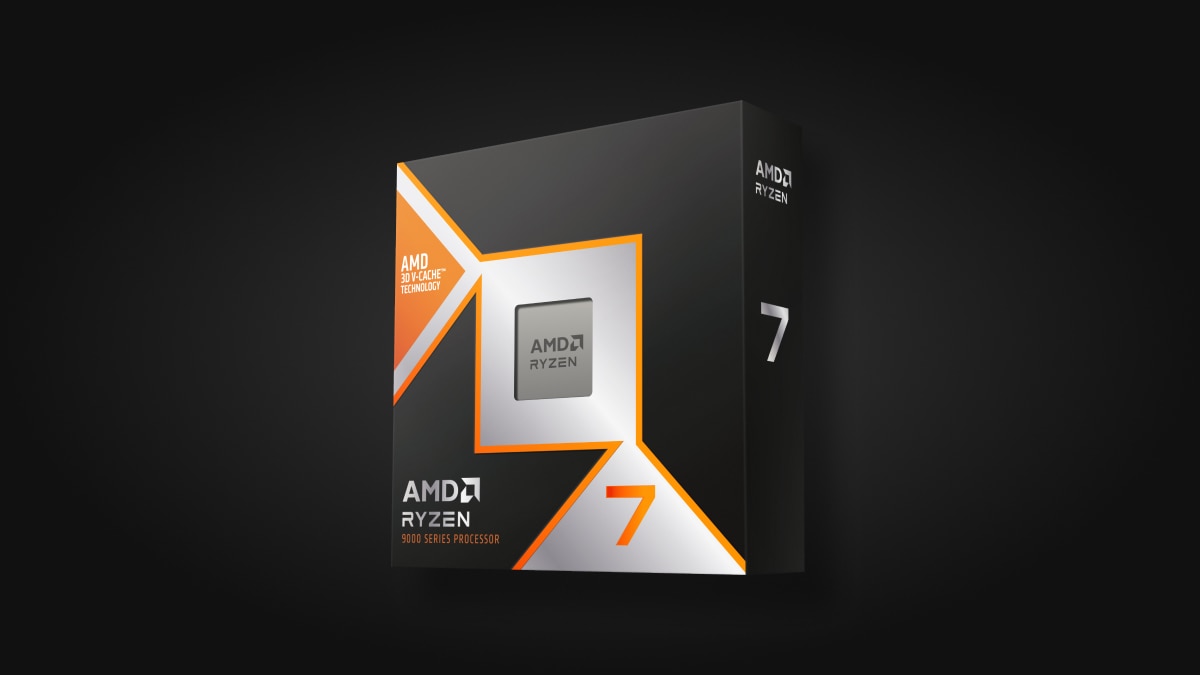
AMD Ryzen 7 9800X3D
An eight-core Zen 5 AM5 processor with 96 MB of L3 cache from 2nd Gen 3D V-Cache, and the first fully unlocked X3D chip.
Full Specification Sheet
| Cores / Threads | 8 / 16 |
|---|---|
| Base / Boost Clock | 4.7 GHz / up to 5.2 GHz |
| Cache | 104 MB total (96 MB L3 with 2nd Gen 3D V-Cache + 8 MB L2), 640 KB L1 |
| TDP | 120 W |
| Socket | AM5 |
| Architecture | Zen 5 (TSMC 4nm cores, 6nm I/O die) |
| Memory | DDR5, dual-channel, up to DDR5-5600 (2 DIMMs), ECC with board support |
| PCIe | PCIe 5.0, 28 lanes (24 usable) |
| Integrated Graphics | AMD Radeon Graphics (2 cores, 2200 MHz) |
| Overclocking | Unlocked (PBO, Curve Optimizer, EXPO) |
The AMD Ryzen 7 9800X3D is an eight-core, sixteen-thread desktop processor for the AM5 socket, built on the Zen 5 architecture and using second-generation AMD 3D V-Cache technology. AMD announced it on 31 October 2024 in a press release titled "The Gaming Legend Continues", and its launch date is listed as 7 November 2024. It is aimed squarely at gaming: AMD's own product description calls it the ultimate solution for the PC gaming market. This page goes through the published specification, explains how the stacked cache differs from earlier designs and sets out what to check before pairing it with a board and a cooler.
Core configuration and clocks
The processor has eight Zen 5 cores with simultaneous multithreading for 16 threads. The base clock is 4.7 GHz and the maximum boost clock is up to 5.2 GHz; AMD's press release says these are the highest clock speeds ever on an X3D chiplet. AMD notes that the boost figure is the maximum frequency achievable by a single core on a bursty workload and varies with cooling, thermal paste and motherboard. The default TDP is 120 W and the maximum operating temperature (Tjmax) is 95 degrees Celsius. The instruction set includes AVX2 and AVX-512. Instead of a mixture of core types, all eight cores are the same, which keeps thread scheduling simple.
Cache: what "3D V-Cache" means
The headline feature is the cache. AMD lists 640 KB of L1 cache, 8 MB of L2 and 96 MB of L3, and its press release gives a total of 104 MB. The large L3 comes from a 64 MB layer of extra cache that AMD stacks onto the compute chiplet in addition to the 32 MB the chiplet has natively, which is where the term 3D V-Cache comes from. Larger L3 caches help workloads whose working data would otherwise repeatedly go out to main memory, and games are the standard example, so AMD positions the X3D line as its gaming series. What is new in this second generation is the position of the cache. In the earlier Ryzen 7 5800X3D and Ryzen 7 7800X3D the cache sat on top of the core chiplet, which put a thermal layer between the cores and the cooler. AMD says it has re-engineered the design so that the 64 MB cache memory sits below the processor, placing the core complex die closer to the cooling solution. According to AMD, that lets the Zen 5 cores stay cooler and reach higher clock rates.
Overclocking and tuning
AMD states that the change in cache placement allows extreme overclocking, and that the 9800X3D is the first X3D processor to be fully unlocked. The product page confirms support for Precision Boost Overdrive, Curve Optimizer voltage offsets, Ryzen Master and AMD EXPO memory profiles. AMD's usual caution applies: its warranty does not cover damage caused by overclocking, even when enabled through AMD hardware or software, and undervolting or overclocking carries risk. For most owners the practical benefit is the ability to tune power and boost behaviour rather than to reach records. Our article on XMP and EXPO memory profiles describes the memory side of the equation.
Manufacturer performance claims
AMD's press release says the 9800X3D delivers an average gaming performance improvement of up to 8 percent over its previous-generation X3D processor, the Ryzen 7 7800X3D, and up to an average of 20 percent faster than the competition, which in its test configuration was Intel's Core Ultra 9 285K. It adds that many games see double-digit generational improvements and cites a 31 percent higher 1 percent low frame rate in one title compared with the competing processor. These are AMD's own figures from tests run by AMD Performance Labs in October 2024 with specific hardware and settings, and system manufacturers may vary configurations, so treat them as the manufacturer's claims rather than independent results.
Platform, memory and connectivity
The processor uses socket AM5 and is supported by A620, B650, B650E, X670, X670E, B840, B850, X870 and X870E chipsets. It supports dual-channel DDR5 up to 256 GB, with rated speeds of DDR5-5600 for two single- or dual-rank modules and DDR5-3600 for four; ECC is supported where the motherboard allows it. It provides PCIe 5.0 with 28 lanes in total, 24 of them usable, and native connectivity of four USB 3.2 Gen 2 (10 Gbps) ports and one USB 2.0 port, plus NVMe boot and RAID 0, 1, 5 and 10. Integrated graphics are AMD Radeon Graphics with two graphics cores at 2200 MHz, enough for display output and basic use. For a high-end board that fits this processor, see the ASUS ROG Strix X870E-E Gaming WiFi. Our platform guide explains how AM5 compares with AM4 and Intel's LGA1700.
Process technology and design
AMD lists the CPU cores as made on TSMC's 4nm FinFET process and the I/O die on TSMC's 6nm FinFET process, with a package of two dies. Separating the compute chiplet from the I/O die is the chiplet design that AMD has used across the Ryzen 7000 and 9000 generations, and it allows the cache layer to be stacked on the compute chiplet without redesigning the I/O die.
Cooling and installation
AMD does not include a cooler with the boxed processor and recommends a liquid cooler for optimal performance. The 120 W default TDP is not extreme by current standards, but a stacked-cache design still benefits from good cooling because sustained clocks depend on heat removal. The AM5 mounting interface is shared with earlier AM5 coolers, so many existing coolers can be reused. Our air versus liquid cooling guide helps you decide which type suits your case and budget.
How it fits
Within AMD's lineup the 9800X3D is the eight-core gaming specialist, placed above the non-X3D Ryzen 9000 chips for games and below the higher-core-count parts for heavy multi-threaded work. It follows on from the Ryzen 7 5800X3D on the older AM4 platform, and our Ryzen 7 9800X3D versus Ryzen 7 5800X3D comparison sets out the differences in socket, memory and architecture. Browse the processor category for other options. All specifications on this page come from AMD's product page and press release; prices are not listed here because AMD's material does not state one, and availability varies by region.
Product image: AMD product image.