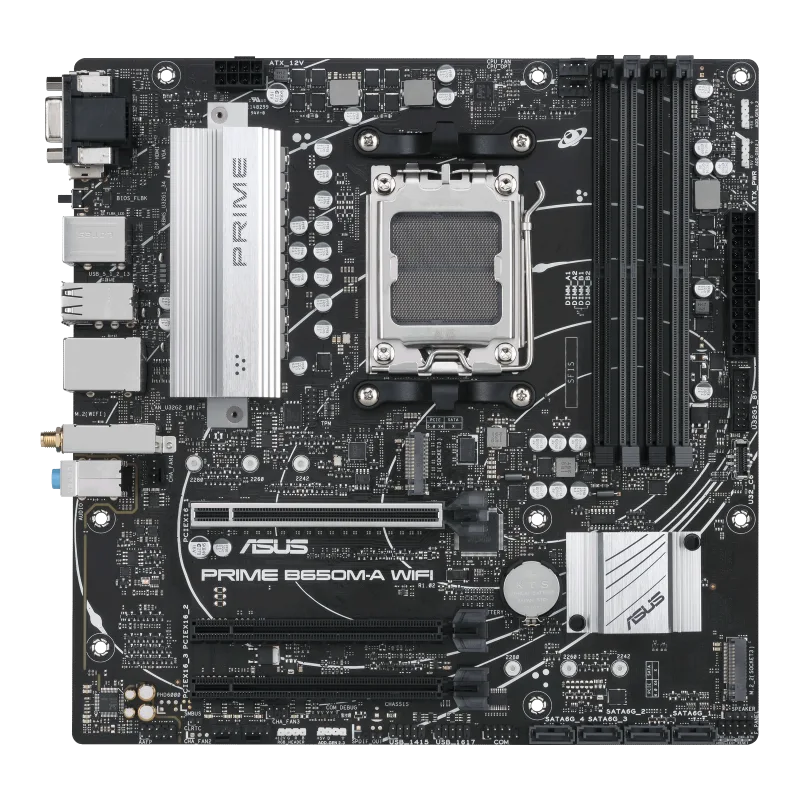
ASUS PRIME B650M-A WIFI
A compact mATX AM5 board on the AMD B650 chipset with DDR5, a PCIe 5.0-capable M.2 slot, Wi-Fi 6, 2.5 Gb Ethernet, BIOS FlashBack and DisplayPort, HDMI and VGA outputs.
Full Specification Sheet
| Socket | AMD Socket AM5 |
|---|---|
| Chipset | AMD B650 |
| CPU Support | AMD Ryzen 9000, 8000 and 7000 Series desktop processors, up to AMD 170 W CPUs |
| Memory | 4 x DIMM, DDR5 4800 to 5600 MT/s (5400 and 5600 with OC), ECC and non-ECC unbuffered, AMD EXPO |
| Expansion | 1 x PCIe 4.0 x16 (CPU), 2 x PCIe 4.0 x16 slots in x1 mode (chipset) |
| Storage | 2 x M.2 (M.2_1 PCIe 5.0 x4 with Ryzen 9000/7000, M.2_2 PCIe 4.0 x4) and 4 x SATA 6Gb/s |
| Networking | Realtek 2.5Gb Ethernet, Wi-Fi 6 (802.11ax) 2x2, Bluetooth 5.2 |
| Rear USB | 2 x USB 3.2 Gen 2 Type-A, 2 x USB 3.2 Gen 1 Type-A, 4 x USB 2.0 |
| Video Output | DisplayPort, HDMI and VGA |
| Audio | Realtek 7.1, up to 24-bit/192 kHz |
| Form Factor | mATX, 24.4 x 24.4 cm |
The ASUS PRIME B650M-A WIFI is a micro-ATX motherboard for the AMD AM5 socket built on the B650 chipset. It comes from ASUS's Prime line, the company's mainstream family, and its purpose is plain from the tech-spec page: give Ryzen 7000, 8000 and 9000 processors a small, affordable platform with DDR5, Wi-Fi 6, 2.5 Gb Ethernet and enough storage for a typical desktop. This page reads through the specification ASUS publishes, explains what each entry means for a build and leaves out everything the page does not state, including a price, a launch date and a VRM phase count. There are no benchmarks and no tests here. Every figure is an ASUS specification unless it is marked as simple arithmetic, and several entries change with the processor family, so they deserve a careful read.
Processor and chipset support
The socket is AMD AM5, and ASUS lists AMD Ryzen 9000, 8000 and 7000 Series desktop processors, adding that the board supports up to AMD 170 W CPUs and pointing to its site for the full CPU support list. The chipset is the AMD B650. What the board offers a Ryzen 9000 or 7000 processor differs from what it offers a Ryzen 8000 processor in the expansion and storage sections, so the family of your processor matters. For the mainstream-versus-premium question that a board like this raises, our guide to budget versus premium motherboards gives a framework for deciding which extras are worth paying for.
Memory
There are four DIMM slots for DDR5. ASUS lists the speeds 4800, 5000 and 5200 MT/s, and 5400 and 5600 MT/s marked as overclocking (OC), for ECC and non-ECC unbuffered modules in a dual-channel architecture, with AMD EXPO profile support and the ASUS OptiMem II memory routing. The page does not state a maximum capacity, so none is given here. Two footnotes matter: supported types, speeds and module counts vary with the CPU and the memory configuration, and non-ECC unbuffered DDR5 supports on-die ECC, a feature of the memory chips and not full end-to-end ECC. The top speeds ASUS lists are lower than those on the pricier ASUS boards in our database, which reach 8000+ MT/s with overclocking, so a very fast kit is wasted here. Whether a given module runs at its rated speed also depends on the processor, which the memory support list on the ASUS site covers.
Expansion slots
With Ryzen 9000 and 7000 processors, ASUS lists one PCIe 4.0 x16 slot that supports x16 mode; with Ryzen 8000 processors the slot runs in x8 or x4 mode, depending on the CPU. The chipset provides two further PCIe 4.0 x16-shaped slots that run in x1 mode. A footnote directs users to a PCIe bifurcation table on the ASUS support site. The important detail for gamers is that the main slot on this board is PCIe 4.0, not 5.0, so the PCIe 5.0 capability of the processor is used only for storage; a current graphics card will fit and run, and whether the generation difference matters depends on the card. The two x1 slots are for small add-in cards, such as a sound card or a capture card that needs little bandwidth.
Storage
ASUS counts two M.2 slots and four SATA 6Gb/s ports. With Ryzen 9000 and 7000 processors, M.2_1 is a Key M slot that supports 2242, 2260 and 2280 drives at PCIe 5.0 x4; with Ryzen 8000 processors the same slot runs at PCIe 4.0 x4. M.2_2, from the chipset, takes the same three sizes at PCIe 4.0 x4. AMD RAIDXpert2 technology is listed for both PCIe RAID 0/1/10 and SATA RAID 0/1/10. Two M.2 slots and four SATA ports are enough for a fast system drive, a second drive and a few storage disks, but this is the limit of the board's connectivity, and a build that wants three or more NVMe drives should look at a larger board. There is no M.2 heatsink in the thermal list, so a drive that runs hot would need its own, a subject we cover in our guide to NVMe thermal throttling and heatsinks. The box contains a screw package for M.2 drives.
Networking
Wired networking is a Realtek 2.5Gb Ethernet port. Wireless is Wi-Fi 6 (802.11 a/b/g/n/ac/ax) in a 2x2 configuration on the 2.4 and 5 GHz bands, with Bluetooth 5.2, and the box includes ASUS Wi-Fi moving antennas. The 2.5 Gb port is 2.5 times the speed of a gigabit port (arithmetic from the stated line rate), which helps only if your switch or router also supports it. Wi-Fi 6 without the 6 GHz band is a generation behind the Wi-Fi 7 listed on the pricier boards in our database.
USB and video output
The rear panel has eight USB ports: two USB 3.2 Gen 2 Type-A, two USB 3.2 Gen 1 Type-A and four USB 2.0 Type-A, plus a PS/2 keyboard and mouse combo port. There is no USB Type-C on the rear panel, which is the most visible difference from newer boards. Internally there is a front-panel USB 3.2 Gen 1 connector with Type-C support, a USB 3.2 Gen 1 header for two more ports and two USB 2.0 headers for four more, seven front-panel ports in total. Video output is unusually broad for the tier: one DisplayPort supporting up to 8K at 60 Hz as specified in DisplayPort 1.4, one HDMI port supporting 4K at 60 Hz as specified in HDMI 2.1, and one VGA port. ASUS notes that graphics specifications vary between CPU types, and these outputs are used when the processor has integrated graphics, such as the Ryzen 8000G line.
Audio, power and protection
The audio codec is a Realtek 7.1 surround-sound design supporting jack detection, multi-streaming and front-panel jack retasking, with playback up to 24-bit/192 kHz, plus audio shielding, premium capacitors and dedicated audio PCB layers; ASUS notes a chassis with an HD audio module is needed for 7.1 output. Power is a 24-pin main connector and one 8-pin 12 V connector. The protection list, ASUS 5X PROTECTION III, names a digital DIGI+ VRM, LANGuard, overvoltage protection, SafeSlot Core+ and a stainless-steel back I/O. The thermal list gives a VRM heatsink design, and the page does not publish a phase count or current rating, so this page does not either. The BIOS is stored on a 256 Mb flash ROM.
Firmware, headers and software
The back panel carries a BIOS FlashBack button and a matching LED, which allow a firmware update without a working CPU, an important feature on AM5 boards where a new processor may need a newer BIOS; our guide to BIOS FlashBack explains the procedure. Cooling connectors are one CPU fan header, one CPU OPT header and three chassis fan headers, which is fewer than on larger boards and can matter in a case with many fans, though the page lists no AIO pump header. Lighting is three addressable Gen 2 headers and one Aura RGB header. Other headers include Clear CMOS, a COM port, front-panel audio, an S/PDIF out header, a speaker header, an SPI TPM header and a system panel header. Software includes Armoury Crate with Aura Creator, Aura Sync, Fan Xpert 2+ and Power Saving, AI Suite 3 with TurboV EVO, DIGI+ VRM and PC Cleaner, ASUS CPU-Z, MyASUS, a Norton anti-virus trial and WinRAR.
Size and what is in the box
The form factor is micro-ATX at 9.6 x 9.6 inches (24.4 x 24.4 cm), which fits both micro-ATX and ATX cases; see our comparison of ATX, micro-ATX and Mini-ITX form factors for what that means for case choice. The box holds two SATA cables, the Wi-Fi antennas, an I/O shield, a screw package for M.2 drives and a user guide, and the operating systems named are Windows 11 and Windows 10 64-bit. To see how this board differs from a larger AM5 board in our database, open the side-by-side comparison with the TUF GAMING B650-PLUS WIFI. A processor that suits the board is the AMD Ryzen 5 7600X, and the whole motherboard category is a click away.
What the page does not say
ASUS's tech-spec page carries no price, no launch date, no warranty term, no maximum memory capacity and no measured results, so this page offers none. Before buying, check the ASUS CPU support list for your exact processor, confirm the memory kit against the memory support list, and decide whether two M.2 slots, three chassis fan headers and no rear USB Type-C are enough for your plans.