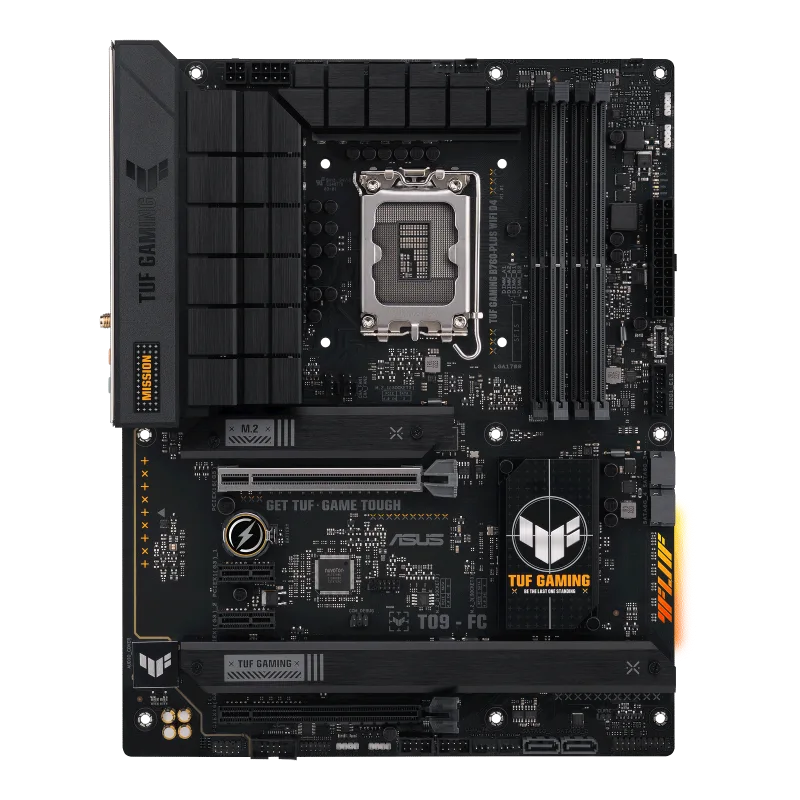
ASUS TUF GAMING B760-PLUS WIFI D4
An ATX LGA1700 board on the Intel B760 chipset that keeps DDR4 memory, with a PCIe 5.0 x16 slot, three PCIe 4.0 M.2 slots, Wi-Fi 6, 2.5 Gb Ethernet and a USB 3.2 Gen 2x2 port.
Full Specification Sheet
| Socket | Intel LGA1700 |
|---|---|
| Chipset | Intel B760 |
| CPU Support | Intel Core 14th, 13th and 12th Gen, Pentium Gold and Celeron processors |
| Memory | 4 x DIMM, up to 192 GB, DDR4 (3200 to 5333 MT/s with OC steps), non-ECC unbuffered, Intel XMP |
| Expansion | 1 x PCIe 5.0 x16 (CPU), 1 x PCIe 3.0 x16 (x4 mode) and 2 x PCIe 3.0 x1 (chipset) |
| Storage | 3 x M.2 (all PCIe 4.0 x4) and 4 x SATA 6Gb/s |
| Networking | Realtek 2.5Gb Ethernet, Wi-Fi 6 (802.11ax) 2x2, Bluetooth 5.2 |
| Rear USB | 1 x USB 3.2 Gen 2x2 Type-C, 1 x USB 3.2 Gen 2 Type-A, 3 x USB 3.2 Gen 1 Type-A, 1 x USB 2.0 |
| Video Output | DisplayPort and HDMI |
| Audio | Realtek 7.1, up to 24-bit/192 kHz |
| Form Factor | ATX, 30.5 x 24.4 cm |
The ASUS TUF GAMING B760-PLUS WIFI D4 is an ATX motherboard for Intel's LGA1700 socket on the B760 chipset, and the D4 in its name is the important part: it uses DDR4 memory, not DDR5. That makes it a board for people who already own DDR4 modules, or who want to keep total platform cost down while still using a 12th, 13th or 14th Generation Intel Core processor. It comes from ASUS's TUF Gaming family. This page works through the specification published on the ASUS tech-spec page, explains what each entry means in practice and leaves out everything the manufacturer page does not state, including a price, a launch date and a VRM phase count. There are no benchmarks and no tests here; every figure is an ASUS specification unless it is marked as simple arithmetic.
Processor and chipset support
The socket is Intel LGA1700, and ASUS lists Intel Core 14th and 13th Generation processors, Intel Core 12th Generation processors, Pentium Gold and Celeron processors, with a pointer to its site for the CPU support list. The chipset is the Intel B760. The page states support for Intel Turbo Boost Technology 2.0 and Turbo Boost Max Technology 3.0, and adds that Max 3.0 depends on the CPU type. Because LGA1700 spans three processor generations, the practical checklist starts with the support list and the BIOS version: an older BIOS may need an update before a newer chip will start, which is where a BIOS update method without a CPU is useful, though this page does not list a FlashBack button for this model. For how LGA1700 relates to the AMD sockets, see our platform guide covering AM4, AM5 and LGA1700.
Memory: the DDR4 choice
There are four DIMM slots with a maximum capacity of 192 GB of DDR4. ASUS lists a long ladder of data rates: DDR4 5333, 5066, 5000, 4800, 4600, 4400, 4266, 4000, 3733, 3600, 3466, 3400 and 3333 with overclocking (OC), and 3200, 3000, 2933, 2800, 2666, 2400 and 2133 without it. Modules are non-ECC and unbuffered, in a dual-channel architecture, with support for Intel Extreme Memory Profile (XMP) and the ASUS OptiMem II routing. A footnote says supported types, speeds and module counts vary with the CPU and memory configuration. The page therefore states 3200 as the highest speed listed without overclocking; anything above that is an OC entry, and whether a given kit reaches it depends on the kit and the processor. If you are weighing DDR4 against DDR5 for a new build, our DDR5 versus DDR4 buying guide lays out the trade-offs.
Expansion slots and lane sharing
The processor provides one PCIe 5.0 x16 slot for the graphics card. The B760 chipset adds one PCIe 3.0 x16 slot that runs in x4 mode and two PCIe 3.0 x1 slots. ASUS states a sharing rule: the PCIe 3.0 x16 slot shares bandwidth with the two x1 slots, and when either x1 slot runs in x1 mode, the x16-shaped slot runs at only x2. The practical consequence is that a device in the long chipset slot gives up bandwidth when you also use the small slots, which matters for cards that need a full four lanes, such as some capture or network cards. Note also that the chipset slots are PCIe 3.0, one generation behind the M.2 slots on this same board.
Storage
ASUS counts three M.2 slots and four SATA 6Gb/s ports. All three M.2 slots are listed at PCIe 4.0 x4: M.2_1 is a Key M slot from the processor supporting 2242, 2260 and 2280 drives, M.2_2 comes from the chipset and accepts drives up to 22110, and M.2_3 comes from the chipset and takes 2242, 2260 and 2280. That means the board offers no PCIe 5.0 M.2 slot at all, which is consistent with the tier, since the single Gen5 connection is spent on the graphics slot. Intel Rapid Storage Technology is listed with SATA RAID 0/1/5/10, and the page does not mention PCIe RAID. Storage cooling is an M.2 heatsink, and the box holds two M.2 rubber packages and a screw package for M.2 drives. To decide which drives to buy for the three slots, see our NVMe SSD buying guide.
Networking
Wired networking is a Realtek 2.5Gb Ethernet port with TUF LANGuard protection. Wireless is Wi-Fi 6 (802.11 a/b/g/n/ac/ax) in a 2x2 configuration on the 2.4 and 5 GHz bands, with Bluetooth 5.2. ASUS notes that the Bluetooth version may vary with the Wi-Fi module manufacturer. Wi-Fi 6 without the 6 GHz band is a step behind the Wi-Fi 6E and Wi-Fi 7 that newer boards in our database list, which is worth knowing if you plan to use a 6 GHz router; if you do not, the difference is smaller. The board ships with an ASUS Wi-Fi moving antenna.
USB and video output
The rear panel has six USB ports: one USB 3.2 Gen 2x2 Type-C, one USB 3.2 Gen 2 Type-A, three USB 3.2 Gen 1 Type-A and one USB 2.0 Type-A. Internally there is a front-panel USB 3.2 Gen 2 connector with Type-C support, one USB 3.2 Gen 1 header for two more ports, and two USB 2.0 headers for four more, seven front ports in total. The Gen 2x2 port is the fastest connection here, at 20 Gbps as defined by the USB 3.2 standard; the board has no USB4 or Thunderbolt connector on the rear panel, though a Thunderbolt (USB4) header is listed for add-in cards. For video, the page lists one DisplayPort supporting up to 4K at 60 Hz as specified in DisplayPort 1.4 and one HDMI port supporting 4K at 60 Hz as specified in HDMI 2.1, both of which depend on the processor having integrated graphics.
Audio and power
The audio codec is a Realtek 7.1 surround-sound design supporting jack detection, multi-streaming and front-panel jack retasking, with playback up to 24-bit/192 kHz, plus audio shielding, premium capacitors, dedicated audio PCB layers, an audio cover and a rear optical S/PDIF output. Power comes through a 24-pin main connector, one 8-pin 12 V connector and one 4-pin 12 V connector. ASUS TUF PROTECTION is listed as a digital DIGI+ VRM with DrMOS, ESD guards, TUF LANGuard, overvoltage protection, SafeSlot Core+ and a stainless-steel back I/O. ASUS gives a VRM heatsink design as the power-delivery cooling but does not publish phase counts or current ratings, so none are given here. The BIOS is stored on a 128 Mb flash ROM.
Headers, software and accessories
Cooling connectors are one CPU fan header, one CPU OPT header, one AIO pump header and four chassis fan headers. For lighting, the board has three addressable Gen 2 headers and one Aura RGB header. Other headers include Clear CMOS, a COM port, front-panel audio, a 20-3 pin system panel header with chassis intrusion and a Thunderbolt (USB4) header. Software listed includes Armoury Crate with Aura Creator, Aura Sync, Fan Xpert 4, Power Saving and Two-Way AI Noise Cancellation, AI Suite 3 with DIGI+ VRM and PC Cleaner, TUF GAMING CPU-Z, DTS Audio Processing, MyASUS, Norton 360 for Gamers and WinRAR. The box contains two SATA cables, the Wi-Fi antenna, a TUF Gaming sticker, two M.2 rubber packages, a screw package for M.2 drives, a TUF certification card and a user guide. The form factor is ATX at 12 x 9.6 inches (30.5 x 24.4 cm), and the operating systems named are Windows 11 and Windows 10 64-bit.
How it fits in our database
To see how this DDR4 board differs from another Intel option in our database, open the side-by-side comparison with the PRIME B760-PLUS, look at the Intel Core i7-14700K, one of the processors this socket can host, or browse the motherboard category. Every value on this page is an ASUS specification and not a measured result. The tech-spec page contains no price, no launch date, no warranty term and no VRM phase count; verify them with a retailer, and confirm your exact processor and memory kit against the ASUS support lists before buying.