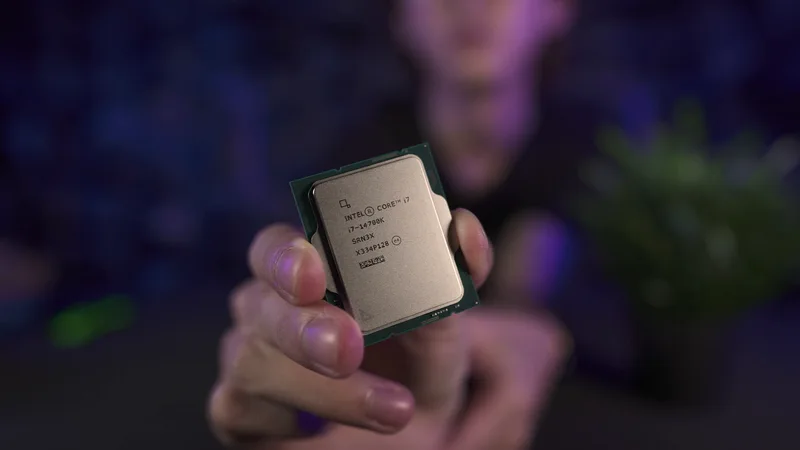
Intel Core i7-14700K
A 20-core, 28-thread LGA1700 processor with 8 Performance-cores and 12 Efficient-cores, up to 5.6 GHz turbo, 33 MB of cache, 125 W base power and DDR5 or DDR4 support.
Full Specification Sheet
| Architecture | 14th Gen Intel Core (formerly Raptor Lake), Intel 7 process |
|---|---|
| Cores | 20 (8 Performance-cores + 12 Efficient-cores) |
| Threads | 28 |
| Max Turbo Frequency | Up to 5.6 GHz |
| P-core Max Turbo / Base | 5.5 GHz / 3.4 GHz |
| E-core Max Turbo / Base | 4.3 GHz / 2.5 GHz |
| Cache | 33 MB Intel Smart Cache, 28 MB total L2 |
| Processor Base Power | 125 W |
| Maximum Turbo Power | 253 W |
| Socket | FCLGA1700 |
| Memory | Up to DDR5-5600 or DDR4-3200, 2 channels, up to 192 GB, 89.6 GB/s |
| PCIe | PCIe 5.0 and 4.0, up to 20 lanes |
| Integrated Graphics | Intel UHD Graphics 770 (32 execution units) |
| Max Operating Temperature | 100 C |
| Launch | Q4 2023 |
The Intel Core i7-14700K is a desktop processor from the 14th generation of the Intel Core family, a product line that Intel's specification database groups under the former code name Raptor Lake. It uses a hybrid design with eight Performance-cores and twelve Efficient-cores, twenty cores in total, and it fits the LGA1700 socket, so it fits LGA1700 motherboards. Intel lists its launch as the fourth quarter of 2023 and a recommended customer price of 409 to 419 US dollars; that is a launch-era list price set by the manufacturer, not a current street price. This page reproduces the published specification, explains what the numbers mean and deliberately avoids benchmark claims, since none is provided by the source.
Cores and threads
Intel's table gives a total of 20 cores, split into 8 Performance-cores and 12 Efficient-cores, with 28 threads in total. The thread count follows from the design: Hyper-Threading is listed as supported, and the eight Performance-cores each handle two threads, which gives sixteen, while the twelve Efficient-cores add one thread each for a total of twenty-eight. Intel lists Intel Thread Director as supported; it is the hardware feedback mechanism that helps the operating system decide which kind of core should run which piece of work. If the hybrid layout is new to you, our article on SMT and Hyper-Threading explains what a thread is and how it differs from a core.
Clock speeds
The two core types have separate frequency tables. The Performance-cores have a base frequency of 3.4 GHz and a maximum turbo frequency of 5.5 GHz. The Efficient-cores have a base frequency of 2.5 GHz and a maximum turbo of 4.3 GHz. The overall maximum turbo frequency is listed as 5.6 GHz, and Intel Turbo Boost Max Technology 3.0 is listed with the same 5.6 GHz figure; that technology identifies the best-performing core or cores and raises their clock as needed within power and thermal limits. The headline 5.6 GHz applies to those favoured cores in short bursts and is not an all-core sustained speed. Intel also notes that the dynamic operating range depends on power and thermal conditions, so real behaviour depends on the cooler and the motherboard settings.
Cache
The processor carries 33 MB of Intel Smart Cache, which is the shared last-level cache, and a total of 28 MB of L2 cache. Cache is small, fast memory on the die that keeps recently used data close to the cores. Intel gives no per-level latency figures, so any statement about speed effects would go beyond the source.
Power figures
Intel states a Processor Base Power of 125 W and a Maximum Turbo Power of 253 W. The first is the power the chip is characterised for at base frequency under a sustained workload; the second is the higher limit it may draw while turbo boosting. The gap between the two is why cooler and power-delivery choices matter more for this class of processor than the base figure suggests. Motherboard makers often expose these limits in the firmware, and the way they interact is described in our guide to PL1 and PL2 power limits versus AMD PBO. Intel's thermal solution specification is PCG 2020A, the maximum operating temperature is 100 degrees Celsius (T junction 100 degrees Celsius), and the package measures 45.0 mm by 37.5 mm.
Memory support
The memory controller supports DDR5 up to 5600 MT/s and DDR4 up to 3200 MT/s, with two memory channels, a maximum memory size of 192 GB and a maximum memory bandwidth of 89.6 GB/s. Only one memory type can be used at a time, and which one is available is decided by the motherboard, because each LGA1700 board is built for either DDR5 or DDR4 slots. Intel also lists ECC memory support as yes, which in practice further depends on the motherboard and platform. The choice between the two generations is covered in our DDR5 versus DDR4 buying guide.
Integrated graphics
The processor includes Intel UHD Graphics 770 with 32 execution units, a base graphics frequency of 300 MHz and a maximum dynamic frequency of 1.6 GHz. Supported outputs are eDP 1.4b, DisplayPort 1.4a and HDMI 2.1, with a maximum resolution of 4096 x 2160 at 60 Hz over HDMI, 7680 x 4320 at 60 Hz over DisplayPort and 5120 x 3200 at 120 Hz for an integrated flat panel, and up to four displays. Intel Quick Sync Video and Intel Clear Video HD Technology are listed, along with DirectX 12, OpenGL 4.5 and OpenCL 3.0 support and two multi-format codec engines. For everyday display output and video decoding this can be enough, while a dedicated graphics card is the normal choice for gaming.
Platform, PCI Express and socket
The socket is FCLGA1700, and the chip supports a single-processor configuration. PCI Express support is listed as revision 5.0 and 4.0, with up to 20 lanes and configurations up to 1x16+4 or 2x8+4. Direct Media Interface revision 4.0 with up to eight lanes links the processor to the chipset. For a motherboard example in this database that supports this generation, see the ASUS PRIME B760-PLUS, which lists 14th, 13th and 12th generation Intel Core processors as supported. Board makers may require a BIOS update for newer chips, so check the compatibility list before you buy. Our platform guide to AM4, AM5 and LGA1700 places the socket in context.
Features and instruction set
Intel lists the 64-bit instruction set with SSE4.1, SSE4.2 and AVX2 extensions, Enhanced Intel SpeedStep, Intel Speed Shift Technology, Intel Turbo Boost Technology 2.0 and Intel Deep Learning Boost on the CPU. Virtualization is covered by VT-x, VT-d and VT-x with Extended Page Tables. The security list includes Intel Boot Guard, Intel Control-Flow Enforcement Technology, Intel AES New Instructions, Intel OS Guard, Intel Secure Key, Execute Disable Bit and Trusted Execution Technology. The chip is also listed as eligible for Intel vPro, which is relevant mainly to business fleets. The use conditions are PC, client and workstation.
How to use this information
The spec sheet suggests a few practical checks. First, confirm the motherboard supports the processor, including the BIOS version. Second, decide on DDR5 or DDR4 by choosing the board, since the chip works with both but a board does not. Third, plan for a cooler and power delivery that can handle the 253 W turbo power figure, because Intel's page does not list a cooler. Fourth, remember that the integrated graphics are an option, not a requirement, if you add a graphics card. To see the numbers next to a related model, open the comparison with the Core i7-13700K or browse the full processor category. Every number on this page is taken from the manufacturer's published specification, and none is a measured benchmark result.
Product image: INVADER PC, CC BY 3.0, via Wikimedia Commons.