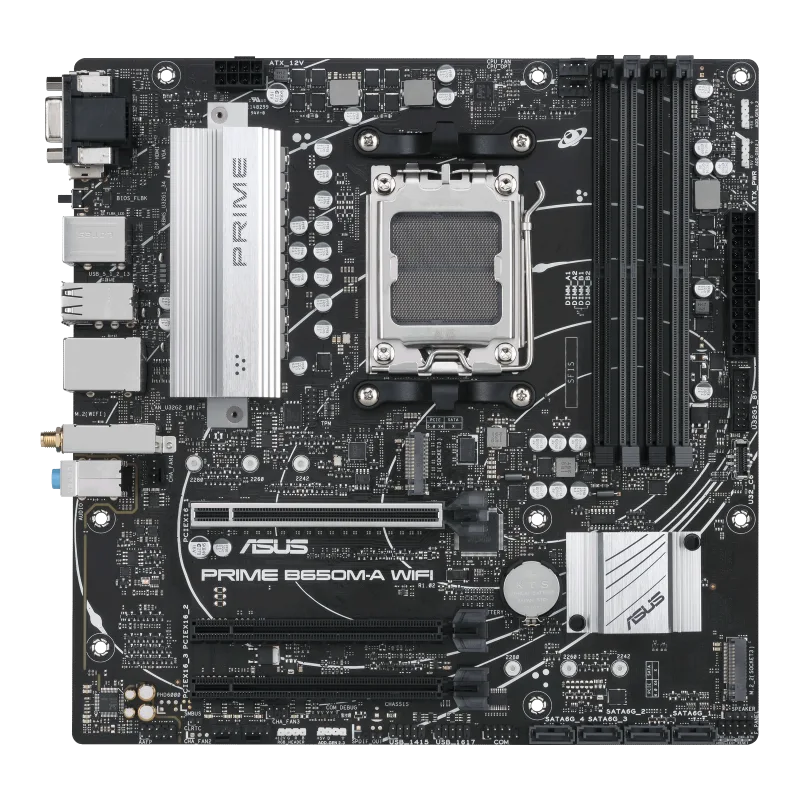
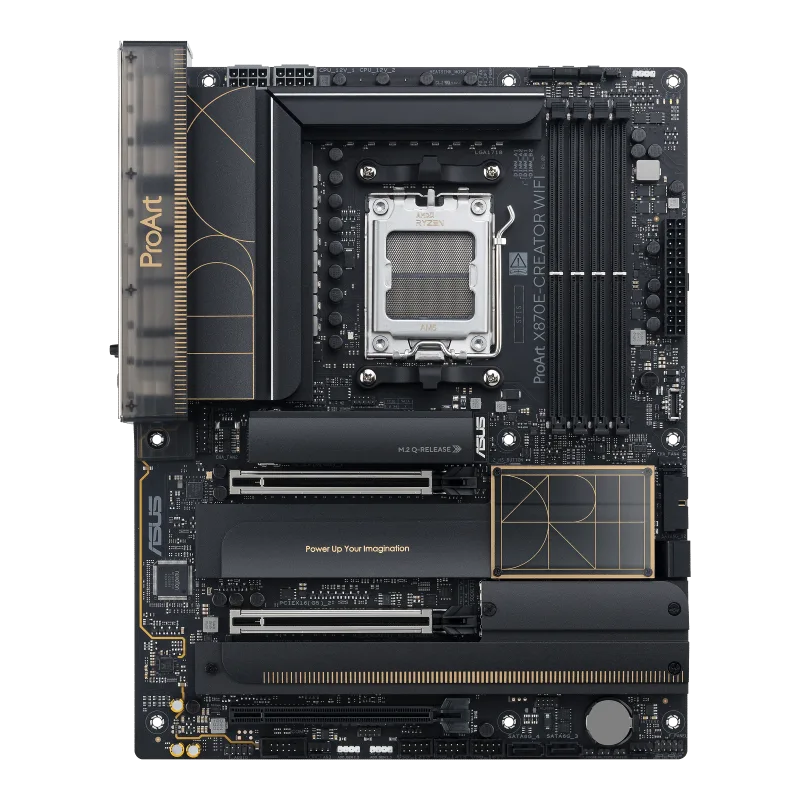
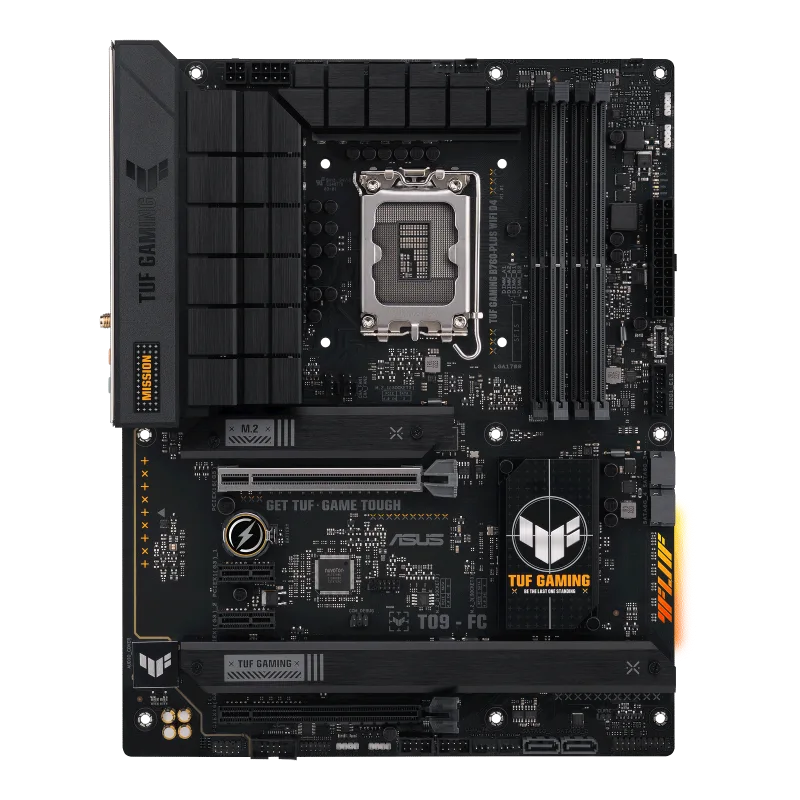
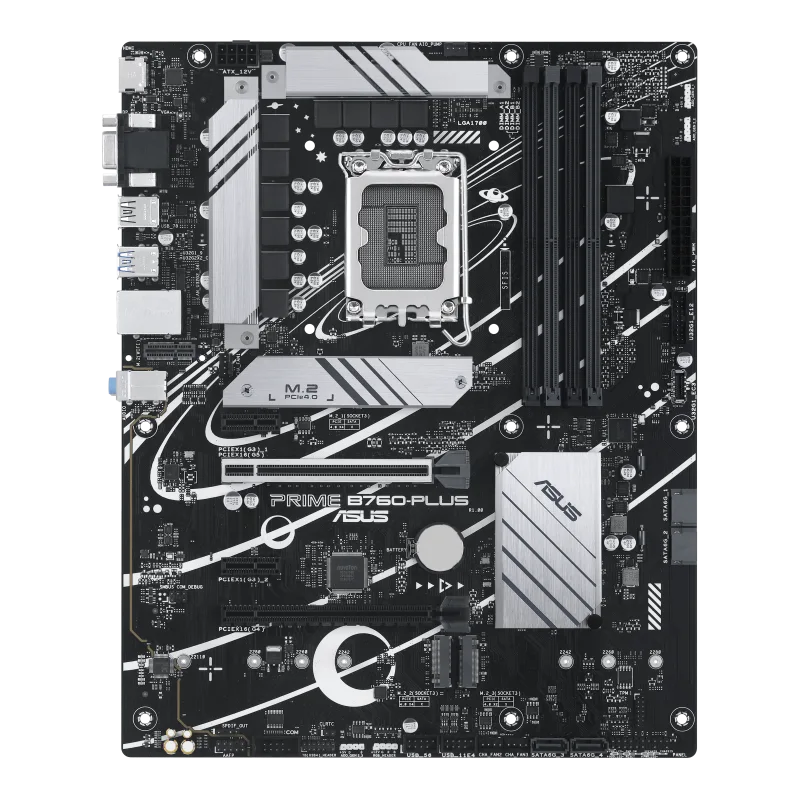
ASUS PRIME B760-PLUS
An ATX LGA1700 board on the Intel B760 chipset with four DDR5 slots, a PCIe 5.0 x16 slot, three PCIe 4.0 M.2 slots, 2.5 Gb Ethernet, DisplayPort, HDMI and VGA outputs and a USB 3.2 Gen 2x2 Type-C port.
Full Specification Sheet
| Socket | Intel LGA1700 |
|---|---|
| Chipset | Intel B760 |
| CPU Support | Intel Core 14th, 13th and 12th Gen, Pentium Gold and Celeron |
| Memory | 4 x DIMM, up to 192 GB, DDR5 up to 7200+ (OC), non-ECC, Intel XMP |
| Expansion | 1 x PCIe 5.0 x16 (CPU), 1 x PCIe 4.0 x16 (x4 mode), 2 x PCIe 3.0 x1 |
| Storage | 3 x M.2 (PCIe 4.0) and 4 x SATA 6Gb/s, Intel RST RAID 0/1/5/10 |
| Networking | Realtek 2.5Gb Ethernet; vertical M.2 Key E slot for a Wi-Fi module (sold separately) |
| Rear USB | 1 x USB 3.2 Gen 2x2 Type-C, 2 x USB 3.2 Gen 2, 1 x USB 3.2 Gen 1, 2 x USB 2.0 |
| Video Output | DisplayPort, HDMI, VGA |
| Audio | Realtek 7.1 Surround Sound HD Audio CODEC |
| Form Factor | ATX, 12 x 9.6 in (30.5 x 24.4 cm) |
The ASUS PRIME B760-PLUS is an ATX motherboard for Intel's LGA1700 socket, built around the B760 chipset. It belongs to ASUS's Prime line, the company's understated, mainstream family, and its specification reads like a practical mid-range board: DDR5 memory, one PCI Express 5.0 x16 slot, three M.2 slots, a 2.5 Gb Ethernet port and a modest but useful set of rear USB ports. This page reproduces the specification ASUS publishes, explains what each entry means for a build and leaves out anything the ASUS tech-spec page does not state, including a price. Nothing here is a benchmark or a test.
Processor and chipset support
The socket is Intel LGA1700, and ASUS lists support for Intel Core 14th and 13th generation processors, Intel Core 12th generation, and Pentium Gold and Celeron processors, with a note that the CPU support list on the ASUS website is the definitive reference and that older BIOS versions may need updating before a newer chip boots. The board supports Intel Turbo Boost Technology 2.0, and Turbo Boost Max Technology 3.0 where the processor supports it. The chipset is the Intel B760, which sits in the mainstream tier: it offers a sensible feature set without the top-tier chipset's extra lanes. If the tiers are unfamiliar, our guide to motherboard chipset tiers shows what changes from one to the next. For a processor that fits this board, see the Intel Core i7-14700K.
Memory
There are four DIMM slots supporting up to 192 GB of DDR5 memory in a dual-channel architecture. ASUS lists speeds of 4800, 5000, 5200, 5400 and 5600 MT/s as standard entries and a range from 5800 up to 7200 and beyond marked OC, meaning overclocked. The memory is non-ECC and unbuffered, with on-die ECC as a feature of DDR5 itself, and the board supports Intel Extreme Memory Profile (XMP) and ASUS's OptiMem II routing. ASUS adds that supported memory types, speeds and module counts vary with the processor and the memory configuration, and directs buyers to its CPU and memory support list. Filling all four slots usually reduces the speed a board can hold, and the board's manual gives the details.
Graphics output
Video output comes from the processor's integrated graphics through one DisplayPort, one VGA port and one HDMI port. ASUS states that the DisplayPort supports a maximum of 4K at 60 Hz as specified in DisplayPort 1.4, and the HDMI port supports 4K at 60 Hz as specified in HDMI 2.1, with the note that graphics specifications vary between CPU types. The presence of a legacy VGA connector is a distinguishing feature for a board of this generation and is useful for older monitors and projectors. A discrete graphics card would normally supply the display connections in a gaming build.
Expansion slots
The processor provides one PCIe 5.0 x16 slot. The B760 chipset provides one PCIe 4.0 x16 slot that runs in x4 mode and two PCIe 3.0 x1 slots. That means a single graphics card goes in the fast top slot, while the lower slot suits an add-in card that needs modest bandwidth, such as a capture card or extra storage controller. ASUS notes that installed devices should be checked against its peripheral compatibility list. The graphics slot and the CPU-connected M.2 slot compete for processor lanes on some platforms; the sharing behaviours are explained generally in our article on PCIe lane sharing between graphics cards and NVMe drives.
Storage
The board supports three M.2 slots and four SATA 6 Gb/s ports. M.2_1, connected to the processor, is a Key M slot for 2242, 2260 and 2280 drives running PCIe 4.0 x4. M.2_2, connected to the chipset, accepts 2242, 2260, 2280 and 22110 drives and also runs PCIe 4.0 x4. M.2_3 accepts 2242, 2260 and 2280 drives at PCIe 4.0 x2. Intel Rapid Storage Technology supports SATA RAID levels 0, 1, 5 and 10. The M.2 slots are PCIe 4.0 rather than 5.0, so the fast drives suited to this board are Gen 4 models.
Networking and wireless
Wired networking is a Realtek 2.5 Gb Ethernet port. The board has no Wi-Fi module fitted: ASUS lists a vertical M.2 slot with Key E, CNVi and PCIe support and notes that the Wi-Fi module is sold separately. If wireless matters to you, this is a point to budget for, and our guide to Wi-Fi versus Ethernet on gaming motherboards gives context on when wired networking is preferable.
USB, audio and rear panel
The rear panel provides six USB ports: one USB 3.2 Gen 2x2 Type-C, two USB 3.2 Gen 2 Type-A, one USB 3.2 Gen 1 Type-A and two USB 2.0 Type-A, along with DisplayPort, VGA, HDMI, the vertical M.2 Key E slot, the Ethernet port and three audio jacks. Internally, ASUS lists seven more USB connections: one USB 3.2 Gen 1 connector supporting Type-C, one USB 3.2 Gen 1 header for two more ports and two USB 2.0 headers for four additional ports. Audio is a Realtek 7.1 Surround Sound High Definition Audio CODEC with jack detection, multi-streaming and front-panel jack retasking, supporting playback up to 24-bit and 192 kHz. It includes audio shielding, premium audio capacitors and dedicated audio PCB layers. A chassis with an HD audio module in the front panel is needed for 7.1 output.
Headers, protection and software
Internal connectors include one CPU fan header, one AIO pump header, three chassis fan headers, a 24-pin main power connector and an 8-pin 12 V power connector. Additional headers are three addressable Gen 2 headers, one Aura RGB header, clear CMOS, a COM port, front-panel audio, S/PDIF out, an SPI TPM header, the system panel header and a Thunderbolt (USB4) header. ASUS groups protection features as 5X PROTECTION III: DIGI+ VRM, LANGuard, overvoltage protection, SafeSlot Core+ and stainless-steel back I/O. Q-Design features include Q-DIMM, Q-LED Core and Q-Slot, and the thermal design includes an M.2 heatsink and a VRM heatsink. Software includes Armoury Crate, Aura Creator and Aura Sync, Fan Xpert 2+, AI Suite 3 and a UEFI BIOS with EZ Mode, CrashFree BIOS 3 and EZ Flash 3 on a 128 Mb flash ROM.
Size and box contents
The board is ATX at 12 by 9.6 inches (30.5 by 24.4 cm) and supports 64-bit Windows 11 and Windows 10. The box includes two SATA cables, an I/O shield, an M.2 rubber package, two screw packages for M.2 SSDs and a user guide. For the broader question of what to pay for on a board, see our guide to budget versus premium motherboards. To see the numbers beside another LGA1700 board in our database, open the comparison with the ROG STRIX Z790-E GAMING WIFI, or browse the motherboard category. All figures are ASUS specifications.