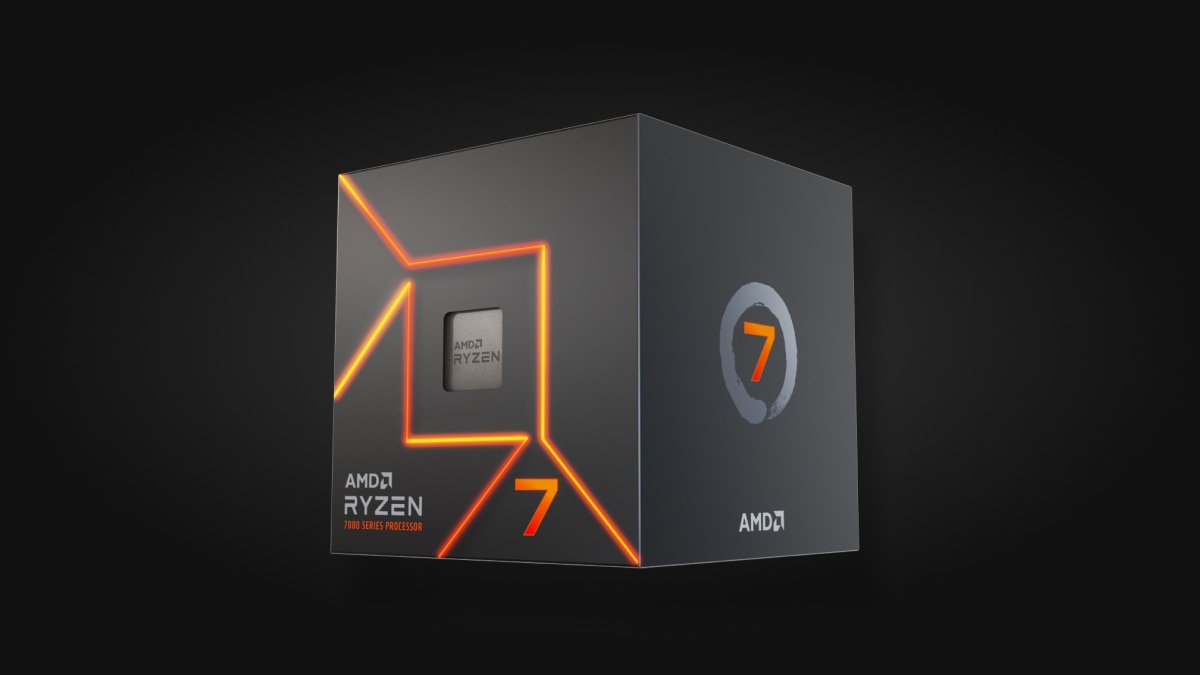
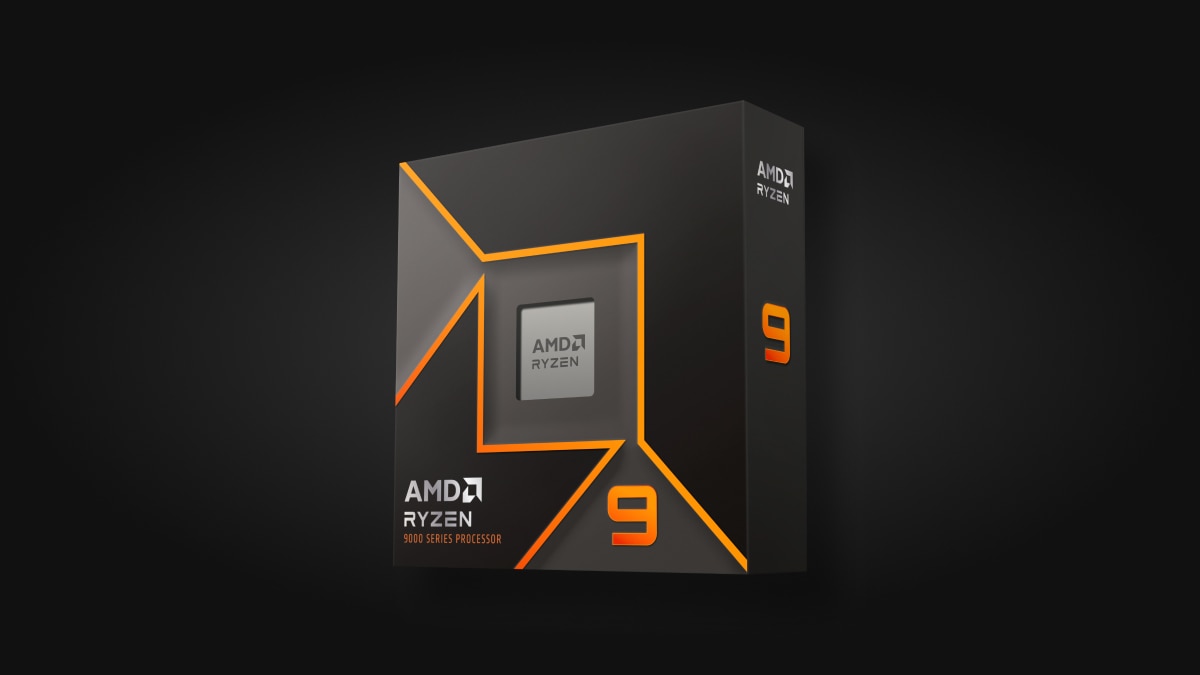
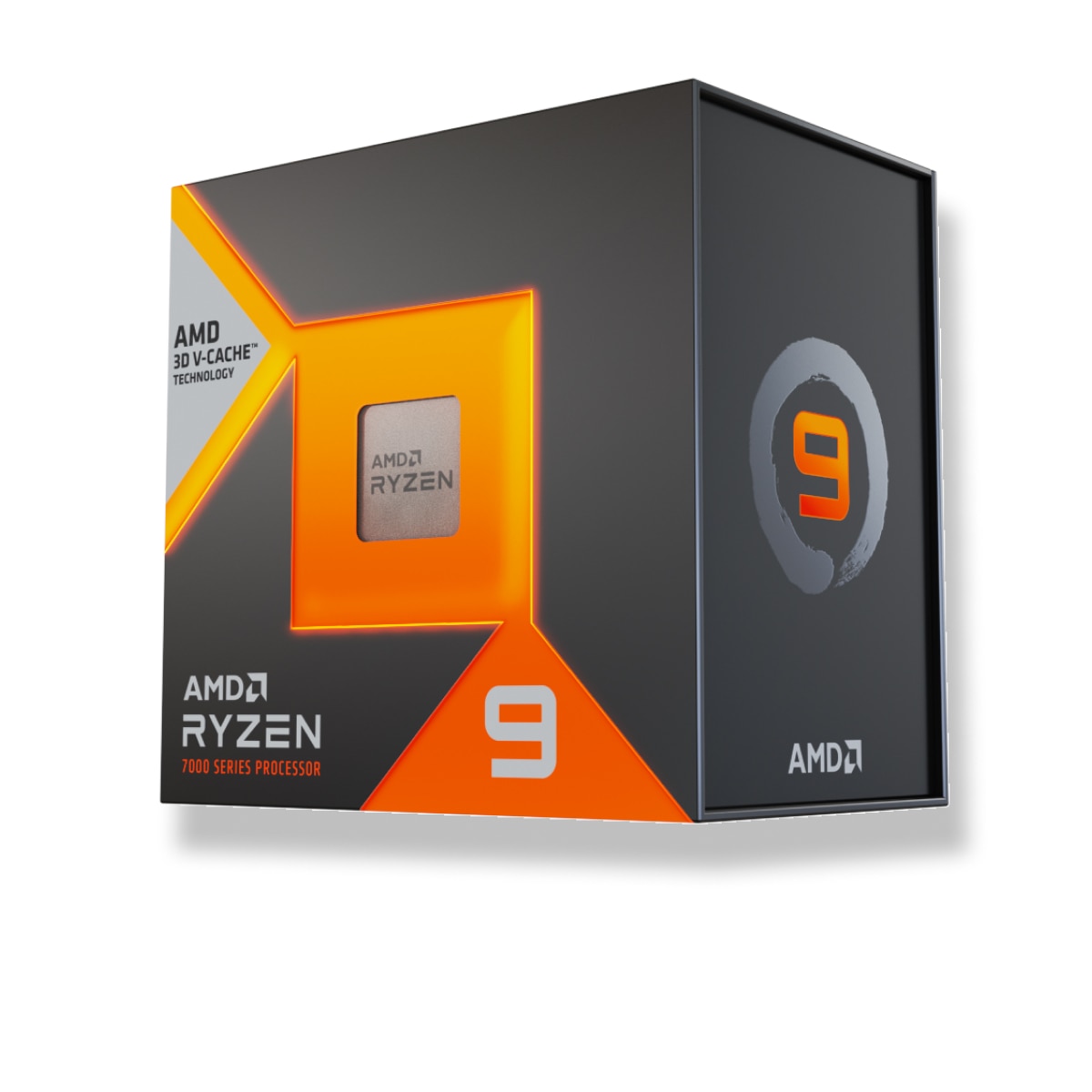
AMD Ryzen 9 7900X
A twelve-core Zen 4 processor for AM5 that balances gaming speed with serious multi-threaded muscle.
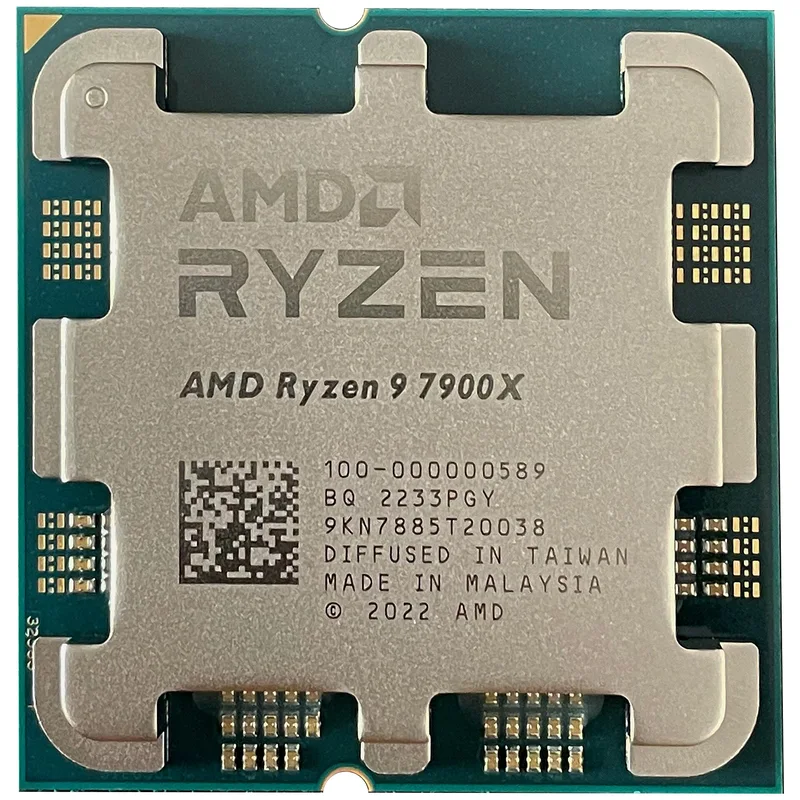
Full Specification Sheet
| Cores / Threads | 12 / 24 |
|---|---|
| Base / Boost Clock | 4.7 GHz / up to 5.6 GHz |
| Cache | 76 MB (64 MB L3 + 12 MB L2) |
| TDP | 170 W |
| Socket | AM5 |
| Architecture | Zen 4 (TSMC 5nm cores, 6nm I/O die) |
| Memory | DDR5, dual-channel, up to DDR5-5200 |
| PCIe | 28 lanes (24 usable) |
| Integrated Graphics | AMD Radeon Graphics (2 CUs) |
The AMD Ryzen 9 7900X sits in the middle of the enthusiast tier of the Ryzen 7000 family. It has twelve Zen 4 cores with simultaneous multithreading for 24 threads, a 4.7 GHz base clock and a boost ceiling of up to 5.6 GHz. It launched on 27 September 2022 together with the first AM5 motherboards, the same day as the Ryzen 5 7600X, Ryzen 7 7700X and Ryzen 9 7950X. For buyers who want more parallel throughput than an eight-core processor can offer but do not need the sixteen cores of the flagship, it is the sweet spot in the lineup on paper.
Architecture and manufacturing
The 7900X is a chiplet design that AMD lists as a three-die package. Two compute chiplets are made on TSMC's 5nm process and measure 71 mm² each, and they share a package with a single 122 mm² I/O die made on TSMC's 6nm process. Splitting the design this way lets AMD build the performance-critical cores on the most advanced process while keeping the memory controller, PCIe controller and other input/output logic on a cheaper, older node. The Zen 4 core also added support for AVX-512 instructions, which the specification sheet lists among the supported extensions along with AES, AVX2, FMA3, SHA and the SSE family.
Cache totals 76 MB when L2 and L3 are counted together: 12 MB of L2 (1 MB per core) and 64 MB of L3, plus 768 KB of L1. The size of the L3 is a hint about the design; it is split between the two chiplets, so the processor behaves as two six-core groups with their own slice of cache, which is worth remembering when comparing it with single-chiplet parts. For the majority of everyday and gaming workloads this is invisible, but very latency-sensitive software can notice when a thread moves between the groups.
Clocks, power and thermals
The default TDP is 170 W, and the maximum operating temperature (Tjmax) is 95 °C. This is a high-power processor: it is designed to boost aggressively until it approaches a thermal or power limit, which is why the cooler matters more than usual. AMD ships the processor without a cooler and recommends a liquid cooler for the best performance. Plan for a strong 280 mm or 360 mm radiator, or a top-tier dual-tower air cooler, and make sure the case has decent airflow. The processor is unlocked, and AMD lists support for Precision Boost Overdrive, Curve Optimizer voltage offsets and the Ryzen Master utility for manual tuning, so enthusiasts have plenty of headroom to adjust behaviour if they wish.
Because the processor targets high boost clocks, actual behaviour varies with the quality of the cooler, the motherboard's power delivery and the ambient temperature. Two identical systems in different rooms can report noticeably different sustained clocks. For predictable results, choose a motherboard with a competent power stage and keep the BIOS current.
Platform: AM5, DDR5 and PCIe
AM5 is a new socket that moved AMD to DDR5 only; there is no DDR4 support here. Officially the processor supports dual-channel DDR5 up to 5200 MT/s with two modules, whether single-rank or dual-rank, and the rating falls to 3600 MT/s when four modules are installed. The maximum capacity is 128 GB, and ECC is supported when the motherboard provides it. AMD EXPO is supported for one-click memory overclocking profiles, so most buyers will enable an EXPO profile on a matched kit. Our DDR5 versus DDR4 buying guide discusses what to look for when choosing memory for this class of platform.
The processor provides 28 PCIe lanes in total, of which 24 are usable, and the supporting chipsets listed by AMD are A620, B650, B650E, X670, X670E, B840, B850, X870 and X870E. That is a broad range: an X670E or X870E board is the choice for the most complete set of expansion options, while B650 or B850 boards cover the majority of builds at a lower price. Native connectivity includes four USB 3.2 Gen 2 ports and one USB 2.0 port, with NVMe boot and RAID 0, 1 and 10 support. Our platform guide covering AM4, AM5 and LGA1700 explains where AM5 sits in the sequence of sockets and why a processor like this needs a new motherboard.
An unusual detail for a performance-oriented chip is the integrated graphics: it includes an AMD Radeon Graphics engine with two graphics cores running at up to 2200 MHz, plus USB-C DisplayPort alternate mode support. That is enough to show a desktop, drive a display while troubleshooting a graphics card, or serve as a basic fallback, but it is not meant for gaming. Consider it a diagnostic and convenience feature rather than a substitute for a discrete graphics card.
Who should buy it
The 7900X suits people who mix gaming with heavy workloads such as video editing, 3D rendering, software builds or virtual machines. Twelve cores give a healthy step up over eight-core parts for jobs that scale with core count, while the high boost clock keeps gaming performance strong. It also suits those who want an AM5 platform with room to grow, since AM5 is the current platform and later Ryzen generations build on it. If your workload is primarily gaming, a processor with a larger cache or fewer cores may offer better value; if you need the highest possible multi-threaded throughput, the Ryzen 9 7950X adds four more cores. You can inspect the differences on a head-to-head page such as Ryzen 9 7900X against Ryzen 9 7950X, and read the Ryzen 9 7950X review to see how the flagship of this generation performs.
For readers deciding between AMD and Intel at this tier, our flagship processor comparison discusses the trade-offs in platform cost, power draw and upgrade path. Browsing the processors catalogue lets you filter those chips by socket and core count.
Practical checklist
Before buying, confirm that your case and cooler mounting support the AM5 socket, that the power supply has enough capacity for a high-power processor plus your graphics card, and that the motherboard has the expansion slots you need. Budget for DDR5 memory, since DDR4 will not work, and plan for a real cooler because none is included. Enable the EXPO memory profile in the BIOS, keep the chipset drivers current, and consider adjusting Curve Optimizer settings only if you understand the stability implications. Done carefully, this processor delivers a strong balance between everyday responsiveness and heavy sustained work, and the specification list above tells you most of what you need to decide whether that balance suits your build.
Photo: CristoCalis / Wikimedia Commons, CC BY-SA 4.0.