AMD Ryzen 9 7950X Review: Sixteen Cores of AM5 Longevity
8.8/10
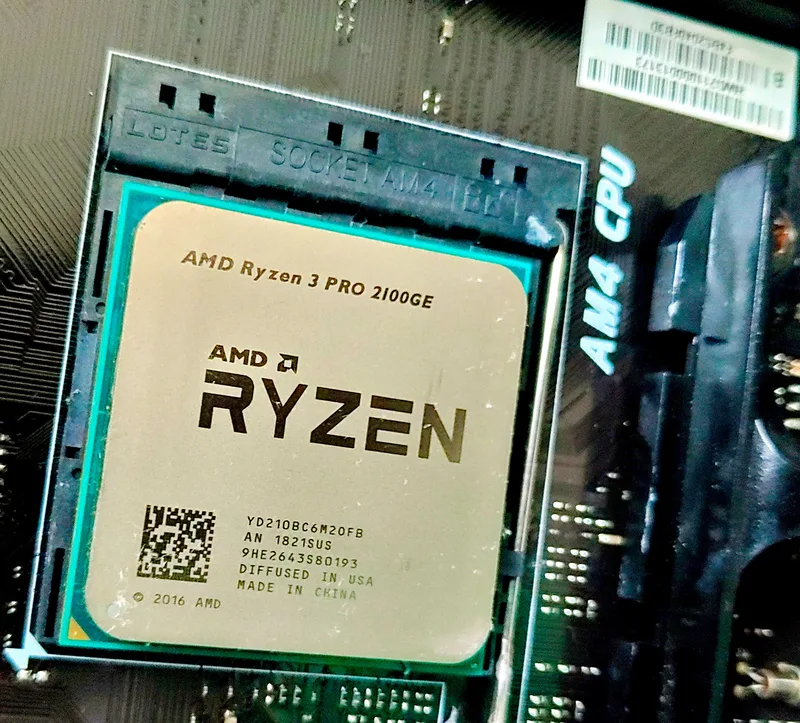
The Ryzen 9 7950X is AMD's answer to the question of how far you can push a symmetric multi-core design before diminishing returns set in, and the answer, for now, is sixteen full cores and thirty-two threads, all built on the same core architecture rather than a mix of big and small cores. Where Intel's flagship splits work across two different core types, every one of the 7950X's sixteen cores is identical, which makes multi-threaded scaling far more predictable for workloads that actually know how to use them.
Clock speeds are conservative-looking on paper — a 4.5GHz base with boost up to 5.7GHz — but AMD's all-core boost behavior under Zen 4 tends to hold clocks higher for longer under sustained load than the raw numbers suggest, which is part of why this chip performs so well in rendering, video encoding, and compilation benchmarks relative to its clock speed alone. The cache story is the more interesting number: 80MB total, split between 64MB of L3 and 16MB of L2, dwarfing what most competing chips carry and directly explaining why the 7950X holds up so well in cache-sensitive workloads like large codebases and complex simulation software.
TDP is rated at a flat 170W, which is lower than Intel's peak flagship draw but should not be read as a "cool" chip — 170W sustained across sixteen cores still needs a serious cooler, and a 240mm-or-larger AIO is the sensible baseline for anyone planning to use all sixteen cores regularly rather than occasionally.
The socket is AM5, and this is where the 7950X's value proposition extends well past the chip itself. AMD has committed to AM5 as a long-lived platform in the same way AM4 supported half a decade of Ryzen generations, which means a motherboard bought today is a reasonable bet to still accept next-generation Ryzen chips via a BIOS update years down the line. That upgrade runway is difficult to put a number on, but for a buyer who upgrades a CPU without replacing a motherboard, it is a genuinely different value calculation than a socket nearing end of life.
Integrated graphics are present — AMD Radeon Graphics with two compute units — and like most flagship integrated graphics, they exist for reliability and bring-up rather than any real gaming ambition. Two CUs is enough to get a desktop on screen, output video, and handle basic 2D work, nothing more, which is exactly the job it needs to do on a chip that virtually every buyer will pair with a discrete GPU.
Where the 7950X earns its keep is heavily-threaded work: video editing timelines with multiple 4K streams, 3D rendering, scientific computing, and large-scale compilation all scale close to linearly across sixteen real cores in a way a hybrid core design cannot always match, because every core here is a full performance core rather than a mix of tiers. For pure gaming-only builds the gap to a cheaper part narrows considerably, since most games still lean on a handful of fast cores rather than sixteen — but for anyone whose workload genuinely spans both gaming and serious production work, the 7950X remains one of the most complete desktop CPUs on the market.
Compared with Intel's current flagship, the decision increasingly comes down to platform philosophy: AM5's promised multi-generation longevity against LGA1700's mature, already-fully-realized peak. Neither answer is wrong; they represent two different bets on how you want to spend the next CPU upgrade cycle.
Real-world thermal behavior on the 7950X follows a similar pattern to any high-core-count chip: under a genuinely sustained sixteen-core workload, clocks will settle to whatever the cooling solution allows them to sustain rather than holding the peak boost figure indefinitely. Where this chip differs from a hybrid design is consistency — because every core is identical, performance scaling under thermal throttling tends to be more predictable and even across all sixteen cores, rather than favoring a handful of cores over the rest. A 280mm-or-larger AIO with a case that has real airflow remains the sensible baseline for anyone who regularly pushes all sixteen cores rather than using them occasionally.
PBO (Precision Boost Overdrive) tuning is worth understanding even for buyers who never plan to manually overclock. AMD's automatic boost algorithm already extracts most of the easy performance headroom out of the box, but enabling PBO in the motherboard BIOS, paired with adequate cooling, can extract a further, genuinely noticeable improvement in sustained multi-core workloads specifically — this is one of the few "free" performance gains left on a modern flagship chip, and it costs nothing but a BIOS setting and confirming your cooler can handle the resulting extra heat.
Common questions worth addressing directly: does this chip need a high-end X670E motherboard? No — a solid B650 board handles the 7950X perfectly well for the vast majority of builds, with X670E's extra PCIe lanes and connectivity mattering mainly to buyers planning multiple high-speed NVMe drives or add-in cards simultaneously. Is 16 cores overkill for gaming? For gaming alone, yes, most titles do not meaningfully benefit past 8 well-clocked cores — the extra eight cores on this chip earn their keep specifically in production and multitasking scenarios, not in gaming frame rates. Does the platform's DDR5-only requirement add real cost? Somewhat, though DDR5 pricing has narrowed considerably since AM5's launch, and pairing with a well-chosen 6000MHz kit tuned to AM5's Infinity Fabric ratio recovers most of the platform's theoretical memory-speed advantage.
The bottom line: the 7950X earns its price most clearly in mixed-use builds where gaming and genuine production work share the same machine. For a pure gaming-only build with no production workload, a less expensive chip in the same family typically delivers nearly identical gaming performance for meaningfully less money — worth checking honestly before defaulting to the flagship.
One more practical point worth spelling out: overclocking headroom on this chip is real but increasingly modest compared to earlier generations, since it already ships close to its practical silicon ceiling from the factory. Buyers hoping for large manual overclocking gains beyond stock boost behavior are more likely to find small, single-digit-percentage improvements rather than the larger jumps possible on older, more conservatively-clocked chips — which is not a criticism, simply a reflection of how much performance Intel already extracts at stock settings on this particular silicon.
Finally, community forums and long-term ownership threads remain one of the more underrated research tools available before a purchase like this — real owners several months or years into ownership tend to surface durability and compatibility patterns that launch-week reviews, however thorough, simply have not had time to observe yet.
See how this chip compares directly against Intel's flagship in our Core i9-14900K review, browse the full CPU comparison hub, or read our broader Intel vs. AMD flagship buying guide before deciding.