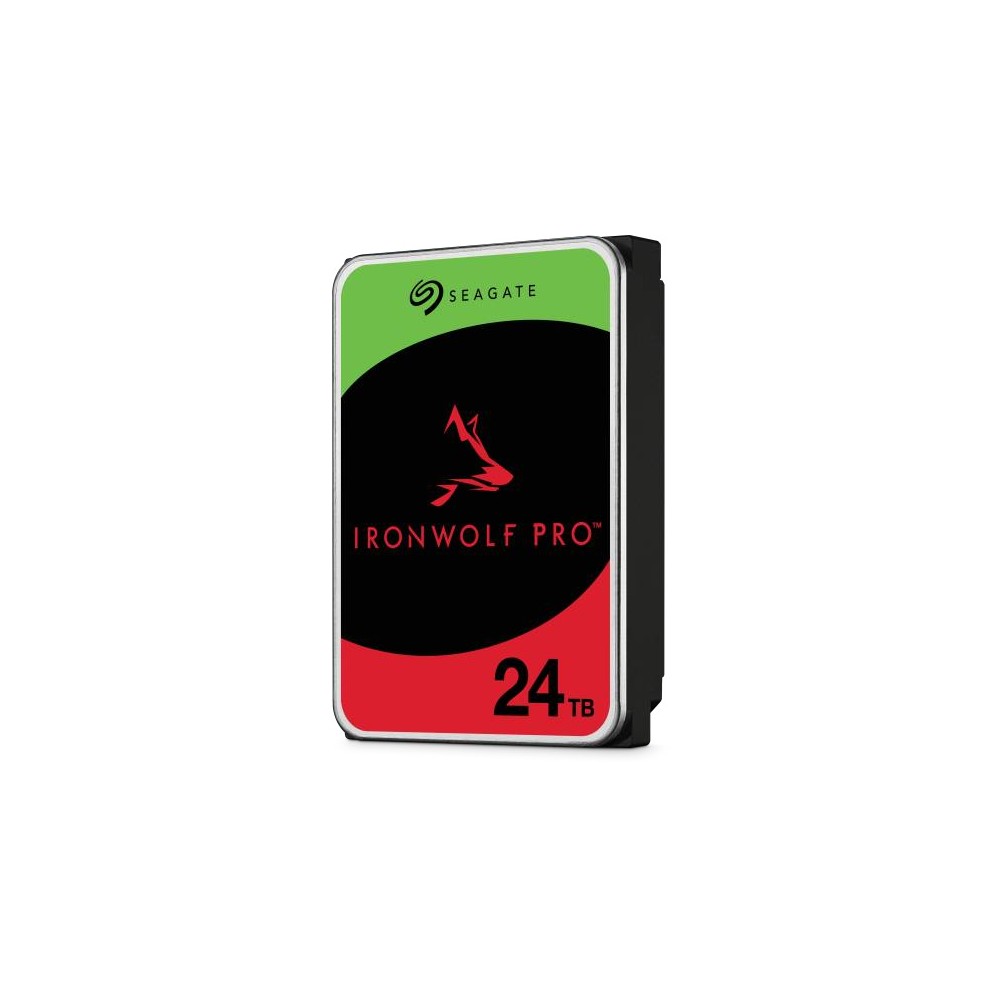
Seagate IronWolf Pro NAS Hard Drive (2TB-24TB)
A 7,200 RPM CMR NAS hard drive family from 2 TB to 24 TB for enclosures of any size, rated for 550 TB/year, up to 2.5 million hours MTBF and a five-year warranty.
Full Specification Sheet
| Type | Internal HDD, NAS-optimized (commercial and enterprise NAS) |
|---|---|
| Interface | SATA 6 Gb/s |
| Form Factor | 3.5-inch (26.11 x 101.85 x 146.99 mm) |
| Capacities | 2, 4, 6, 8, 10, 12, 14, 16, 18, 20, 22, 24 TB |
| Recording Technology | CMR (all models) |
| Spindle Speed | 7,200 RPM |
| Cache | 512 MB (22 TB, 24 TB), 256 MB (other capacities) |
| Max. Sustained Transfer Rate | 285 MB/s (18-24 TB), 270 MB/s (16 TB), 250 MB/s (4 TB), 226 MB/s (2 TB) |
| Drive Design | Helium (12 TB to 24 TB); air (10 TB and below) |
| Drive Bays Supported | Unlimited |
| Workload Rate Limit | 550 TB per year |
| Rotational Vibration Sensors | Yes |
| Power-On Hours | 8,760 per year (24x7) |
| MTBF | 2,500,000 hours (12 TB to 24 TB), 2,000,000 hours (10 TB and below) |
| Average Operating Power | 7.8 W (24 TB), 7.9 W (22 TB), 7.7 W (20 TB), 7.5 W (18 TB), 7.6 W (16 TB) |
| Rescue Data Recovery Services | 3 years |
| Warranty | 5-year limited |
The Seagate IronWolf Pro is the professional tier of Seagate's NAS hard drives, designed for commercial and enterprise network storage, creative workgroups and large multi-bay systems. Compared with the standard IronWolf it offers a workload rating roughly three times as high, a longer warranty, a higher reliability rating and capacities up to 24 TB in the data sheet we use. Every model spins at 7,200 RPM and uses conventional magnetic recording. This page summarises the manufacturer's data sheet. We have not tested the drives, and we publish no prices or measurements of our own.
Capacities and performance
The data sheet covers twelve capacities: 2, 4, 6, 8, 10, 12, 14, 16, 18, 20, 22 and 24 TB. All use SATA 6 Gb/s and run at 7,200 RPM. The maximum sustained transfer rate is 285 MB/s for the 18 TB to 24 TB models and 270 MB/s for the 16 TB model; at the lower end, the 4 TB model is rated at 250 MB/s and the 2 TB model at 226 MB/s. The 22 TB and 24 TB drives have a 512 MB cache, and the other capacities have 256 MB. The sector format is 512e, which means 4K physical sectors presented as 512-byte logical sectors for compatibility.
Helium and air
The models from 12 TB to 24 TB are sealed and filled with helium, while those of 10 TB and below are conventional air-filled drives. Helium is much less dense than air, so the platters meet less resistance. This allows more platters in the same housing and lowers power consumption and heat. The average operating power listed for the large helium models is between 7.5 and 7.9 watts: 7.8 watts for 24 TB, 7.9 watts for 22 TB, 7.7 watts for 20 TB, 7.5 watts for 18 TB and 7.6 watts for 16 TB. For a 24 TB drive that is a low figure per terabyte, which matters in systems with many drives.
Designed for large arrays
The number of supported drive bays is given as unlimited, in contrast to the eight-bay limit of the standard IronWolf. All models have rotational vibration sensors, which let a drive compensate for the vibration produced by many neighbours in a dense chassis. Conventional magnetic recording on every capacity keeps RAID rebuild behaviour predictable. For readers planning a system, our guide how many drives a home NAS needs explains RAID levels and capacity planning in simple terms.
Workload and reliability
The workload rate limit is 550 TB per year, the level usually associated with enterprise-class drives and about three times the 180 TB of the standard IronWolf. The drives are rated for 8,760 power-on hours per year, that is, continuous operation. Mean time between failures is given as 2.5 million hours for the helium models from 12 TB upwards and 2.0 million hours for the air-filled models of 10 TB and below. The rate of non-recoverable read errors is at most one per 10 to the power of 15 bits read, ten times better than typical desktop drives.
Warranty and data recovery
The limited warranty runs for five years. In addition, three years of Rescue Data Recovery Services are included, under which Seagate will attempt to recover data from a failed or damaged drive during the coverage period. As Seagate notes for this service in general, it is not offered in every country, and it complements a backup strategy without replacing one.
Dimensions and environment
All models have the standard 3.5-inch dimensions of 26.11 by 101.85 by 146.99 millimetres. The large helium drives weigh between 670 and 690 grams. The maximum drive-reported operating temperature is 65 °C, and the non-operating range is -40 to 70 °C. High-capacity 7,200 RPM drives produce audible seek noise and some vibration, so a solid enclosure with good airflow is advisable; the extract of the data sheet we use does not let us quote acoustic values reliably.
How it compares in our database
In our storage section, the closest equivalent is the WD Red Pro NAS Hard Drive family, which also combines 7,200 RPM, CMR and a workload rating of up to 550 TB per year; the page IronWolf Pro vs WD Red Pro compares them. One level below sits the standard Seagate IronWolf, rated for 180 TB per year, up to eight bays and a three-year warranty, with 5,400 RPM versions for quieter, more frugal home systems.
Who it suits
The IronWolf Pro is intended for NAS systems that work hard: small and medium businesses with many users, video and photo studios that edit directly from shared storage, surveillance or backup servers with constant writes, and enthusiasts who run large arrays. It is also the logical choice for anyone who needs the highest capacities per bay. For a two-bay or four-bay home NAS that mainly stores media and backups, the standard IronWolf is usually sufficient and, in its 5,400 RPM versions, quieter.
Planning tips
With very large drives, a RAID rebuild can take a day or more, during which the array is vulnerable to a second failure. For that reason, arrays of high-capacity drives are commonly configured with two-drive redundancy. Regardless of the RAID level, an independent backup remains essential; our article on backup strategies with NAS and external drives sets out workable schemes. Check the NAS manufacturer's compatibility list for the exact model number before buying, particularly for the newest capacities.
Installation notes
The drives mount in standard 3.5-inch trays. Handle them by the edges, avoid shocks, and let a drive that has been transported in the cold reach room temperature before powering it on. After adding drives, most NAS systems run a long initial synchronisation, during which performance is reduced.
What the data sheet does not say
The revision of the data sheet we use lists capacities up to 24 TB; newer, larger models are documented separately and are not described here. Sustained transfer rates for some middle capacities and the acoustic figures could not be read reliably from our extract, so we do not quote them. Prices vary by country, retailer and capacity and are not listed on this page.