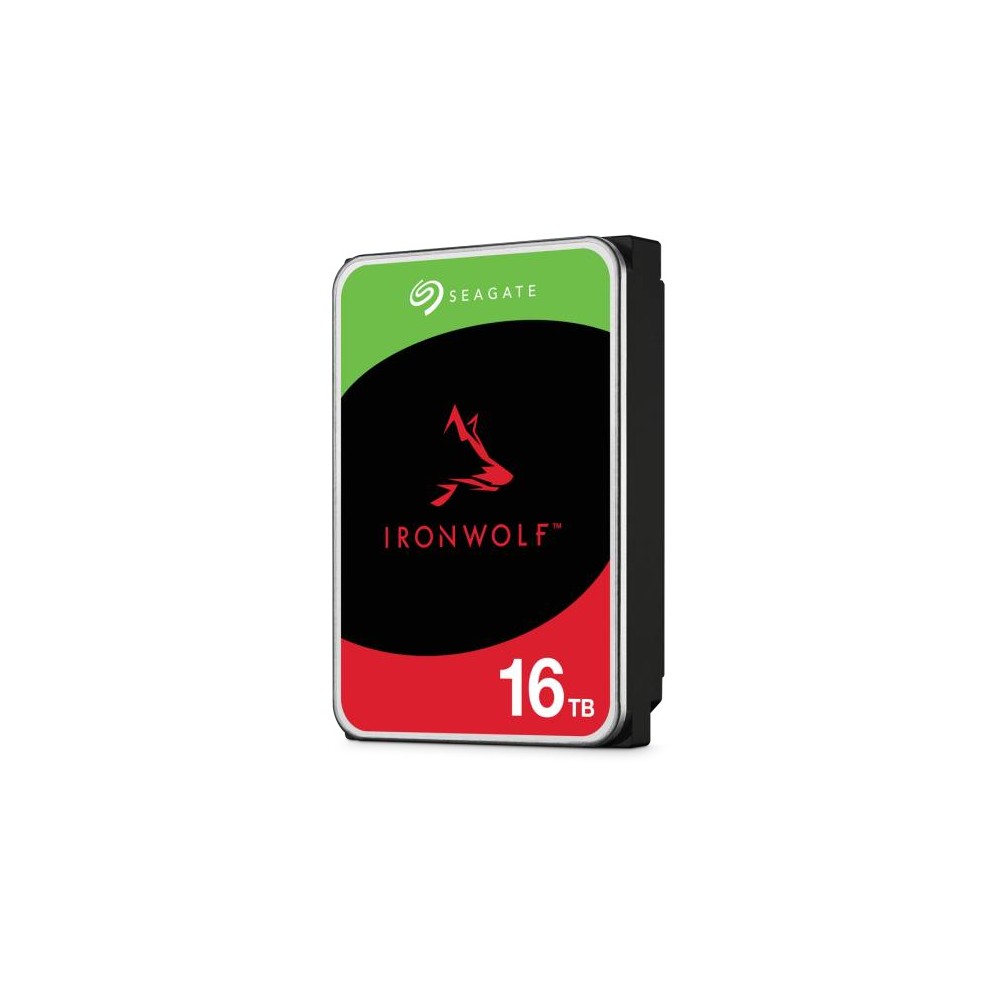
Seagate IronWolf NAS Hard Drive (2TB-16TB)
A CMR NAS hard drive family from 2 TB to 16 TB for enclosures with up to 8 bays, rated for 180 TB/year and 24x7 operation, with 3 years of warranty and data recovery service.
Full Specification Sheet
| Type | Internal HDD, NAS-optimized |
|---|---|
| Interface | SATA 6 Gb/s |
| Form Factor | 3.5-inch (26.11 x 101.85 x 146.99 mm) |
| Capacities | 2 TB, 4 TB, 6 TB, 8 TB, 10 TB, 12 TB, 16 TB |
| Recording Technology | CMR (all models) |
| Spindle Speed | 7,200 RPM (16 TB, 12 TB, 10 TB, 8 TB ST8000VN004); 5,400 RPM (8 TB ST8000VN002, 6 TB, 4 TB, 2 TB) |
| Cache | 256 MB |
| Max. Sustained Transfer Rate | 240 MB/s (16 TB), 210 MB/s (12 TB, 10 TB, 8 TB 7,200 RPM), 202 MB/s (8 TB 5,400 RPM, 6 TB, 4 TB), 180 MB/s (2 TB) |
| Drive Design | Helium (16 TB, 12 TB); air (10 TB and below) |
| Drive Bays Supported | 1 to 8 |
| Workload Rate Limit | 180 TB per year |
| Rotational Vibration Sensor | Yes |
| Power-On Hours | 8,760 per year (24x7) |
| MTBF | 1,000,000 hours |
| Rescue Data Recovery Services | 3 years |
| Warranty | 3-year limited |
The Seagate IronWolf is Seagate's hard drive line for network-attached storage in homes, home offices and small businesses. Unlike desktop drives, it is specified for continuous operation in multi-bay enclosures, with conventional magnetic recording on every model, rotational vibration sensors and a workload rating of 180 TB per year. The data sheet we use covers capacities from 2 TB to 16 TB. This page summarises that document. We have not tested the drives, and we publish no prices or measurements of our own.
Models and speeds
The data sheet lists eight models. The 16 TB ST16000VN001 and the 12 TB ST12000VN0008 are helium-filled drives running at 7,200 RPM, with maximum sustained transfer rates of 240 and 210 MB/s. The 10 TB ST10000VN000 and the 8 TB ST8000VN004 are air-filled 7,200 RPM drives rated at 210 MB/s. A second 8 TB model, the ST8000VN002, runs at 5,400 RPM and reaches 202 MB/s, as do the 6 TB ST6000VN006 and the 4 TB ST4000VN006. The 2 TB ST2000VN003 runs at 5,400 RPM and is rated at 180 MB/s. All models have a 256 MB cache and a SATA 6 Gb/s interface.
Because two different 8 TB drives exist, buyers who care about spindle speed should check the model number. The 7,200 RPM version is faster and draws more power; the 5,400 RPM version is more frugal.
CMR throughout
Every IronWolf model in the data sheet uses conventional magnetic recording. This matters in a NAS, because RAID arrays rewrite data in ways that shingled recording handles poorly, particularly when an array is rebuilt after a drive failure. With CMR drives, rebuild times are predictable and sustained write performance does not collapse under load. For anyone unsure how many drives and which RAID level a home NAS needs, our guide how many drives a home NAS needs explains the options.
Built for multi-bay enclosures
The drives are specified for enclosures with one to eight bays. Each has a rotational vibration sensor, which detects the vibration caused by neighbouring drives and allows the drive to compensate, so that performance stays steady when several disks spin next to each other. The data sheet also lists dual-plane balancing and error recovery control. The latter limits how long a drive spends trying to recover a bad sector by itself, so that the RAID controller can step in and repair the data from redundancy instead of marking the whole drive as failed.
Workload and reliability
The workload rate limit is 180 TB per year, more than three times the figure Seagate gives for its BarraCuda desktop drives. The IronWolf is rated for 8,760 power-on hours per year, which means continuous operation around the clock. Mean time between failures is given as 1,000,000 hours, and the drives are specified for 600,000 load/unload cycles. The limited warranty runs for three years.
Rescue Data Recovery Services
Three years of Rescue Data Recovery Services are included with IronWolf drives. Under this plan, Seagate attempts to recover data from a drive that has failed or been damaged within the coverage period. A footnote states that the service is not available in all countries. It is a useful safety net, though it does not replace a backup, because recovery is never guaranteed and takes time.
Power consumption
Average operating power is listed as 7.3 watts for the helium-filled 16 TB and 12 TB models, 10.1 watts for the air-filled 10 TB and 7,200 RPM 8 TB models, and 5.3 watts for the 5,400 RPM 8 TB model. The helium drives therefore offer the highest capacity at lower power than the mid-sized 7,200 RPM drives, because helium reduces the drag on the platters. In a NAS that runs all day, such differences add up over the years, as does the heat that the enclosure's fan must remove.
Dimensions and environment
All models share the 3.5-inch form factor of 26.11 by 101.85 by 146.99 millimetres. Typical weights are 670 grams for 16 TB, 690 grams for 12 TB and 720 grams for 10 TB. The minimum ambient operating temperature is 0 °C and the maximum drive-reported temperature 65 °C; a footnote advises against sustained operation above 60 °C, since higher temperatures may affect drive health.
How it compares in our database
In our storage section, a classic rival is the WD Red 4TB NAS Hard Drive, a 5,400 RPM class NAS drive with a 64 MB cache; the page IronWolf vs WD Red 4TB compares the specifications. Within Seagate's range, the BarraCuda desktop family is cheaper per terabyte but is rated for only 2,400 power-on hours and 55 TB per year, and its larger models use SMR.
Who it suits
The IronWolf is intended for home and small-office NAS systems with up to eight bays: media servers, shared folders for a family or small team, and backup targets for several computers. It can also serve as a robust data drive in a desktop PC. For enclosures with more than eight bays, heavy multi-user workloads or commercial environments, drives with higher workload ratings and longer warranties are designed for the job.
Planning tips
Buy all drives for an array in the same capacity and, ideally, the same model. RAID protects against the failure of a drive, not against accidental deletion, ransomware or a fire, so a second copy of important data remains necessary; our article on backup strategies with NAS and external drives describes practical approaches. Place the NAS where air can circulate, and keep an eye on drive temperatures and health reports in the NAS software. Before buying, it is also worth checking the compatibility list of the NAS manufacturer for the exact model number.
What the data sheet does not say
The data sheet revision we use lists the eight models above; other capacities sold in some regions are not covered and are therefore not described here. Acoustic figures were not legible in our extract, so we leave them out. Prices vary by country, retailer and capacity and are not listed on this page.