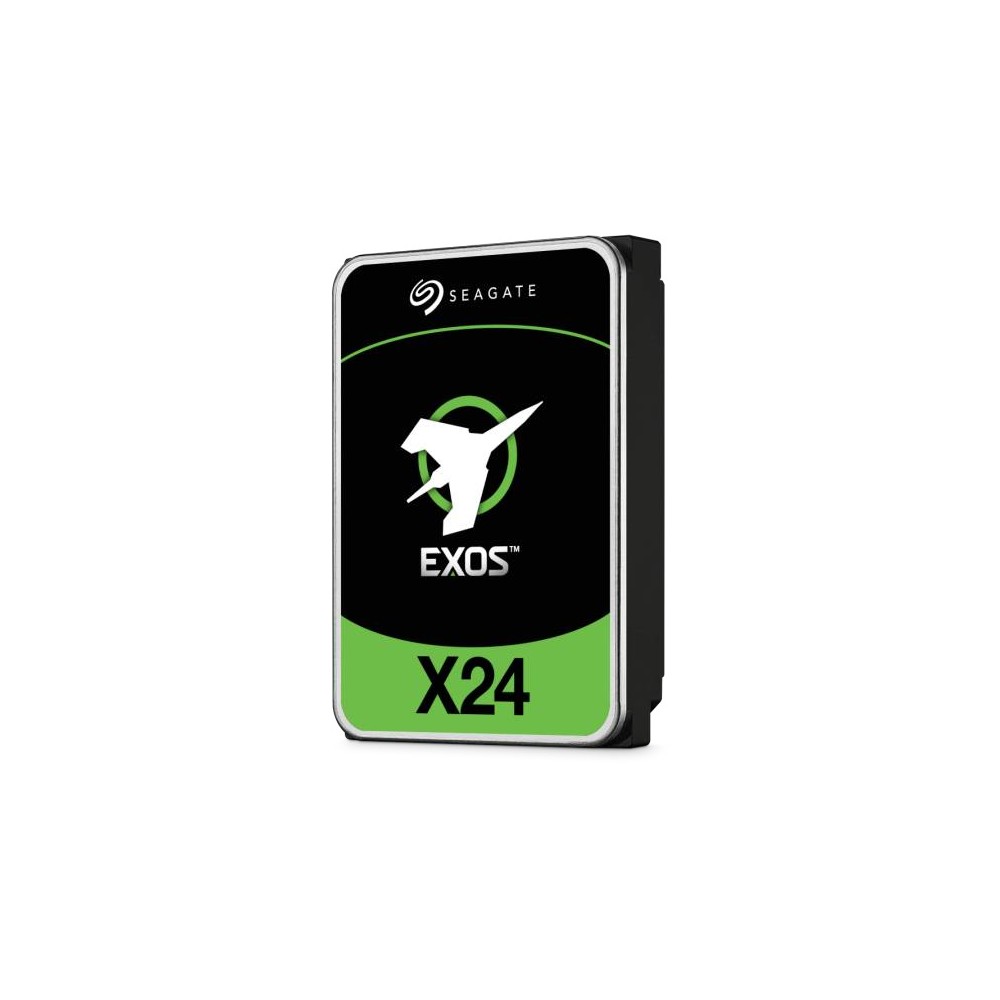
Seagate Exos X24 Enterprise Hard Drive (12TB-24TB)
A helium-sealed 7,200 RPM CMR enterprise hard drive in 12 TB to 24 TB with 512 MB cache, up to 285 MB/s, 2.5 million hours MTBF and a five-year warranty.
Full Specification Sheet
| Type | Internal HDD, enterprise / data centre |
|---|---|
| Interface | SATA 6 Gb/s (SAS 12 Gb/s versions also listed) |
| Form Factor | 3.5-inch (26.1 x 101.85 x 147 mm), 685 g |
| Capacities | 12 TB, 16 TB, 20 TB, 24 TB |
| Recording Technology | CMR |
| Drive Design | Helium sealed |
| Spindle Speed | 7,200 RPM |
| Cache | 512 MB |
| Max. Sustained Transfer Rate | 285 MB/s (272 MiB/s) |
| Random Read / Write 4K QD16 (write cache disabled) | 168 / 550 IOPS |
| Sector Format | 512e / 4Kn (FastFormat) |
| MTBF | 2,500,000 hours |
| Annualized Failure Rate (24x7) | 0.35% |
| Power | Idle 6.3 W average; max operating (random read/write) 8.9 / 7.1 W |
| Security | Instant Secure Erase standard; SED and SED-FIPS models available |
| Operating Temperature | 5 C ambient minimum to 60 C drive-reported maximum |
| Warranty | 5-year limited |
The Seagate Exos X24 is an enterprise-class 3.5-inch hard drive built for data centres, cloud storage and large storage arrays. It combines a helium-sealed design with conventional magnetic recording, a 7,200 RPM spindle and a 512 MB cache, and reaches capacities of up to 24 TB. The data sheet names scalable hyperscale applications and cloud data centres, high-density RAID storage and enterprise backup among its best-fit uses. This page summarises that data sheet for the SATA models. We have not tested the drives, and we publish no prices or measurements of our own.
Capacities and interfaces
The data sheet lists four capacities, 12 TB, 16 TB, 20 TB and 24 TB, each with a SATA 6 Gb/s interface, and a separate table of SAS 12 Gb/s versions for servers and storage systems with SAS controllers. The standard SATA models are the ST24000NM002H, ST20000NM002H, ST16000NM002H and ST12000NM002H. All measure 26.1 by 101.85 by 147 millimetres, the normal 3.5-inch format, and the weight is given as 685 grams. This page describes the SATA versions, which are the ones that also fit ordinary PCs and NAS enclosures.
Performance
The maximum sustained transfer rate at the outer diameter is 285 MB/s, or 272 MiB/s, for the capacities shown. Unlike consumer drive sheets, the document also gives random performance: 168 IOPS for reads and 550 IOPS for writes with 4 KB blocks at a queue depth of 16 with the write cache disabled. These numbers illustrate the nature of any hard disk. Sequential throughput is high, which is ideal for large files, backups and video, but random access is thousands of times slower than on an SSD, because the heads must physically move for each request. Our guide SSD vs HDD: do you still need a hard drive? explains how the two technologies complement each other.
Helium, CMR and sector formats
The Exos X24 is helium-sealed. The low density of helium reduces turbulence and drag inside the drive, which allows more platters in the housing and lowers power draw; the data sheet mentions proven side-sealing weld technology for robustness. Recording is conventional (CMR), so there are no shingled-recording penalties when data is rewritten or a RAID array is rebuilt. The drives ship in 512e format and can be switched to 4Kn with Seagate's FastFormat routine. A footnote warns that this conversion deletes all data on the drive, so it must be done before the drive is put into service.
Reliability ratings
Reliability is specified at enterprise level. Mean time between failures is 2.5 million hours, the annualised failure rate under full 24x7 operation is 0.35 percent, and the drives are rated for 8,760 power-on hours per year. Non-recoverable read errors are specified at fewer than one per 10 to the power of 15 bits read. The limited warranty is five years. Such figures describe the statistical behaviour of large populations of drives in controlled data-centre conditions and are not a promise for an individual unit, which is why redundancy and backups remain necessary.
Power management
Average idle power is listed as 6.3 watts, and maximum operating power during random reads and writes as 8.9 and 7.1 watts. Two Seagate technologies are named: PowerChoice, which provides several idle modes that trade response time for lower consumption, and PowerBalance, which lets operators tune the balance between power use and performance and, according to the data sheet, optimises watts per terabyte. In a single PC these features matter little, but across hundreds of drives they have a measurable effect on electricity and cooling costs.
Security features
The standard models support Seagate Instant Secure Erase, which renders the stored data unreadable in seconds by destroying the internal encryption key, a practical way to retire or repurpose drives. Self-encrypting (SED) and FIPS-validated SED models are listed as well, with the note that they are available through franchised authorised distributors and may require a TCG-compliant host or controller. The data sheet also mentions RSA 3072 firmware verification, which protects against tampered firmware, and hot-plug support.
Environment
The operating temperature range runs from a minimum ambient temperature of 5 °C to a maximum drive-reported temperature of 60 °C. The drive is specified for rotational vibration of 12.5 rad/s² between 20 and 1,500 Hz, a sign that it is meant to operate in chassis packed with many drives. Enterprise 7,200 RPM drives are generally louder than desktop models, and adequate airflow is essential.
How it compares in our database
In our storage section, the direct counterpart is the WD Gold Enterprise Class SATA HDD family, likewise 7,200 RPM CMR drives with an MTBF of up to 2.5 million hours; the page Exos X24 vs WD Gold compares them. Seagate's own IronWolf Pro reaches the same capacity and similar transfer rates, is tuned for NAS systems and includes three years of data recovery service, while the Exos line adds SAS versions, self-encrypting options and data-centre power features.
Who it suits
The Exos X24 is designed for servers, storage arrays and backup systems that run around the clock, and for organisations that need the lowest cost per terabyte at high capacity. Enthusiasts also use such drives in large home servers and NAS systems, where their capacity and reliability ratings are attractive. For a desktop PC that is switched on a few hours a day, a desktop drive is quieter and cheaper, and for a small home NAS a NAS-class drive is the more natural fit.
Planning tips
Before buying for a NAS, check the manufacturer's compatibility list for the exact model number. Decide on the sector format before deployment, since changing it later erases the drive. With drives of this size, plan redundancy carefully, because rebuilding a 20 TB or 24 TB member takes a long time. And keep an independent backup of important data; our article on backup strategies with NAS and external drives outlines the options.
What the data sheet does not say
The extract of the data sheet we rely on did not let us read the workload rating and acoustic figures with certainty, so they are not quoted here. Capacities other than the four listed are not covered. Prices vary by country, distributor and capacity and are not listed on this page.