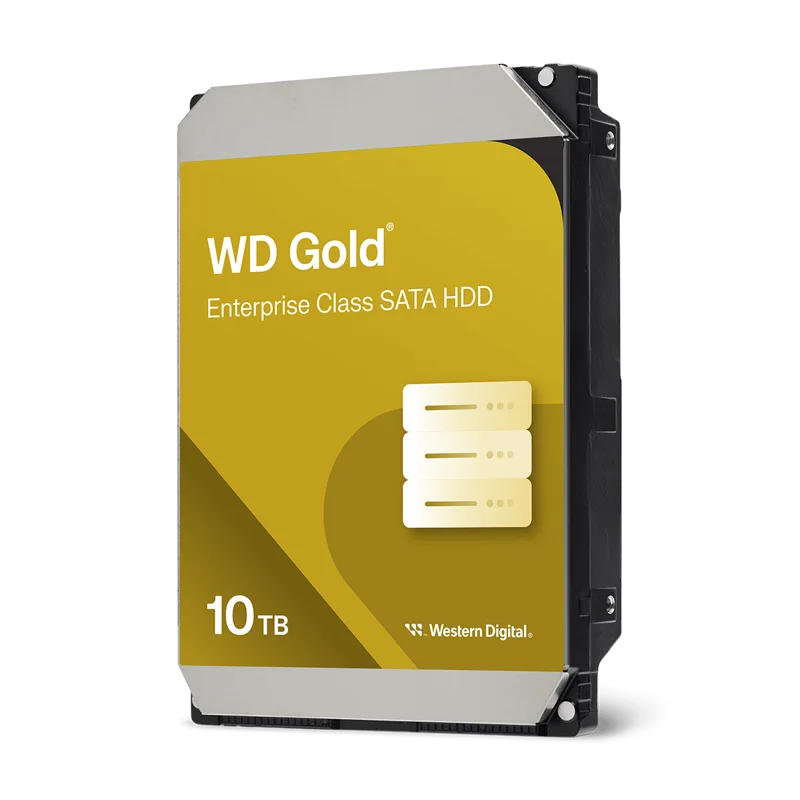
Western Digital WD Gold Enterprise Class SATA HDD (4TB-26TB)
A family of enterprise-class 3.5-inch SATA hard drives from 4 TB to 26 TB, CMR at 7200 RPM, with 256 or 512 MB of cache, up to 291 MB/s, a 550 TB per year workload rating, up to 2.5 million hours MTBF and a five-year warranty.
Full Specification Sheet
| Type | Internal HDD, enterprise class |
|---|---|
| Capacities | 4, 6, 8, 10, 12, 14, 16, 18, 20, 22, 24, 26 TB |
| Interface | SATA |
| Form Factor | 3.5-inch |
| Spindle Speed | 7200 RPM |
| Recording Technology | CMR |
| Cache | 256 MB (4-8 TB and WD121KRYZ) or 512 MB (other models) |
| Transfer Rate | Up to 255 to 291 MB/s depending on model |
| Workload Rate | Up to 550 TB/year |
| MTBF | Up to 2.5 million hours |
| Technologies | HelioSeal, ArmorCache, OptiNAND |
| Warranty | 5-year limited |
| Operating Temperature | 5 to 60 C |
| Non-Operating Temperature | -40 to 70 C |
| Dimensions | 5.79 x 4 x 1.03 inches |
| Weight | 750 g (listed for all models) |
| Model Numbers | WD4004FRYZ, WD6004FRYZ, WD8005FRYZ, WD103KRYZ, WD121KRYZ, WD122KRYZ, WD142KRYZ, WD161KRYZ, WD181KRYZ, WD203KRYZ, WD221KRYZ, WD242KRYZ, WD261KRYZ |
The WD Gold line is Western Digital's enterprise-class 3.5-inch SATA hard drive family. Western Digital's page presents it as storage for businesses, design professionals and deskside AI: drives that provide the capacity, durability and performance for running AI models locally, storing large datasets and 4K or 8K video on site, and keeping sensitive data under your control. The page lists thirteen models from 4 TB to 26 TB, so, as with other families in our database, this entry is a family row rather than a single capacity; the capacity and the model number identify the exact drive you buy. The manufacturer page lists no price, so none is given, and it does not state a launch date. We have not tested the drives. Everything below is the manufacturer's published information, with a few clearly marked pieces of arithmetic.
What the drive is for
Western Digital positions Gold for servers, edge computing, workstations, RAID environments and other enterprise storage where performance, durability and scalability matter. The page describes use cases such as video editing, photography, audio, filming and data centre work, and an additional-details field mentions cloud applications and distributed file systems such as Apache Hadoop, bulk object storage such as Ceph and OpenStack Swift, direct and network-attached storage, RAID storage, industrial applications and entry server storage. The company's own comparison with the WD Red Pro, which is in our database as a separate entry, is that Gold is optimised for heavy, continuous enterprise workloads including mixed read and write applications and high-uptime servers, while Red Pro is tuned specifically for multi-user NAS. The page says Gold offers broader workload flexibility than purely file-sharing NAS use. If you want to understand the array level you would run these drives in, our explainer on RAID levels for NAS and server storage covers the options.
Recording technology, speed and cache
Every model uses conventional magnetic recording (CMR), which the page says helps deliver consistent performance and predictable operation, and a spindle speed of 7200 RPM. The cache is 256 MB on the 4, 6 and 8 TB drives and on the 12 TB model WD121KRYZ, and 512 MB on the other models. The listed transfer rate rises with capacity: up to 267 MB/s on the 4, 6, 8 and 10 TB models and on one of the two 12 TB models, 255 MB/s on the 256 MB 12 TB model, 262 MB/s on the 14 and 16 TB models, 269 MB/s on 18 TB and 291 MB/s on the 20, 22, 24 and 26 TB models. These are maximum sequential figures from a manufacturer table, not average speeds. A little arithmetic puts the capacity in context: reading a full 4 TB drive at 267 MB/s takes about 4.2 hours, while a full 26 TB drive at 291 MB/s takes about 24.8 hours (capacity divided by transfer rate, ideal conditions), which is why rebuild times for very large drives are a real planning factor in RAID.
Endurance, reliability and warranty
Western Digital rates the whole family for workloads of up to 550 TB per year, a mean time between failures of up to 2.5 million hours and a five-year limited warranty. The footnotes add useful limits. The MTBF is based on a sample population and statistical estimation under typical conditions of a 220 TB per year workload and a drive temperature of 40 degrees Celsius, and it is derated above those parameters up to 550 TB per year and 60 degrees. The company also says MTBF does not predict an individual drive's reliability and is not a warranty. The workload rate is defined as the amount of user data transferred to or from the drive, annualised. A quick conversion helps: 550 TB per year is about 1.5 TB per day, which equals roughly 21 full-drive transfers a year on a 26 TB model, or 137 on a 4 TB model (arithmetic). For a related concept on solid-state storage, see SSDs versus hard drives in 2026.
Technologies named on the page
The page names HelioSeal, ArmorCache and OptiNAND for the family. HelioSeal is described as delivering higher storage density, better thermal efficiency and proven reliability for high-capacity CMR drives, and the 26 TB model is described as built on the world's first 11-disk HDD platform with the tenth generation of HelioSeal. ArmorCache is described as a Western Digital feature that gives enterprise power-loss protection when the write cache is enabled and a performance boost when the write cache is disabled. One inconsistency deserves a flag: the feature text says ArmorCache is available in 22 TB and above, while the specification table lists ArmorCache under technologies for every capacity, including 4 TB. We follow the feature text for the claim about which models have it and tell you plainly that the table is broader. The page also mentions rotational vibration sensors that anticipate and counteract disturbances in multi-drive environments.
Physical and environmental data
The drive is a 3.5-inch unit with listed dimensions of 5.79 by 4 by 1.03 inches, which converts to about 147 by 101.6 by 26.2 mm, the standard 3.5-inch drive footprint, and a listed weight of 750 grams for every model (a single figure for the whole family, which we treat as approximate). The operating temperature range is 5 to 60 degrees Celsius, and the non-operating range is minus 40 to 70 degrees. The page lists a long set of regulatory certifications, among them BSMI, CE, FCC, KC, RCM, UKCA, VCCI, TUV and UL. Compatibility is listed as Windows, Windows Server, Linux and macOS. The page does not list power consumption, idle or seek figures, or acoustic levels, so we do not either. For a very large drive in a home workstation, the missing noise data is worth noting.
Where it sits in our database
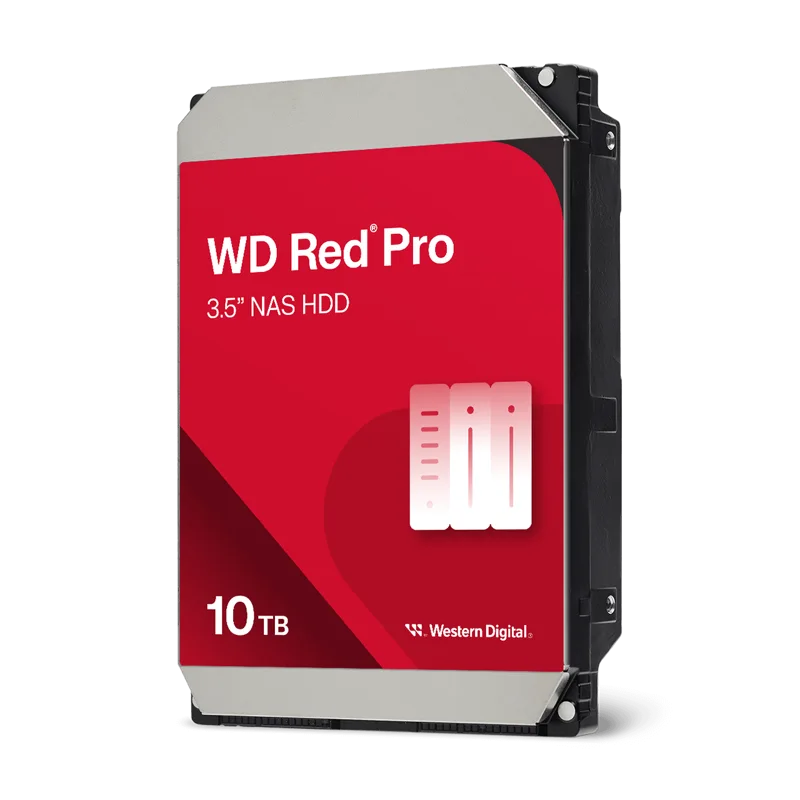
Within the storage category, Gold is the heavy-duty end of the hard drive range. The WD Red Pro NAS hard drive family is the closest relative, with the same 4 to 26 TB span, 7200 RPM, CMR and 550 TB per year workload rating, tuned for NAS rather than general enterprise use; the side-by-side comparison of WD Gold and WD Red Pro sets their fields next to each other. At the other end, the WD Red 4 TB NAS hard drive already in the database lists a 5400 RPM spindle and a 64 MB cache, which shows how far the enterprise drives have moved in speed and cache. Browse the full storage category for solid-state and portable options too.
What the page does not say
The page does not list a price for the family, a launch date, a power or noise figure, the number of platters per model or the exact capacity of each model beyond the headline. Dimensions are given in inches, and the same weight is printed for every capacity, which suggests it is nominal. The page's feature copy and its specification table disagree about ArmorCache, as explained above. For a purchase, confirm the exact model number, the cache size and the warranty terms for your region with Western Digital or an authorised seller.