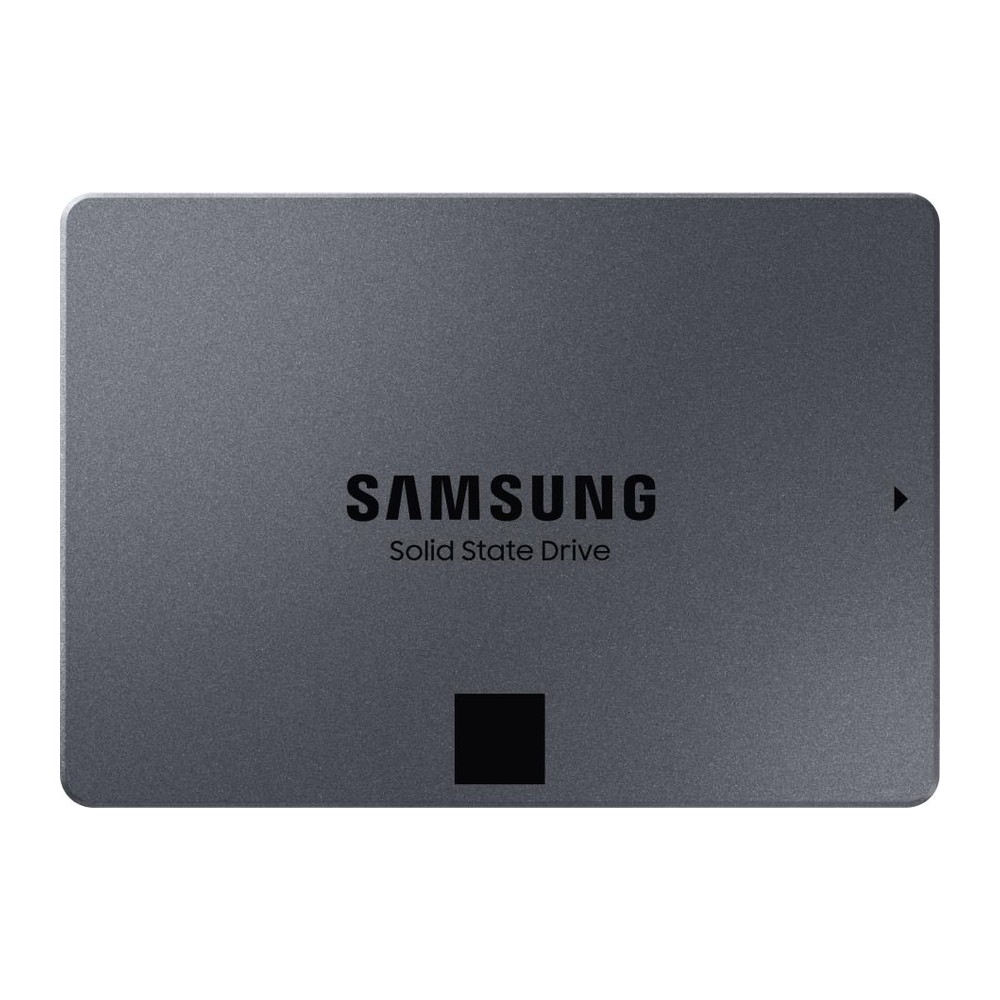
Samsung 870 QVO SATA SSD (1TB-8TB)
A high-capacity 2.5-inch SATA SSD with QLC V-NAND in 1 TB to 8 TB, rated up to 560/530 MB/s within its write buffer, up to 2,880 TBW and a three-year warranty.
Full Specification Sheet
| Type | Internal SSD, SATA (client) |
|---|---|
| Interface | SATA 6 Gb/s (compatible with SATA 3 Gb/s and 1.5 Gb/s) |
| Form Factor | 2.5-inch, 100 x 69.85 x 6.8 mm |
| Capacities | 1 TB, 2 TB, 4 TB, 8 TB |
| Controller | Samsung MKX |
| NAND | Samsung 4-bit MLC V-NAND (QLC) |
| DRAM Cache | 1 GB (1 TB), 2 GB (2 TB), 4 GB (4 TB), 8 GB (8 TB) LPDDR4 |
| Sequential Read / Write | Up to 560 / 530 MB/s (write after TurboWrite: 80 MB/s for 1 TB, 160 MB/s for 2-8 TB) |
| Random 4K (QD32) | Up to 98,000 read / 88,000 write IOPS |
| Random 4K (QD1) | Up to 11,000 read / 35,000 write IOPS |
| Endurance (TBW) | 360 TB (1 TB), 720 TB (2 TB), 1,440 TB (4 TB), 2,880 TB (8 TB) |
| Power (active read/write, avg.) | 2.1/2.2 W (1 TB), 2.1/3.0 W (2 TB), 2.2/3.2 W (4 TB), 2.4/3.3 W (8 TB) |
| Encryption | AES 256-bit, TCG Opal 2.0, IEEE 1667 |
| Operating Temperature | 0 to 70 C |
| MTBF | 1,500,000 hours |
| Warranty | 3-year limited (or TBW, whichever comes first) |
The Samsung 870 QVO is a SATA solid-state drive designed around capacity. It uses Samsung's 4-bit MLC V-NAND, the flash type commonly called QLC, which stores four bits in every cell and therefore packs more data into the same amount of silicon than TLC. The result is a 2.5-inch drive family that starts at 1 TB and goes up to 8 TB, a size that until recently was the preserve of hard disks. Samsung describes it as its second generation of QLC-based client SSDs, built with the MKX controller. This page summarises the data sheet. We have not tested the drive, and we publish no prices or measurements of our own.
Capacity and format
Four capacities are offered: 1 TB, 2 TB, 4 TB and 8 TB. All share the same 2.5-inch housing of 100 by 69.85 by 6.8 millimetres and the SATA 6 Gb/s interface, which is backward compatible with 3 Gb/s and 1.5 Gb/s ports. The data sheet points out that 8 TB in a 7-millimetre 2.5-inch body exceeded the largest 2.5-inch hard disks at the time of launch. For a laptop or a small-form-factor PC with a single drive bay, that is a significant amount of silent, shock-resistant storage. Our guide SSD vs HDD: do you still need a hard drive? discusses when flash can replace spinning disks.
Performance: fast inside the buffer, slower outside
On paper the 870 QVO matches other SATA SSDs: up to 560 MB/s sequential read and up to 530 MB/s sequential write, with random 4 KB performance of up to 98,000 IOPS read and 88,000 IOPS write at queue depth 32, and 11,000 IOPS read and 35,000 IOPS write at queue depth 1. These figures apply while the drive is using its Intelligent TurboWrite buffer, a region of flash that temporarily operates in a faster mode.
What sets the data sheet apart is that it also states the performance once that buffer is exhausted. Sequential writing then drops to 80 MB/s on the 1 TB model and 160 MB/s on the 2 TB, 4 TB and 8 TB models. Random performance after TurboWrite is given as 5,000 IOPS for reads at queue depth 1 on all capacities. This is the fundamental trade-off of QLC flash. In everyday use, where writes come in small bursts and the drive has time to clear its buffer, the reduced speed is rarely encountered. During a long, uninterrupted copy of tens or hundreds of gigabytes, it will be, and throughput can then fall to a level similar to or below that of a hard disk.
Controller and cache
The MKX controller is paired with a generous LPDDR4 DRAM cache that scales with capacity: 1 GB for the 1 TB model, 2 GB for 2 TB, 4 GB for 4 TB and 8 GB for 8 TB. A full-size DRAM cache keeps the address mapping table in fast memory and helps the drive remain responsive when it holds a lot of data, which is exactly the situation a high-capacity drive is bought for.
Endurance and warranty
Total bytes written are 360 TB for 1 TB, 720 TB for 2 TB, 1,440 TB for 4 TB and 2,880 TB for 8 TB, which corresponds to 360 full drive writes in each case. The limited warranty lasts three years or until the TBW value is reached, whichever comes first. Both figures are lower than those of TLC-based drives, which typically offer five years, but the absolute endurance of the larger models is still very high for a drive used mainly to store data that changes rarely. Mean time between failures is 1.5 million hours. For more on how to read these ratings, see our article TBW endurance ratings explained.
Power consumption
The data sheet lists average active power for reading and writing as 2.1 and 2.2 watts for the 1 TB model, 2.1 and 3.0 watts for 2 TB, 2.2 and 3.2 watts for 4 TB, and 2.4 and 3.3 watts for 8 TB. Idle power with device-initiated power management is 30 milliwatts for 1 TB and 2 TB, 35 milliwatts for 4 TB and 45 milliwatts for 8 TB, and the device sleep state draws between 3 and 10 milliwatts. These are low values in comparison with a 3.5-inch hard disk, which typically needs several watts simply to keep its platters spinning.
Security and software
AES 256-bit full-disk encryption, TCG Opal 2.0 and IEEE 1667 Encrypted Drive are supported, along with TRIM, garbage collection and S.M.A.R.T. Samsung's Magician management software and its Data Migration cloning tool support the 870 QVO; the data sheet highlights a custom cloning function that can migrate a system even when the source holds more data than the new drive can take.
How it compares in our database
The natural counterpart in our storage section is the Samsung 870 EVO, which uses TLC flash, keeps its write speed on the larger capacities after the buffer is full and carries a five-year warranty, but stops at 4 TB in the data sheet we use. The page 870 QVO vs 870 EVO shows the differences line by line. Against a desktop hard disk such as the WD Blue PC Desktop Hard Drive, the QVO offers far better random access and no moving parts, while hard disks keep an advantage in the cost of very large capacities.
Who it suits
The 870 QVO is a good match for a games library, a photo and video archive, a media server or any other collection of large files that is written once and read many times. It also suits laptop owners who want as much internal storage as possible in a single bay. It is less suitable as a scratch disk for video editing, for frequent large backups in a short window, or for any workload that writes continuously for long periods, where a TLC drive is the safer choice.
Practical advice
When buying, consider the 2 TB model or larger if sustained write speed matters at all, since the 1 TB version is rated at only 80 MB/s after its buffer. Leaving a portion of the drive unused helps any SSD maintain its performance, and it is particularly worthwhile with QLC. For the initial transfer of an existing archive, plan for it to take a while and let the drive rest afterwards, and performance in normal use should then be as expected.
What the data sheet does not say
The size of the TurboWrite buffer for each capacity is not given in the part of the data sheet we rely on, so we cannot say how many gigabytes can be written at full speed. No release date is stated. Prices vary by country, retailer and capacity and are not listed here.