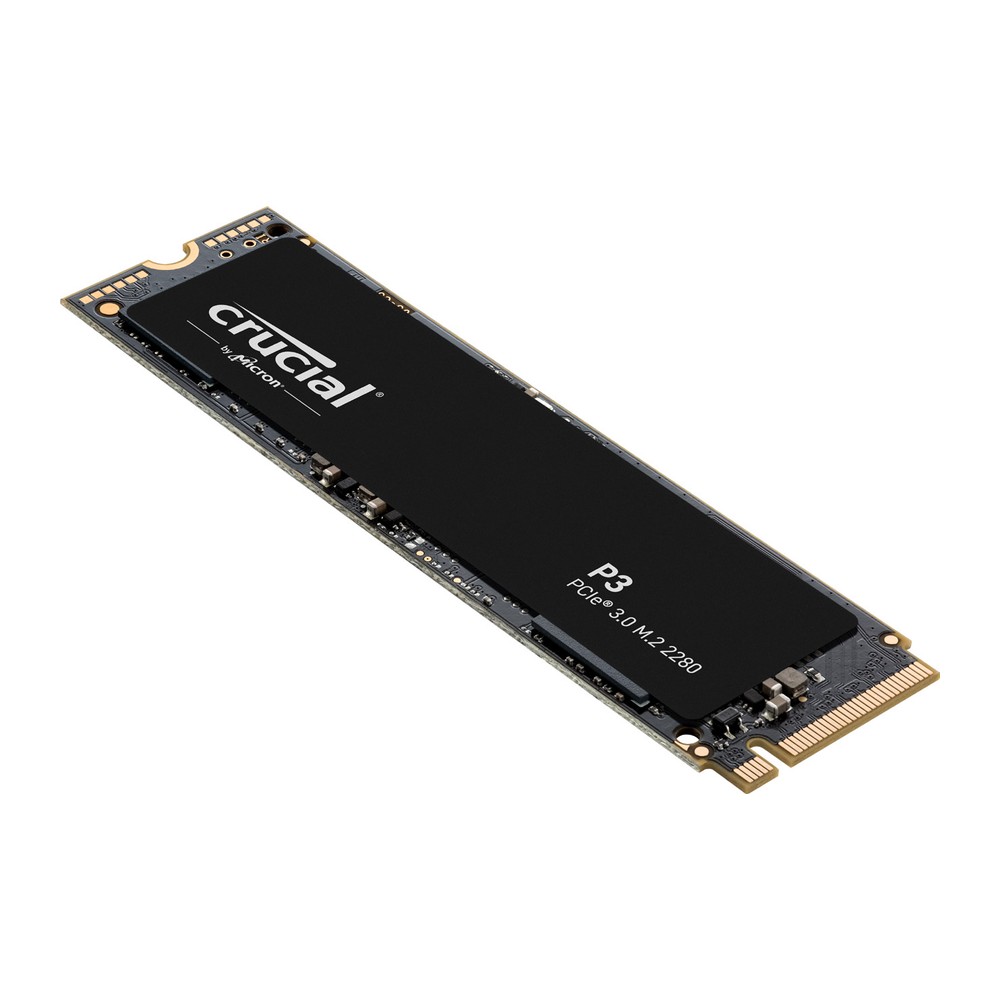
Crucial P3 NVMe SSD (500GB-4TB)
A value PCIe 3.0 NVMe SSD in M.2 2280 with 500 GB to 4 TB, rated up to 3,500/3,000 MB/s, up to 800 TBW and a five-year limited warranty.
Full Specification Sheet
| Type | Internal SSD, NVMe (client) |
|---|---|
| Interface | PCIe 3.0, NVMe |
| Form Factor | M.2 2280 |
| Capacities | 500 GB, 1 TB, 2 TB, 4 TB |
| NAND | Micron Advanced 3D NAND (launched with 176-layer NAND) |
| Sequential Read / Write | Up to 3,500 / 3,000 MB/s (write up to 1,900 MB/s on 500 GB) |
| Endurance (TBW) | 110 TB (500 GB), 220 TB (1 TB), 440 TB (2 TB), 800 TB (4 TB) |
| Features | Dynamic write acceleration, RAIN, multistep data integrity algorithm, adaptive thermal protection, integrated power loss immunity, TRIM, SMART, ECC, device sleep |
| Software | Crucial Storage Executive, Acronis True Image for Crucial |
| Operating Temperature | 0 to 70 C |
| MTTF | 1,500,000 hours |
| Warranty | 5-year limited (or TBW, whichever comes first) |
The Crucial P3 is Crucial's affordable NVMe drive for systems with PCIe 3.0, offered as an M.2 2280 card in capacities from 500 GB to 4 TB. The product flyer rates it at sequential speeds of up to 3,500 MB/s for reading and 3,000 MB/s for writing, which places it at the top of what the Gen3 interface allows on paper. Crucial builds the drive with Micron's own 3D NAND and backs it with a five-year limited warranty. This page summarises the official flyer. We have not tested the drive, and we give no prices or measurements of our own.
Interface and format
The P3 is a PCIe 3.0 NVMe drive in the M.2 2280 format, 22 millimetres wide and 80 millimetres long, which is the size accepted by the great majority of desktop motherboards and laptops. It works in any M.2 slot that supports NVMe. In newer PCIe 4.0 or 5.0 slots it operates at its own Gen3 speed, so nothing is lost by installing it in a modern system, and nothing is gained either. Many motherboards share PCIe lanes or SATA ports between their M.2 slots and other connectors; our article on PCIe lane sharing explains what to check in the manual before adding a second drive.
Performance figures
The flyer lists sequential reads of up to 3,500 MB/s and sequential writes of up to 3,000 MB/s for the family, with a lower write figure of 1,900 MB/s for the 500 GB model. According to the footnote, these are typical values measured with CrystalDiskMark with the command queue full, the write cache enabled and the drive in a fresh, out-of-box state. Crucial compares the P3 with its predecessor, the P2, which was rated at up to 2,400 and 1,900 MB/s, so the newer model represents a clear step in sequential speed.
Random read and write performance in IOPS is not published in the flyer. Among the listed features is dynamic write acceleration, Crucial's name for a fast write buffer; as with all drives that use this technique, write speed will be lower during long transfers once the buffer has been filled. The flyer gives no figure for that sustained speed.
NAND and what is not specified
The memory is described as Micron Advanced 3D NAND, and the flyer notes that the drive launched with Micron's 176-layer NAND. It adds that Micron reserves the right to transition between NAND series during future production cycles, so later batches may use a different generation. The flyer does not state how many bits are stored per cell, does not name the controller and does not say whether the drive has a DRAM cache. We therefore do not make claims on those points. Buyers who need certainty about cell type or cache design for a demanding workload should consult the current datasheet for the specific part number.
Endurance and warranty
Total bytes written are 110 TB for the 500 GB model, 220 TB for 1 TB, 440 TB for 2 TB and 800 TB for 4 TB. That is 220 full drive writes for the three smaller capacities and 200 for the 4 TB model, noticeably lower than the 600 drive writes typical of premium TLC drives. For a home or office PC, or a games library that is mostly read, the rating is still more than sufficient: writing 30 GB every day would take about twenty years to reach 220 TB. The limited warranty is valid for five years from purchase or until the TBW figure recorded in the drive's SMART data is reached, whichever comes first. Mean time to failure is given as 1.5 million hours.
Reliability features
The flyer lists a set of protective functions: Redundant Array of Independent NAND (RAIN), which stores parity data inside the drive; a multistep data integrity algorithm; error correction code; adaptive thermal protection, which adjusts activity when the drive becomes hot; and integrated power loss immunity, intended to protect data at rest if power is interrupted. Active garbage collection, TRIM, SMART reporting and device sleep are supported. The operating temperature range is 0 to 70 °C.
Software
Crucial supports the P3 with its Storage Executive utility for monitoring, performance optimisation and firmware updates, and with Acronis True Image for Crucial, a cloning tool that copies an existing system to the new drive. An installation guide is available as well.
How it compares in our database
In our storage section, the natural comparison is with the Samsung 980, another entry-level PCIe 3.0 drive. The Samsung states TLC flash, hardware encryption and higher endurance per gigabyte, but ends at 1 TB, while the Crucial reaches 4 TB. The page Crucial P3 vs Samsung 980 shows both specifications. The Kingston NV3 is a similar value concept on PCIe 4.0.
Who it suits
The P3 is designed for people who want to move from a hard disk or SATA SSD to NVMe at low cost, particularly in systems limited to PCIe 3.0, and for anyone looking for a large second drive for games and media. The 2 TB and 4 TB versions are attractive where capacity per slot matters. It is less suited to heavy write workloads such as daily video editing or large scratch files, where higher endurance and documented sustained performance are important. Our NVMe SSD buying guide helps to weigh these criteria.
Installation tips
Insert the card into the M.2 slot at an angle, press it flat and secure it with the screw or latch. A heatsink is not included; the drive's thermal protection will slow it down if necessary, and a motherboard M.2 cover helps during long copy jobs. When choosing a capacity, avoid the 500 GB model if write speed matters, since it is rated well below the others.
What the flyer does not say
Beyond the missing cell type, controller and cache details, the flyer gives no random IOPS, no power consumption values and no release date, and it notes that not all capacities were available at initial launch. Prices vary by country, retailer and capacity and are not listed on this page.