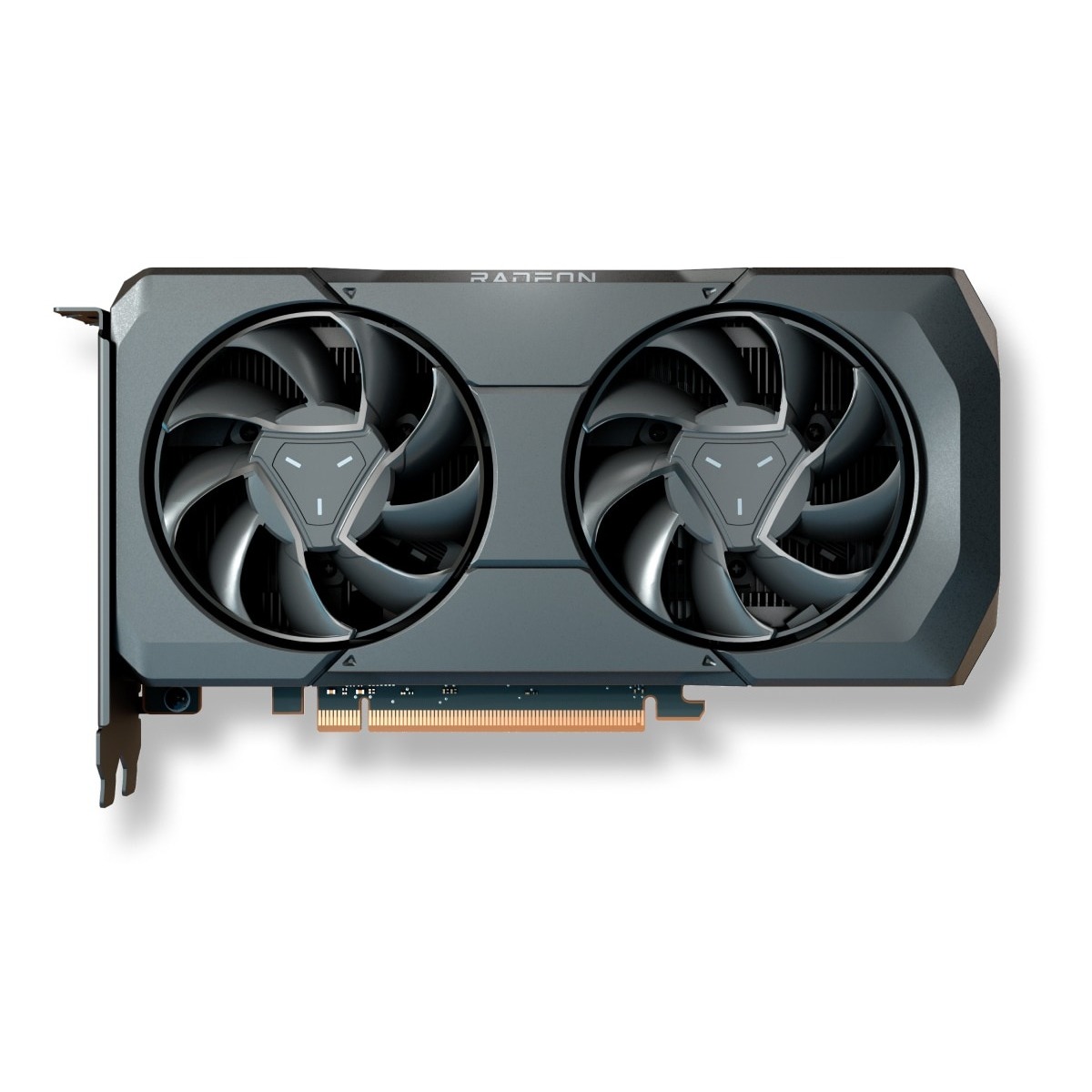
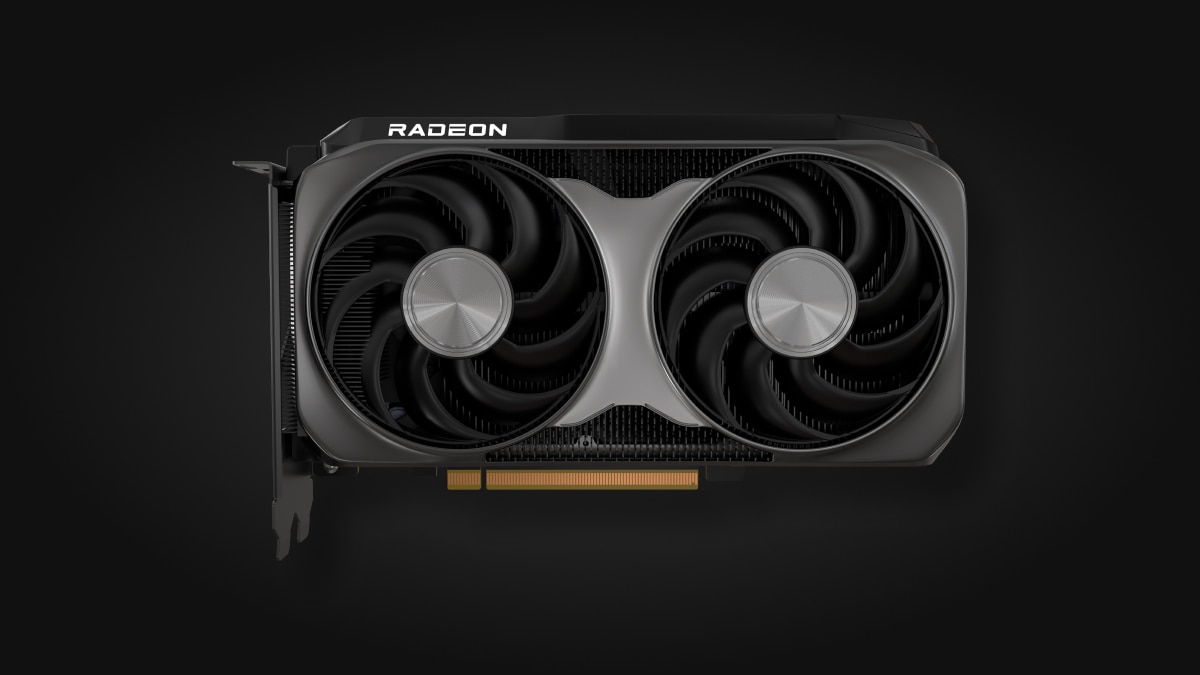
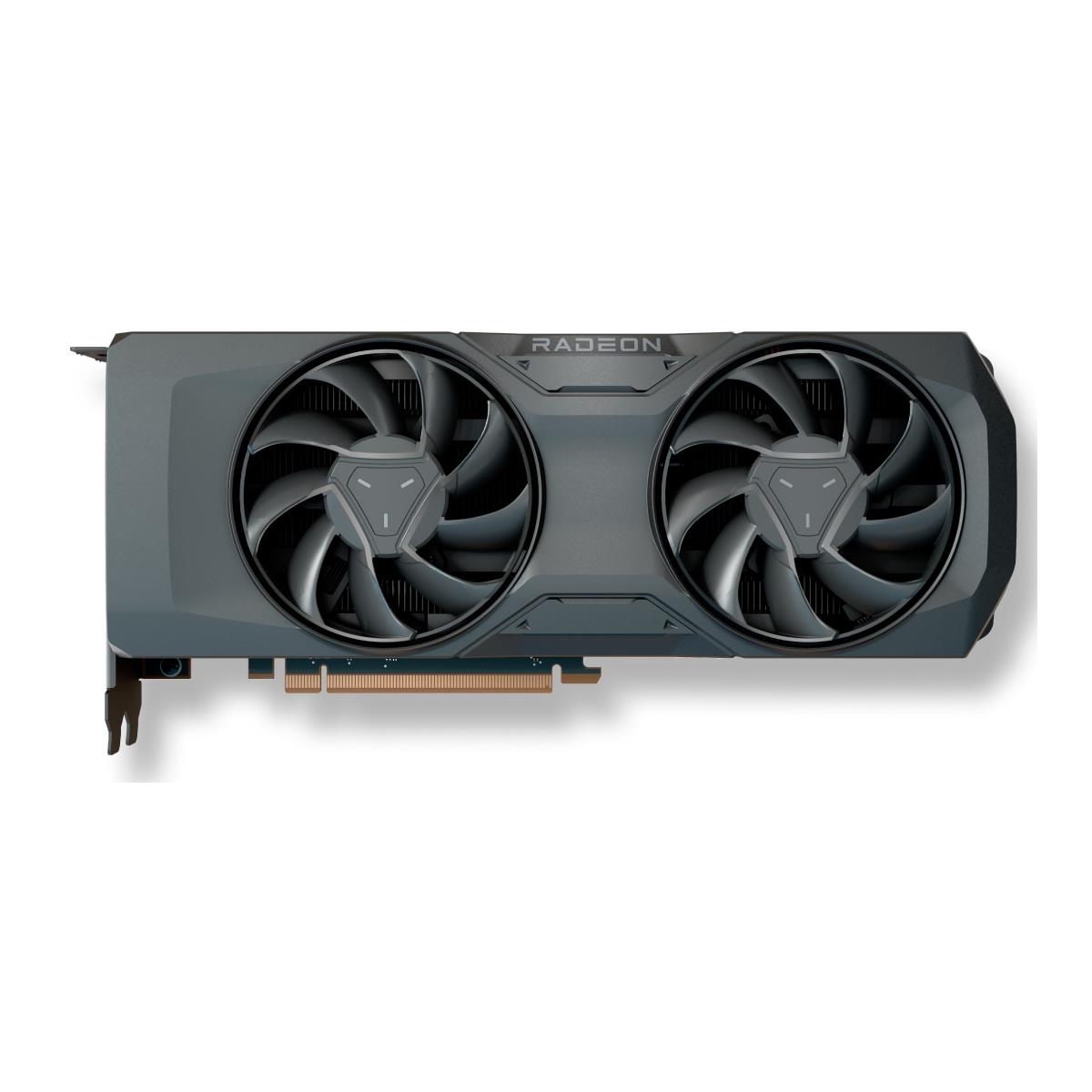
AMD Radeon RX 7800 XT
A Radeon RX 7000 Series graphics card with 60 compute units, 16 GB of GDDR6 on a 256-bit bus, 64 MB of AMD Infinity Cache, a 263 W typical board power and DisplayPort 2.1.
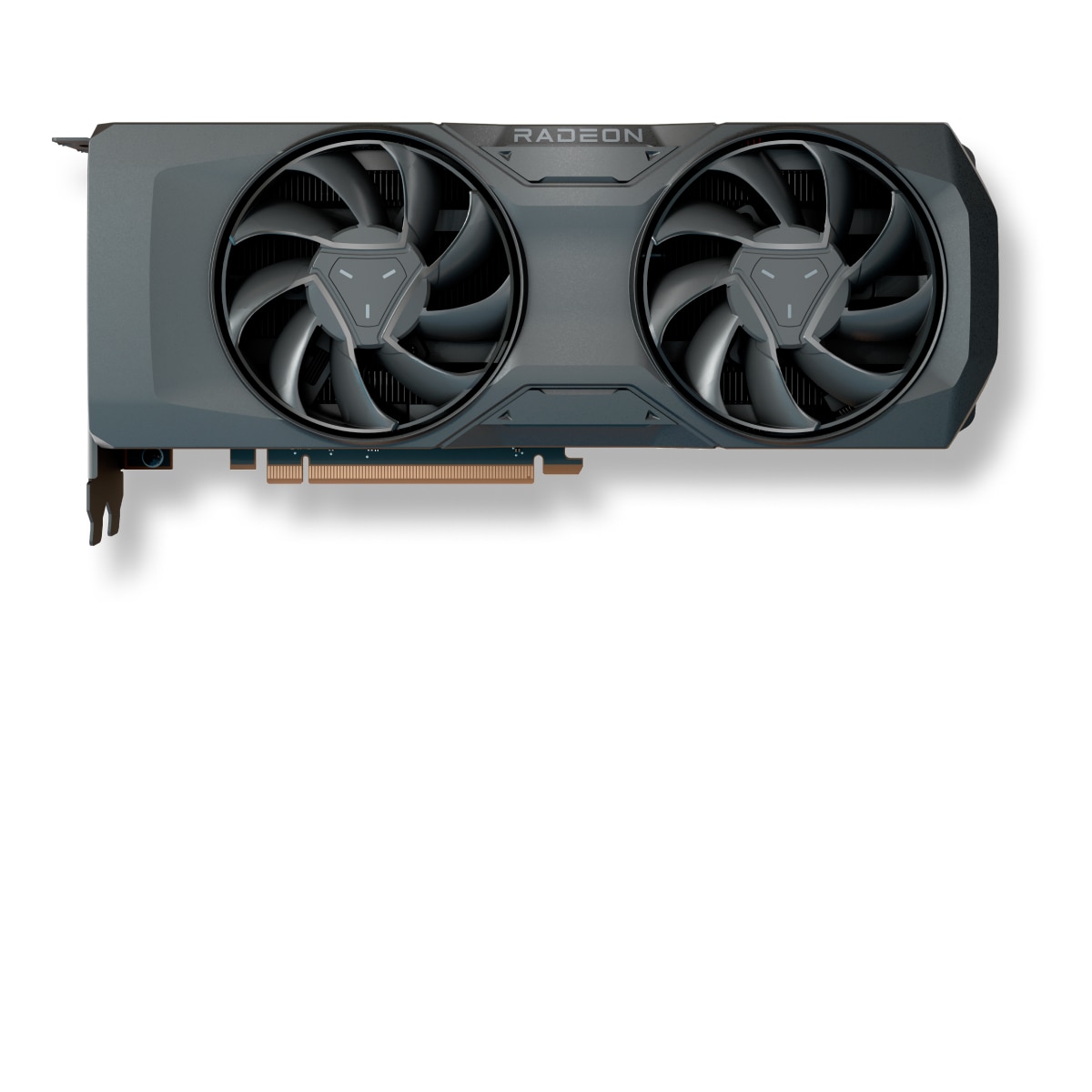
Full Specification Sheet
| Series | Radeon RX 7000 Series (AMD RDNA architecture) |
|---|---|
| Compute Units | 60 |
| Stream Processors | 3840 |
| Ray Accelerators | 60 |
| AI Accelerators | 120 |
| Boost Clock | Up to 2430 MHz |
| Game Clock | 2124 MHz |
| Memory | 16 GB GDDR6, 256-bit |
| Memory Speed | Up to 19.5 Gbps |
| Memory Bandwidth | Up to 624 GB/s |
| Infinity Cache | 64 MB |
| Typical Board Power | 263 W |
| Power Connectors | 2 x 8-pin |
| Minimum PSU Recommendation | 700 W |
| Outputs | DisplayPort 2.1, HDMI 2.1 |
| Length / Slots | 267 mm / 2.5 slots |
The AMD Radeon RX 7800 XT is a desktop graphics card from the Radeon RX 7000 Series, built on the AMD RDNA architecture. AMD's page lists it with 60 compute units, 3,840 stream processors and 16 GB of GDDR6 memory on a 256-bit interface. It is a two-and-a-half slot, 267 mm card that draws power through two 8-pin connectors and lists a typical board power of 263 W. This page goes through AMD's published specification, explains what each line means when you are choosing a card, and leaves out anything the manufacturer page does not state. There are no benchmark or test claims here: every figure is a manufacturer specification unless it is marked as simple arithmetic. AMD's page does not give a launch date or a price, so neither appears in this entry.
Compute units, accelerators and clocks
The GPU has 60 compute units. AMD lists 3,840 stream processors, 240 texture units, 96 render output units (ROPs), 60 ray accelerators and 120 AI accelerators. Dividing the totals by the 60 compute units gives 64 stream processors, 4 texture units, 1 ray accelerator and 2 AI accelerators per compute unit; that is arithmetic from AMD's figures, and it is a useful way to compare across cards. Clock speeds are given as two numbers. The boost clock is up to 2430 MHz, which AMD defines as the maximum frequency achievable on the GPU running a bursty workload, and which varies with thermal conditions and with the application. The game frequency is 2124 MHz, which AMD describes as the expected GPU clock when running typical gaming applications at typical total graphics power. The gap between the two is a reminder that the top number is a ceiling rather than an everyday figure. The transistor count is listed as 28.1 billion.
Peak rates AMD publishes
AMD lists theoretical peak figures rather than measured results. Peak pixel fill rate is up to 233 GP/s and peak texture fill rate is up to 583 GT/s. Peak single-precision (FP32 vector) performance is 37.3 TFLOPs, peak half-precision (FP16 vector) performance is also 37.3 TFLOPs and peak FP16 matrix performance is 74.6 TFLOPs. On the integer side, AMD lists 74.6 TOPs for 8-bit matrix work and 149 TOPs for 4-bit matrix work. Peak numbers describe what the hardware could do in ideal conditions and say nothing about how a specific game or application behaves, so treat them as a way to compare hardware on paper, not to predict frame rates. If you want to understand what these upscaling and frame-generation features need from a card, our explainer on DLSS, FSR and frame generation hardware requirements gives the background.
Memory: capacity, bus and bandwidth
The card carries 16 GB of GDDR6 on a 256-bit memory interface, with a memory speed of up to 19.5 Gbps. AMD lists memory bandwidth as up to 624 GB/s, and you can verify the figure yourself: 19.5 Gbps per pin across 256 pins is 4,992 Gbit/s, and dividing by eight gives 624 GB/s. Alongside the raw memory sits AMD Infinity Cache, a 64 MB cache on the GPU. AMD also lists an effective memory bandwidth of up to 2,708 GB/s, a figure that accounts for the cache; the page does not explain the exact method beyond the name, so read it as AMD's own effective-bandwidth metric rather than a physical bus speed. Capacity matters as much as speed in modern games. Sixteen gigabytes is the sort of figure discussed in our guide on VRAM capacity from 8 GB to 24 GB, which explains when a larger frame buffer helps and when it does not.
Power, cooling and dimensions
AMD lists a typical board power of 263 W and two 8-pin additional power connectors. The minimum power supply recommendation is 700 W, with a 12 V output of 54 A. AMD states that this recommendation is based on a PC configured with an AMD Ryzen 9 7950X processor plus typical power requirements for other components, and adds that your own system requirements may differ. That caveat is worth taking seriously: if you use a different processor or more drives and fans, do the sums for your own build. Our guide on how much PSU wattage you need walks through the reasoning. The listed board type is component, which reflects AMD's own page for the reference-style design; add-in-board partners may ship cards with different coolers, lengths and clocks, so check the partner's own specification before buying a specific model. The reference dimensions on the page are 267 mm long and 2.5 slots wide, which is a useful check against your case's clearances.
Display and media capabilities
For outputs, AMD lists DisplayPort 2.1 and HDMI 2.1. It states 4K support for HDMI, and the media engine section lists 4K H.264 decode and encode, H.265/HEVC decode and encode, and AV1 decode and encode, all as supported. AMD notes that certain technologies or features may not be enabled in every operating-system environment, so confirm details with the system manufacturer if you depend on them. If you are thinking about how outputs relate to your monitor, our overview of HDMI 2.1 versus DisplayPort 2.1 on graphics cards compares the two connectors.
Software and supported technologies
AMD's supported-technologies list is long. It names AMD Software: Adrenalin Edition, AMD FSR, AMD Noise Suppression, Radeon FRTC, Radeon Super Resolution, AMD Smart Access Memory, AMD Smart Access Video, AMD Privacy View, Radeon Boost, Radeon Anti-Lag, Radeon Image Sharpening, Enhanced Sync, AMD FreeSync, Radeon Chill and Virtual Super Resolution. Operating-system support covers Windows 11 and Windows 10 in 64-bit editions, plus Ubuntu and Linux x86 64-bit. The resources section points to AMD's driver downloads, the Adrenalin software, the RDNA architecture overview and the HYPR-RX profiles, which AMD describes as a suite of features enabled in one click from the AMD Software home tab. AMD also carries footnotes on its page describing its own testing, including a live-participant test at a trade event and an internal lab comparison of this card and the RX 7700 XT. Those are AMD's claims from AMD's testing; this site does not reproduce or endorse the results.
Reading the specification sensibly
The most useful way to use a specification sheet is to compare like with like. The 60 compute units and 16 GB of memory place this card in a different tier from the Radeon RX 7900 XTX that already has an entry on this site, and different again from the newer Radeon RX 9070, which you can also open on its own page. See the Radeon RX 7900 XTX and the Radeon RX 9070 for the manufacturer's numbers, or open the side-by-side comparison to lay two sets of specifications next to each other. The whole graphics card category lists every card we cover. Whatever you compare, the specification tells you what the hardware is, not how a given game will run on it, and real-world results depend on your processor, memory, resolution, settings and drivers.