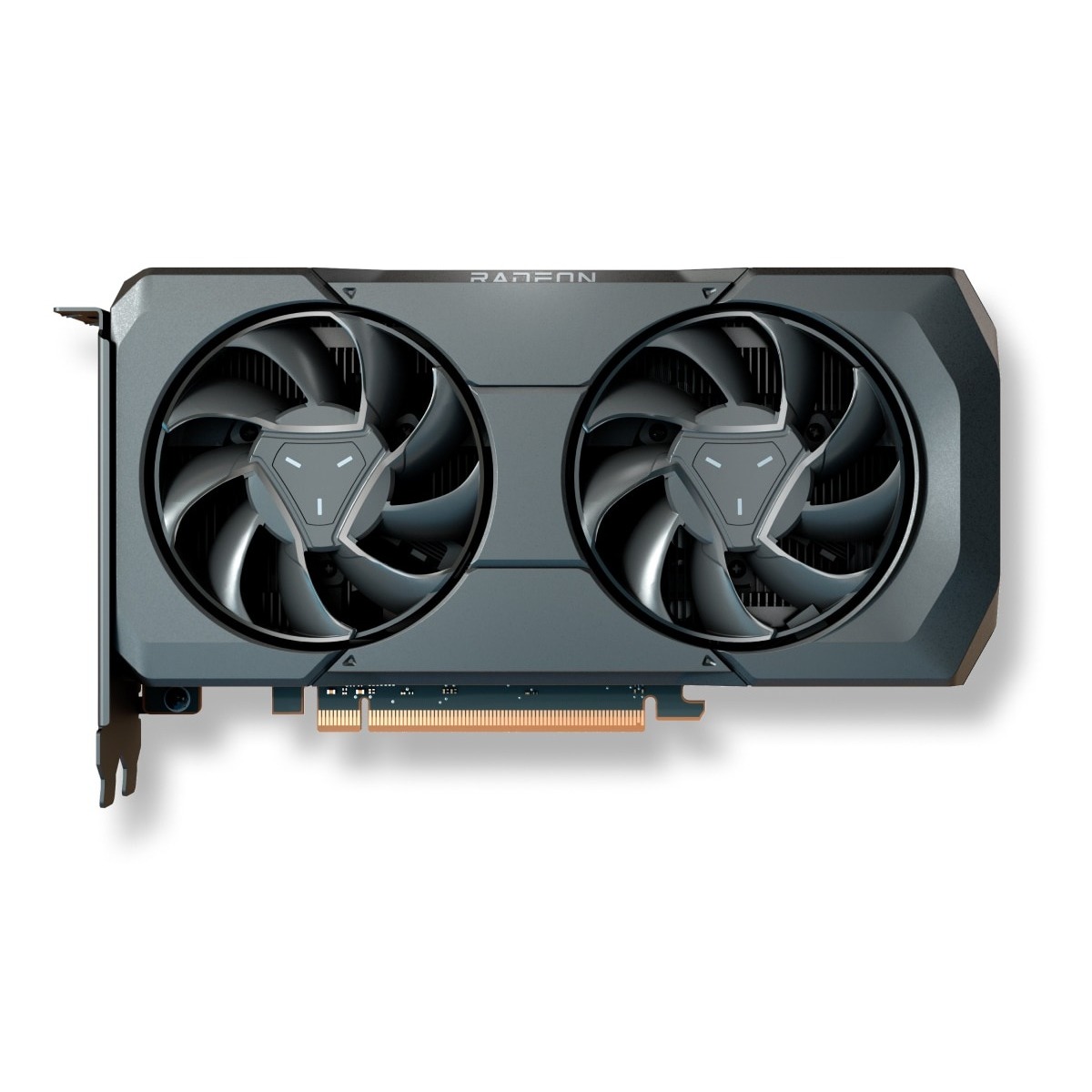
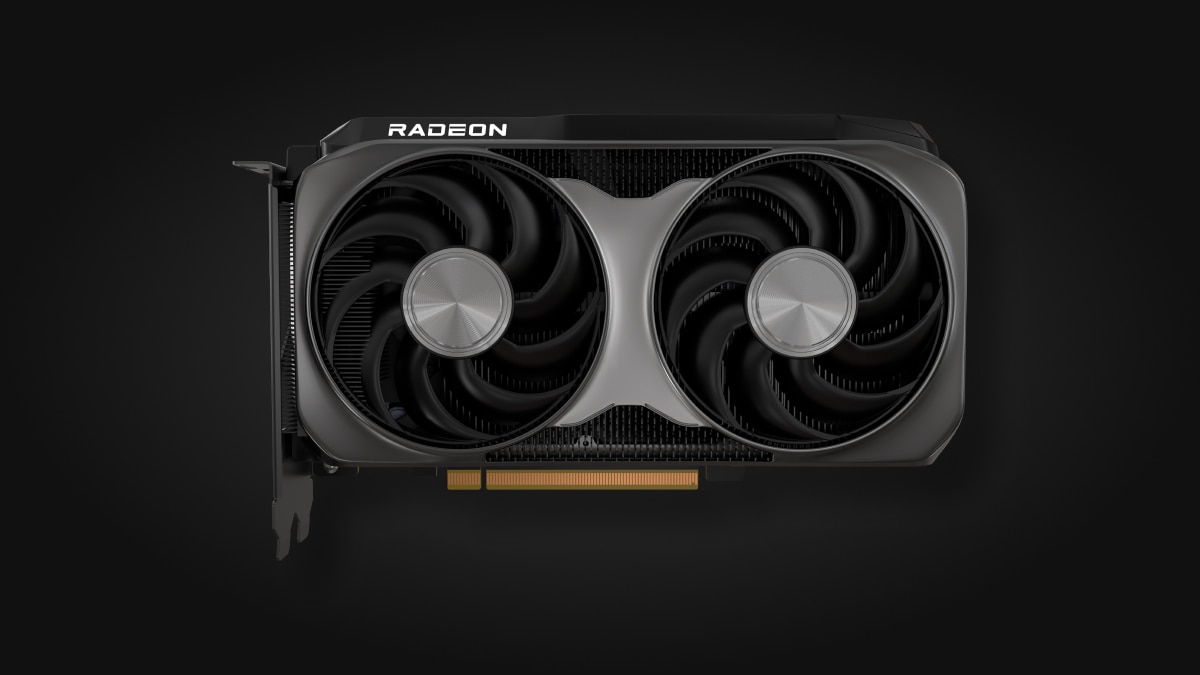
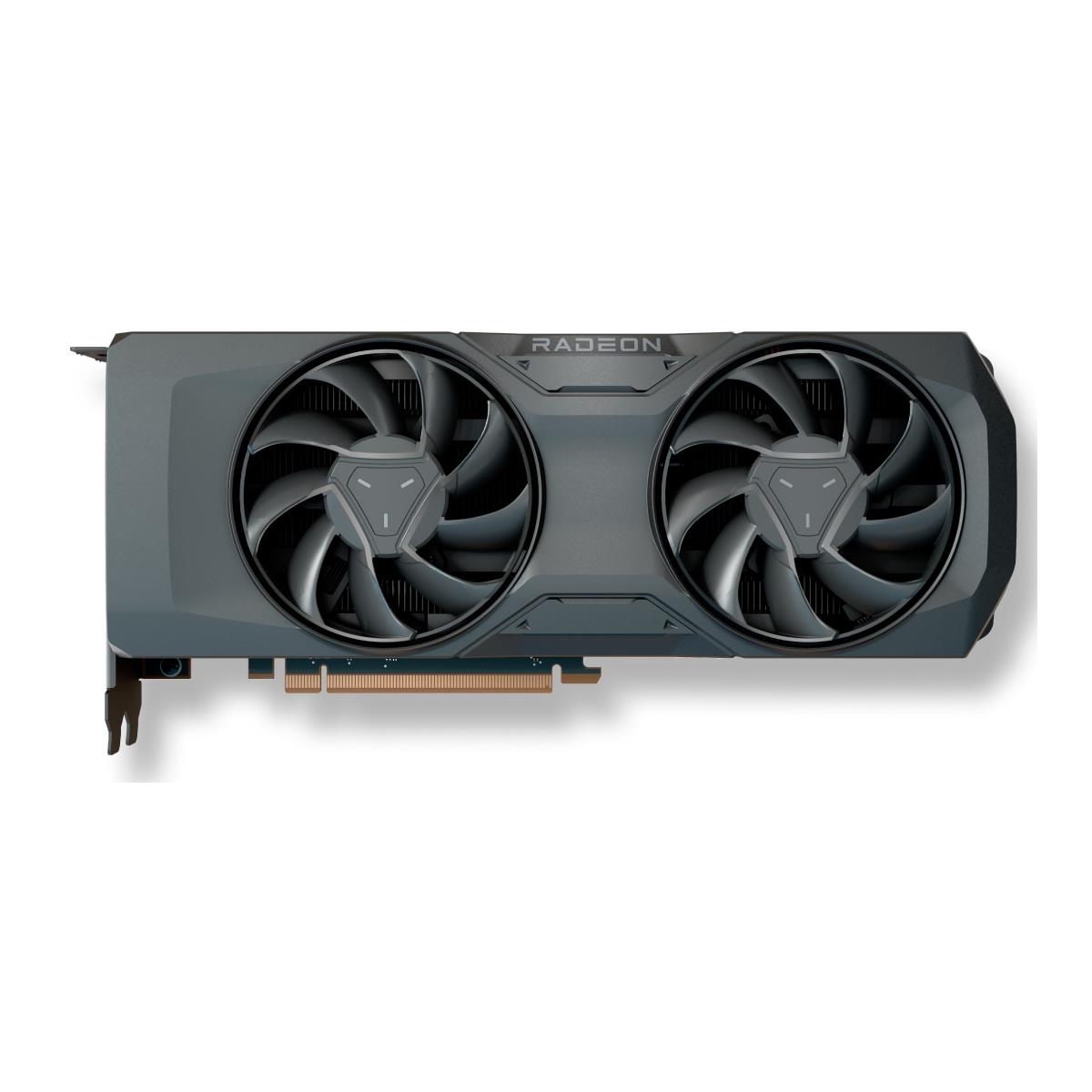
AMD Radeon RX 9070
A 56-compute-unit Radeon card with 16 GB of GDDR6, a 220 W typical board power and a 650 W recommended power supply.
Full Specification Sheet
| Compute Units | 56 |
|---|---|
| Stream Processors | 3,584 |
| Ray / AI Accelerators | 56 / 112 |
| Boost / Game Clock | up to 2,520 MHz / 2,070 MHz |
| Memory | 16 GB GDDR6, 256-bit, up to 20 Gbps |
| Memory Bandwidth | up to 640 GB/s |
| Infinity Cache | 64 MB |
| Typical Board Power | 220 W |
| Recommended PSU | 650 W |
| Power Connector | 2x 8-pin |
| Bus | PCIe 5.0 x16 |
| Outputs | DisplayPort 2.1a, HDMI 2.1b |
The AMD Radeon RX 9070 is the second model in the Radeon RX 9000 series, placed directly below the RX 9070 XT and launched alongside it in March 2025 at a manufacturer-announced starting price of 549 US dollars. It uses the same 53.9-billion-transistor graphics chip as the XT, but with fewer compute units enabled and lower clocks, and this cut brings a large reduction in power: AMD lists a typical board power of 220 W against 304 W for the XT. It keeps the full 16 GB of GDDR6 memory and the 256-bit interface, which makes it an unusual proposition among mid-range cards, where memory capacity is often the first thing to be reduced. This page sets out the published specification, explains the trade-offs against the XT and notes who the card is meant for.
Shader hardware and clocks
AMD specifies 56 compute units with 56 ray accelerators and 112 AI accelerators, for 3,584 stream processors. The clock figures are a boost frequency of up to 2,520 MHz, defined by AMD as the maximum reachable in a bursty workload and dependent on thermals and the application, and a game frequency of 2,070 MHz, the expected clock in typical gaming at typical total graphics power. Compared with the XT, which has 64 compute units and a game clock of 2,400 MHz, the standard 9070 gives up eight compute units and roughly 330 MHz of game clock. The ROP count remains 128, and the peak pixel fill rate is quoted at up to 322.6 gigapixels per second.
Theoretical compute peaks follow the reduced configuration: 36.1 TFLOPS of FP32 vector and FP16 vector performance, 145 TFLOPS of FP16 matrix performance (289 with structured sparsity), 289 TFLOPS of FP8 matrix (578 with sparsity), 289 TOPS of INT8 matrix (578 with sparsity) and 578 TOPS of INT4 matrix (1,156 with sparsity). These are manufacturer-stated theoretical maxima and not application benchmarks; sparsity numbers apply only where software can take advantage of structured sparsity. If you want to know why matrix throughput matters for upscaling and frame generation, our guide to frame-generation hardware requirements gives the background.
Memory and cache
The memory configuration is identical to the XT: 16 GB of GDDR6 at up to 20 Gbps on a 256-bit bus, giving up to 640 GB/s, plus 64 MB of Infinity Cache. Keeping the memory system intact is the most significant design choice for this card. In a market where cards below the flagship often ship with 8 or 12 GB, 16 GB gives the 9070 room for high-resolution textures, ray-traced scenes and content creation tasks that hold large datasets in video memory. That capacity is the main reason to choose it over similarly priced cards with smaller memory pools, and the question of when capacity starts to matter is covered in our explainer on GPU naming tiers, which also shows how model numbers map to performance classes.
Outputs, video and software
The card offers DisplayPort 2.1a and HDMI 2.1b. Video hardware supports decode and encode for H.264, H.265/HEVC and AV1, including at 4K, so it is suitable for game streaming and video work. The bus is PCIe 5.0 x16, and the card will operate in a PCIe 4.0 slot at reduced bandwidth. Software features listed by AMD include Adrenalin Edition, FSR Redstone, Fluid Motion Frames, Radeon Super Resolution, Smart Access Memory, Anti-Lag, Boost, Chill, Image Sharpening, Enhanced Sync, FreeSync, Noise Suppression and Virtual Super Resolution. Windows 10, Windows 11 and 64-bit Linux are supported. As with any driver-level feature, availability in a specific game depends on the developer and the system configuration.
Power and thermal design
A typical board power of 220 W and a recommended minimum power supply of 650 W make the RX 9070 far easier to accommodate than the XT. The card uses two 8-pin power connectors, so no new-style 12-volt connector is needed, and a quality 650 W unit is enough for a typical build; our guide to power supply wattage explains how to check headroom for your own configuration. When two cables are required, use two separate cables from the power supply rather than a daisy-chained pigtail, a practice discussed in the article on GPU power connector adapters and daisy chains. The lower board power also means that partner cards can use smaller coolers and quieter fan curves, though the actual designs vary by manufacturer, and you should check dimensions and noise ratings for the specific model.
Choosing between the 9070 and the 9070 XT
The decision comes down to money, power and performance. AMD's announced prices were 549 dollars for the 9070 and 599 dollars for the 9070 XT, so the gap at launch was 50 dollars; the XT adds 14 percent more compute units and a higher clock in return for 84 more watts of board power. Whether that extra performance justifies the increase depends on the resolution of your monitor and the games you play, and the Radeon RX 9070 versus Radeon RX 9070 XT comparison puts the two sets of specifications next to each other. Owners of older mid-range cards can also check the Radeon RX 9070 versus GeForce RTX 4070 comparison to see how the generations differ in memory and power. To browse other cards, see the graphics card category.
Reading the specification sheet
Three entries on AMD's sheet deserve a closer look. Typical board power describes the power the card is expected to draw in gaming, not a hard limit, and partner models with factory overclocks can exceed it. The recommended power supply figure is a minimum for a whole system with a typical processor, so a build with a power-hungry CPU or several drives needs more headroom. Finally, the difference between boost and game frequency matters: the boost figure is a ceiling that is rarely held for long, whereas the game frequency reflects sustained behaviour. When you compare two cards, compare like with like, and treat every peak throughput number as theoretical rather than as a prediction of frame rates.
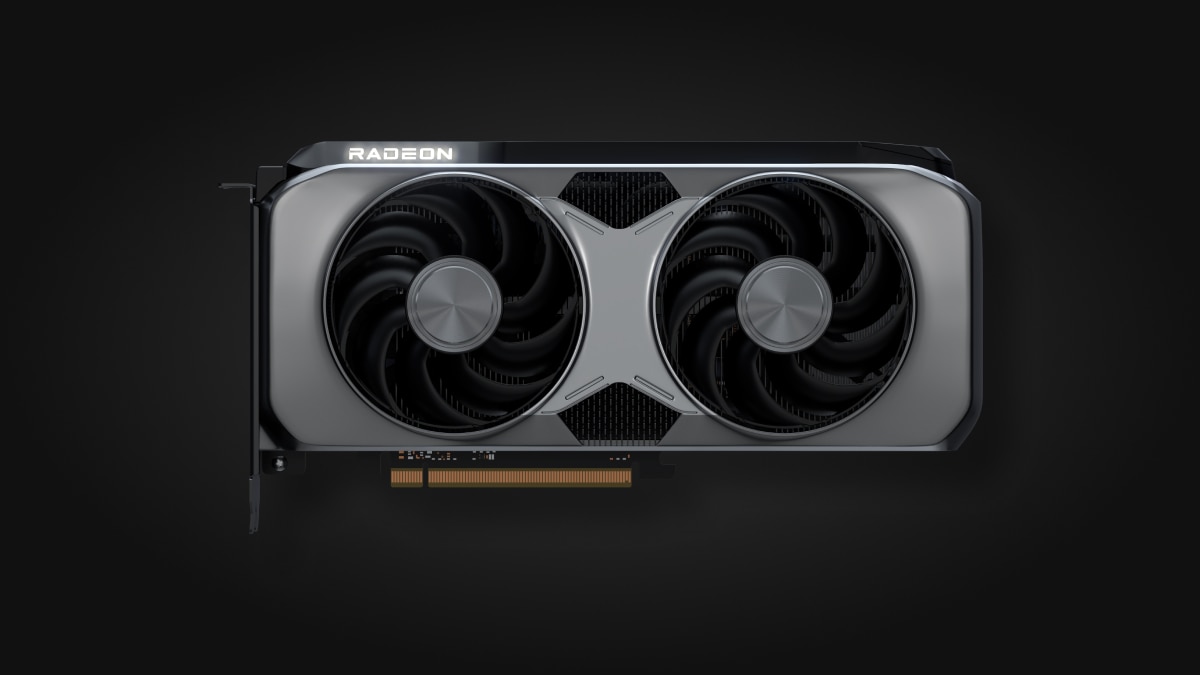
All numbers on this page come from AMD's official product specification, and the image is an artist render provided by AMD. Real-world prices and availability differ by market and retailer, and partner cards may use different clocks and power targets from the reference figures above.
Product image: AMD product image (artist render).