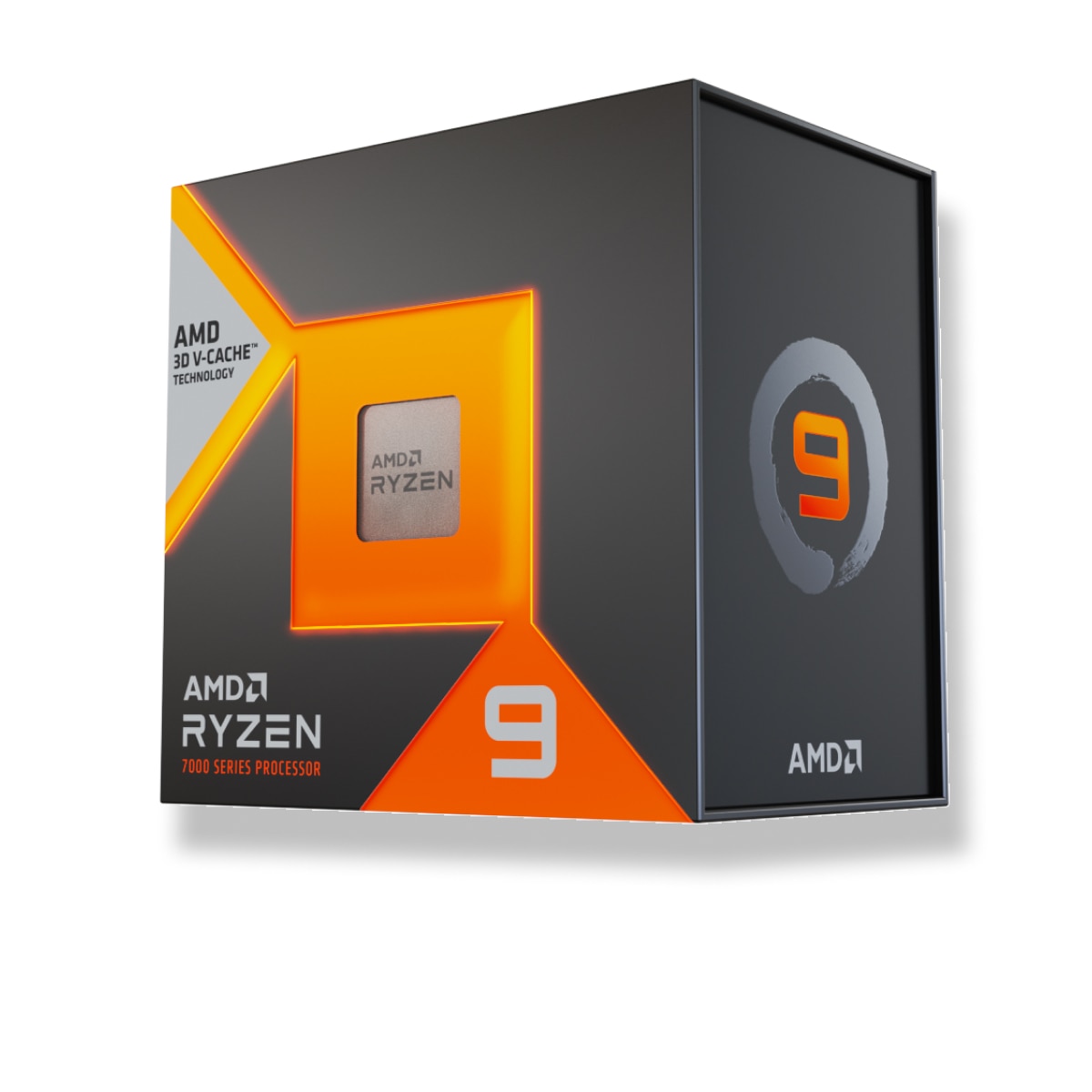
AMD Ryzen 9 9950X3D
A 16-core, 32-thread AM5 flagship with 128 MB of L3 cache from second-generation AMD 3D V-Cache, up to 5.7 GHz boost, a 170 W default TDP and an unlocked multiplier.
Full Specification Sheet
| Architecture | Zen 5 (codename Granite Ridge) |
|---|---|
| Cores / Threads | 16 / 32 |
| Base Clock | 4.3 GHz |
| Max Boost Clock | Up to 5.7 GHz |
| L1 Cache | 1280 KB |
| L2 Cache | 16 MB |
| L3 Cache | 128 MB (2nd gen AMD 3D V-Cache) |
| Default TDP | 170 W |
| Process | TSMC 4nm FinFET (CPU cores), TSMC 6nm FinFET (I/O die) |
| Socket | AM5 |
| Memory | DDR5, 2 channels, up to 256 GB, DDR5-5600 (2 modules) |
| PCIe | PCIe 5.0, 28 lanes (24 usable) |
| Integrated Graphics | AMD Radeon Graphics, 2 cores, 2200 MHz |
| Unlocked | Yes |
| Max Operating Temperature | 95 C |
| Cooler Included | No |
The AMD Ryzen 9 9950X3D is the sixteen-core member of AMD's Ryzen 9000 Series that adds 3D V-Cache technology. AMD describes it as the ultimate 16-core desktop CPU, with second-generation 3D V-Cache, that can do it all for the most demanding gamers and creators. That sentence is the manufacturer's positioning, not a measured result, and this page does not turn it into performance claims. The chip uses the Zen 5 architecture (former codename Granite Ridge), fits the AM5 socket and, according to AMD's specification page, launched on 12 March 2025. Below is the published specification, explained in practical terms; where AMD's page is silent, so are we.
Cores, threads and clock speeds
The 9950X3D has sixteen CPU cores with simultaneous multithreading, so it presents thirty-two threads to the operating system. AMD lists a base clock of 4.3 GHz, described as the average effective base frequency across all cores, and a maximum boost clock of up to 5.7 GHz. As on every Ryzen product page, AMD notes that the maximum boost is the highest frequency a single core can reach on a bursty single-threaded workload, and that it depends on thermal paste, system cooling, motherboard design and BIOS, the latest chipset driver and operating-system updates. If you are unsure what the thread count means for everyday use, our explanation of SMT and Hyper-Threading describes how one core can serve two threads.
Cache: 128 MB of L3
The cache table reads 1280 KB of L1, 16 MB of L2 and 128 MB of L3. The L3 figure is the headline: AMD attributes the size to second-generation 3D V-Cache technology, a stacked cache design that adds capacity beyond what the compute dies carry on their own. The three cache levels form a hierarchy, with L1 the smallest and fastest and L3 the largest and slowest of the on-chip levels, and each level exists to keep data close to the cores so that fewer requests travel out to main memory. How much any of this matters depends on the software being run, and AMD's own marketing points to gaming and content creation. For a concept-level walkthrough that makes no claims about this particular model, see our article on AMD X3D processors and 3D V-Cache.
Manufacturing and package layout
AMD states that the CPU cores are built on TSMC 4nm FinFET technology and the I/O die on TSMC 6nm FinFET, with three dies in the package. Two of those are the compute dies that carry the sixteen cores; the third is the I/O die, which handles memory, PCI Express and the integrated graphics. AMD's page does not list the individual die areas for this model, so we do not give any.
Power, temperature and overclocking
The default TDP is 170 W, and the maximum operating temperature (Tjmax) is 95 degrees Celsius. AMD says the processor is unlocked for overclocking and adds a warning that its product warranty does not cover damage caused by overclocking, even when overclocking is enabled through AMD hardware or software. The supported tuning features are AMD EXPO memory overclocking technology, Precision Boost Overdrive, Curve Optimizer voltage offsets and control through Ryzen Master. Boost is managed by Precision Boost 2. No thermal solution is included in the box, and AMD recommends a liquid cooler for optimal performance, so a cooler must be budgeted separately. Anyone planning manual tuning should first read our guide to CPU overclocking and voltage safety.
Socket and chipset compatibility
The processor uses the AM5 socket. AMD's list of supporting chipsets is A620, B650, B650E, X670, X670E, B840, B850, X870 and X870E, so it is compatible with every current AM5 chipset tier, subject to the motherboard's BIOS support. For a board from this database that is built around one of those chipsets, see the ASUS ROG Crosshair X870E Hero. AMD lists PCI Express 5.0 with 28 native lanes, 24 of them usable. Native connectivity is four USB 3.2 Gen 2 (10 Gbps) ports and one USB 2.0 port. NVMe boot is supported along with RAID 0, RAID 1, RAID 5 and RAID 10.
Memory
The 9950X3D supports DDR5 memory only, in two channels, with unbuffered DIMMs and a maximum capacity of 256 GB. AMD's listed maximum memory speed is DDR5-5600 for two single-rank or two dual-rank modules and DDR5-3600 for four modules of either type. ECC support is listed as yes, but requires motherboard support. These are the official figures, and the difference between two and four modules is worth understanding before buying: filling all four slots lowers the officially supported speed. Our guide to dual-channel and quad-channel DDR5 explains how channels and modules relate.
Integrated graphics
The processor includes AMD Radeon Graphics with two graphics cores at 2200 MHz, and USB Type-C DisplayPort Alternate Mode is supported. This is a basic display engine intended for troubleshooting and light use rather than a replacement for a graphics card, and whether video outputs are available depends on the motherboard.
Instruction set and software
AMD lists x86-64 with AES, AVX, AVX2, AVX-512, FMA3, MMX-plus, SSE, SSE2, SSE3, SSSE3, SSE4.1, SSE4.2 and SSE4A. Operating-system support is given as Windows 11 64-bit, Windows 10 64-bit, RHEL x86 64-bit and Ubuntu x86 64-bit. The boxed product ID is 100-100000719WOF and the tray product ID is 100-000000719. AMD's page carries no price, so none is shown here.
How to read this listing
For buyers, the specification suggests a few practical rules. The 9950X3D is a socketed processor that needs a cooler, DDR5 memory and an AM5 board; with a 170 W default TDP it deserves a cooler chosen with that number in mind. It has the same 28-lane PCI Express 5.0 layout as AMD lists for the Ryzen 9 9900X, so the number of fast slots is decided mostly by the motherboard. If you are weighing it against its non-X3D sibling, use our side-by-side comparison to place the published numbers next to each other, and browse the full processor category for alternatives. All numbers on this page are published specifications from the manufacturer; none is a benchmark result. A further practical point concerns the platform: because AM5 spans several chipset tiers from A620 to X870E, the processor can go into an entry-level board or an enthusiast board, but the number of memory slots, USB ports and PCI Express slots differs considerably from board to board. Check the specification page of the motherboard you choose, and its BIOS update procedure, before pairing the two.