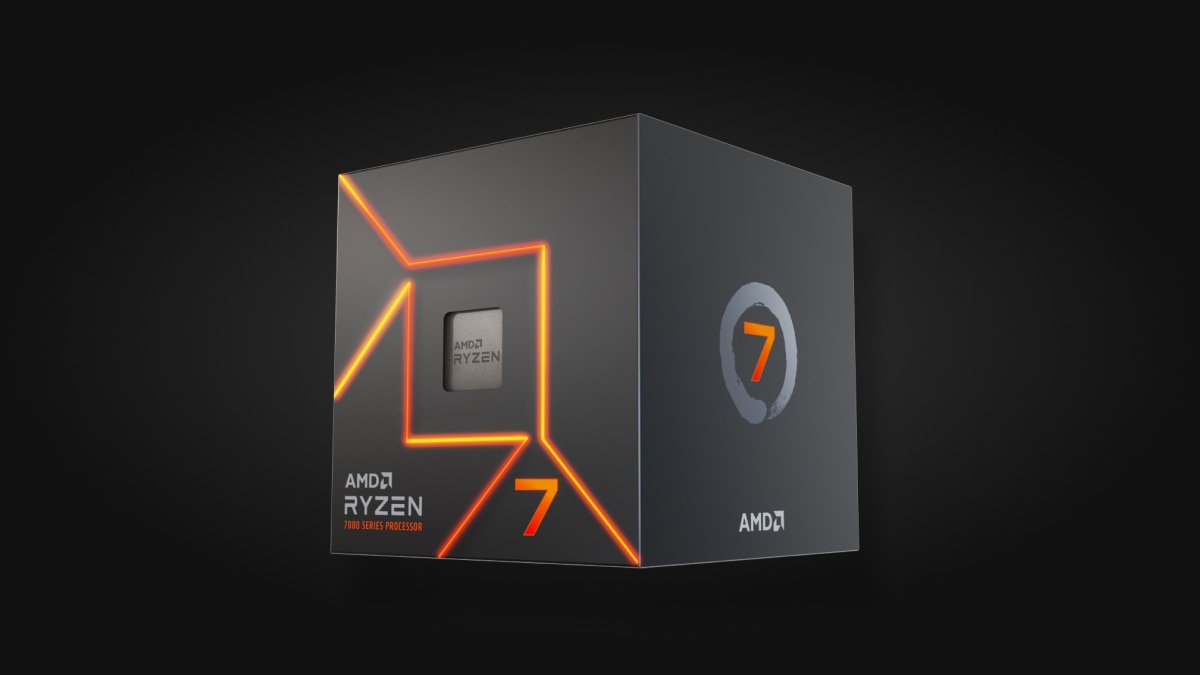
AMD Ryzen 7 9700X
An eight-core, 16-thread Zen 5 processor for AM5 with a 65 W default TDP, 32 MB of L3 cache and boost clocks up to 5.5 GHz.
Full Specification Sheet
| Architecture | Zen 5 (Granite Ridge) |
|---|---|
| Cores / Threads | 8 / 16 |
| Base / Max Boost | 3.8 GHz / up to 5.5 GHz |
| L2 + L3 Cache | 8 MB + 32 MB |
| Default TDP | 65 W |
| Process | TSMC 4nm CPU die, 6nm I/O die |
| Socket | AM5 |
| Memory | DDR5, 2 channels, up to 256 GB, DDR5-5600 (2 DIMMs) |
| PCIe | PCIe 5.0, 28 lanes (24 usable) |
| Integrated Graphics | Radeon Graphics, 2 CUs, 2200 MHz |
| Max Temperature | 95 C |
The AMD Ryzen 7 9700X is an eight-core, 16-thread desktop processor from the Ryzen 9000 series, built on the Zen 5 architecture and released on 8 August 2024 alongside the Ryzen 5 9600X. AMD's own tagline for it is that it is the new standard for a gaming processor, and its specification supports the idea of a balanced part: enough cores for streaming and content work, high boost clocks for games, and a modest 65 W default power rating that keeps cooling requirements sensible. It sits on the AM5 socket and uses DDR5 memory only. This page sets out the published specification, explains the parts that matter for a build and places the chip against its siblings.
Core layout and clocks
The 9700X has eight Zen 5 cores with simultaneous multithreading, giving 16 threads. AMD specifies a base clock of 3.8 GHz, described as the average effective base frequency across all cores, and a maximum boost of up to 5.5 GHz on a single core in a bursty, lightly threaded workload. The base figure is lower than on the 170 W flagship because the 9700X is tuned for a 65 W envelope, so its sustained all-core speed is set more by that power limit than by the boost ceiling. The instruction set list includes AVX2 and AVX-512, AES, SHA and the virtualisation extensions.
Physically the package holds two dies: one CPU die on TSMC's 4 nm FinFET process containing all eight cores, and an I/O die on TSMC's 6 nm process. Because all eight cores live on a single CPU die, there is no cross-die hop between cores, which makes the layout simple for the scheduler and predictable for latency-sensitive software. If you are deciding whether eight fast cores or a larger count suits your workload, our guide to core count versus clock speed explains where each approach pays off.
Cache and memory support
AMD lists 640 KB of L1 cache, 8 MB of L2 cache (1 MB per core) and 32 MB of L3 cache. That is the standard Zen 5 arrangement with no stacked cache; the 3D V-Cache models in the same generation carry considerably more L3 and are aimed at gaming. The 9700X is the conventional alternative, giving up that large cache in exchange for a lower price and higher clock behaviour in some tasks. As with the rest of the family, AMD's generational claims about instructions-per-clock improvement are manufacturer figures and should be read as an indication of direction.
For memory, the processor supports dual-channel DDR5 up to 256 GB. The officially specified data rate is DDR5-5600 with two modules, single- or dual-rank, and DDR5-3600 with four modules. EXPO memory profiles are supported for higher speeds, and ECC is listed as supported where the motherboard allows it. In practice most builders fit two modules, and a 6000 MT/s kit with an EXPO profile is the popular target for this platform. The processor has no built-in cooler and AMD recommends a premium air cooler, which is a notable difference from the flagship, where a liquid cooler is advised.
AM5 platform and connectivity
The 9700X works in AM5 boards with A620, B650, B650E, X670, X670E, B840, B850, X870 and X870E chipsets. That means a wide range of prices for the board, from entry-level A620 designs to the top X870E models, and our platform guide explains how AM5 compares with the older AM4 and Intel LGA1700 platforms. The processor offers PCIe 5.0 with 28 native lanes, of which 24 are usable; boards add extra Gen4 lanes through the chipset (8 on X870E and B650E, 12 on X670E and X670, 4 on X870). Four native USB 3.2 Gen 2 ports at 10 Gbps and one USB 2.0 port come directly from the processor, and DisplayPort alternate mode over USB Type-C is supported. NVMe boot and RAID 0, 1, 5 and 10 are listed.
The integrated graphics consist of a Radeon Graphics engine with two graphics cores at up to 2,200 MHz. This is a basic display engine, useful for booting without a discrete card, testing a build or driving office displays, and it is not intended for gaming. Anyone building a gaming machine will pair the chip with a graphics card, and for a current example on the same generation you can look at the Ryzen 7 9700X versus Ryzen 7 9800X3D comparison, which shows how a cache-heavy sibling differs from this standard part.
Power, temperatures and tuning
AMD gives the 9700X a default TDP of 65 W and a maximum operating temperature of 95 degrees Celsius. The low rating is the main practical advantage: it lets the chip run on a modest tower cooler, keeps the whole system quieter, and reduces the load on the motherboard's voltage regulators, so even an inexpensive B650 or B850 board will handle it without concern. The processor is nonetheless unlocked for overclocking, supports Precision Boost Overdrive, Curve Optimizer voltage offsets and Ryzen Master. Enabling these can raise the effective power draw well above 65 W, which is the topic of our explainer on power limits and Precision Boost Overdrive. AMD notes that its warranty does not cover damage from overclocking, so tuning is at the owner's own risk.
Because the part is so undemanding, it suits small cases and quiet builds well. A single-fan tower or a compact 240 mm radiator is typically more than enough, and there is little reason to spend heavily on cooling unless you plan to raise the power limits deliberately.
Where it fits in the range
Within the Ryzen 9000 lineup the 9700X sits between the six-core Ryzen 5 9600X and the higher-end 12- and 16-core Ryzen 9 chips, and it shares its 8-core count with the cache-stacked Ryzen 7 9800X3D. AMD's announced launch price for the 9700X was 359 US dollars; actual retail prices vary by region and period. For a motherboard, the mainstream choice is a B850 board such as the ASUS ROG Strix B850-F Gaming WiFi, which also lists AM5 support for Ryzen 9000, 8000 and 7000 processors. To see other options, browse the processor category.
Every figure on this page is taken from AMD's official product specification. Boxed contents, pricing and availability differ between markets, so confirm the details with your retailer.
Product image: AMD product image.