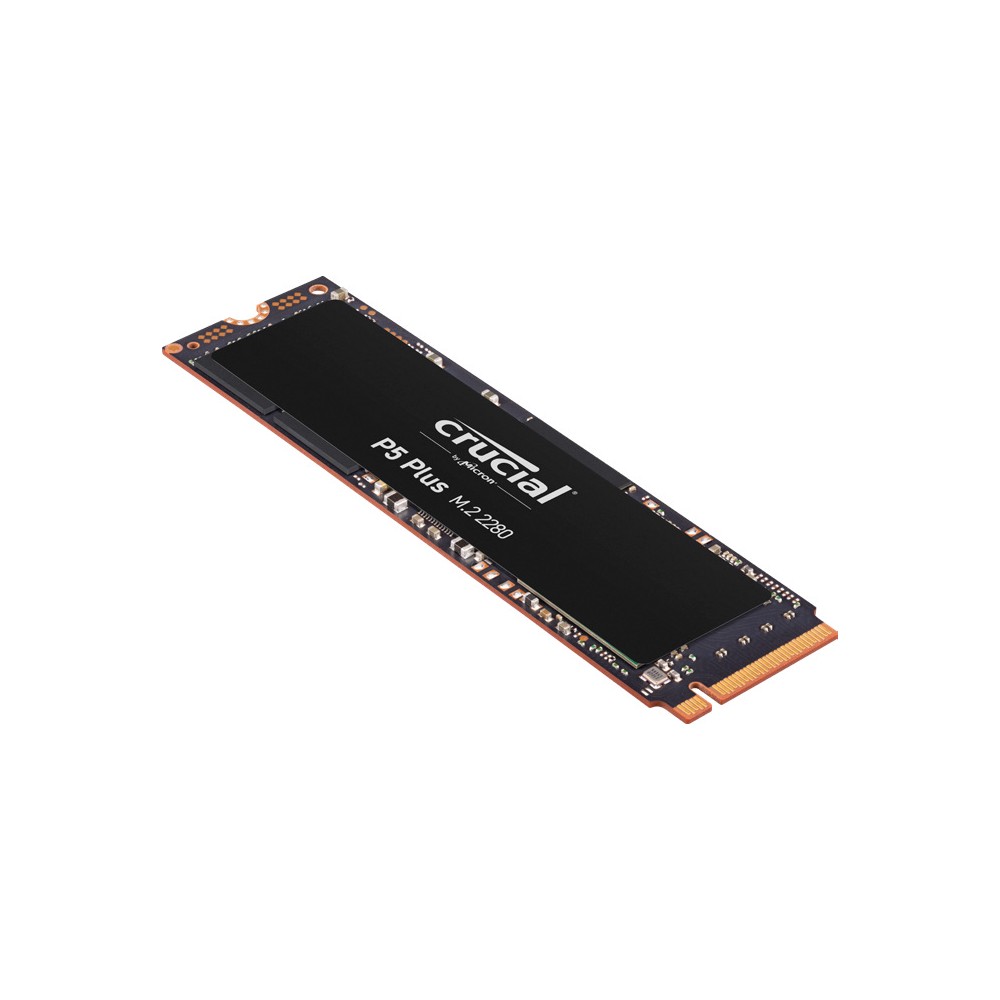
Crucial P5 Plus PCIe 4.0 NVMe SSD (500GB-2TB)
A PCIe 4.0 NVMe SSD in M.2 2280 with 500 GB to 2 TB, rated up to 6,600/5,000 MB/s, up to 1,200 TBW, TCG Opal 2.0 encryption and a five-year warranty.
Full Specification Sheet
| Type | Internal SSD, NVMe (client) |
|---|---|
| Interface | PCIe 4.0, NVMe (backward compatible with PCIe 3.0) |
| Form Factor | M.2 2280 |
| Capacities | 500 GB, 1 TB, 2 TB |
| NAND | Micron Advanced NAND |
| Sequential Read | Up to 6,600 MB/s |
| Sequential Write | Up to 4,000 MB/s (500 GB), 5,000 MB/s (1 TB and 2 TB) |
| In a PCIe 3.0 system | Typically 3,300 / 2,700 MB/s read / write |
| Endurance (TBW) | 300 TB (500 GB), 600 TB (1 TB), 1,200 TB (2 TB) |
| Encryption | Full-drive encryption capable (TCG Opal 2.0) |
| Features | Dynamic write acceleration, RAIN, multistep data integrity algorithms, adaptive thermal protection, integrated power loss immunity, TRIM, SMART, ECC, APST, device sleep |
| Software | Crucial Storage Executive, Acronis True Image for Crucial |
| Operating Temperature | 0 to 70 C |
| MTTF | 2,000,000 hours |
| Warranty | 5-year limited |
The Crucial P5 Plus was Crucial's first performance drive for PCIe 4.0. It is an M.2 2280 NVMe SSD rated at up to 6,600 MB/s for sequential reads and up to 5,000 MB/s for sequential writes, aimed at intensive workloads, content creation and gaming. Beyond raw speed, the product flyer emphasises hardware-based full-drive encryption, a higher endurance rating than Crucial's value lines and a mean time to failure of two million hours. Three capacities are listed: 500 GB, 1 TB and 2 TB. This page summarises the official flyer. We have not tested the drive, and we publish no prices or measurements of our own.
Interface and compatibility
The drive uses PCIe 4.0 with NVMe in the M.2 2280 format, and Crucial states that it is backward compatible with most Gen3 systems. The flyer is helpfully specific here: when the P5 Plus is installed in a Gen3 system, typical read and write speeds are 3,300 and 2,700 MB/s. That makes it a workable upgrade for an existing PCIe 3.0 computer, with the full Gen4 performance available later in a newer machine. Our NVMe SSD buying guide describes how to match a drive to the slots a system provides.
Performance figures
Sequential read is given as up to 6,600 MB/s. Sequential write is up to 4,000 MB/s for the 500 GB model and up to 5,000 MB/s for the 1 TB and 2 TB models. According to the footnote, these are typical values measured with CrystalDiskMark at a queue depth of 128 with the write cache enabled and the drive in a fresh, out-of-box state. Crucial notes that the read speed is nearly twice that of the previous-generation P5, which was rated at 3,400 MB/s.
Random read and write figures in IOPS are not included in the flyer. The feature list names dynamic write acceleration, a fast write buffer that raises burst performance; the sustained write speed after that buffer is not stated.
NAND and controller
The flyer refers to Micron Advanced NAND and to "innovative controller technology", and stresses that the drive is developed, manufactured and tested with Micron. It does not state the number of bits per cell, the layer count, the controller model or the DRAM cache configuration. We do not add assumptions on these points.
Endurance and reliability
Total bytes written are 300 TB for 500 GB, 600 TB for 1 TB and 1,200 TB for 2 TB. This is 600 full drive writes, the level expected of a performance drive and almost three times the rating of the P3 and P3 Plus families at the same capacity. Mean time to failure is stated as two million hours; the footnote explains that it is predicted from component reliability data using Telcordia SR-332 methods and validated in a reliability demonstration test. The limited warranty is valid for five years from the date of purchase.
Encryption and protective features
The P5 Plus is listed as full-drive encryption capable with TCG Opal 2.0, so it can serve as a self-encrypting drive under management software that supports that standard. The flyer also lists Redundant Array of Independent NAND (RAIN), multistep data integrity algorithms, error correction code, adaptive thermal protection and integrated power loss immunity. Active garbage collection, TRIM, the NVMe self-monitoring and reporting technology (SMART), autonomous power state transitions (APST) and device sleep are supported. APST allows the drive to drop into low-power states on its own, which is useful in notebooks.
Temperature and cooling
The operating temperature range is 0 to 70 °C. The flyer we use lists the bare M.2 drive, without a heatsink. A fast Gen4 drive generates noticeable heat under sustained load, and the adaptive thermal protection will reduce its activity if temperatures rise too far. For long transfers, a motherboard heat spreader is therefore advisable. Our guide to thermal throttling and heatsinks covers the options.
Software
Crucial provides the Storage Executive utility for monitoring the drive, updating firmware and managing features such as encryption, and Acronis True Image for Crucial for cloning an existing installation. An installation guide is offered as well.
How it compares in our database
In our storage section, the P5 Plus belongs to the same class as the Samsung 980 PRO, which is rated slightly higher for sequential reads, publishes its random performance and DRAM cache sizes and has the same endurance per capacity. The page P5 Plus vs 980 PRO lists the figures. Within Crucial's own range, the Crucial P3 Plus is the more affordable Gen4 option, with lower write speeds and endurance but capacities up to 4 TB.
Who it suits
The P5 Plus is intended for users who want a solid Gen4 drive for a main system: gamers, people who edit photos and video, developers and anyone who values encryption support and a comfortable endurance margin. With a maximum of 2 TB, it is less suited to those who want a very large single drive. For a basic office PC, a value NVMe drive is sufficient, and the extra speed of the P5 Plus would go largely unused in that role.
Choosing a capacity
The 1 TB and 2 TB models share the higher write rating of 5,000 MB/s and are the natural choices for a primary drive. The 500 GB model is rated at 4,000 MB/s for writes and 300 TBW, which is still strong for its size, though modern games and creative projects fill half a terabyte quickly.
Installation tips
Install the card in an M.2 slot that supports PCIe 4.0 to obtain the rated speeds; on many motherboards this is the slot nearest the processor. Insert it at an angle, press it down and secure it, then fit the board's heat spreader if one is provided. After the first start, check for firmware updates with the manufacturer's utility.
What the flyer does not say
The flyer gives no random IOPS, no power consumption values, no cell type and no release date, and it notes that not all capacities were available at initial launch. Prices vary by country, retailer and capacity and are not listed on this page.