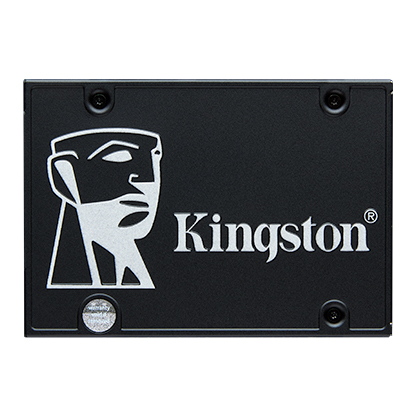
Kingston KC600 SATA SSD (256GB-2TB, 2.5-inch and mSATA)
A self-encrypting SATA SSD with 3D TLC NAND, DRAM cache and up to 550/520 MB/s, sold as 2.5-inch (256 GB to 2 TB) and mSATA (256 GB to 1 TB) with a five-year warranty.
Full Specification Sheet
| Type | Internal SSD, self-encrypting (client) |
|---|---|
| Form Factors | 2.5-inch (7 mm) and mSATA |
| Interface | SATA Rev. 3.0 (6Gb/s), backwards compatible with SATA Rev. 2.0 (3Gb/s) |
| Capacities | 2.5-inch: 256 GB, 512 GB, 1024 GB, 2048 GB; mSATA: 256 GB, 512 GB, 1024 GB |
| Controller | SM2259 |
| NAND | 3D TLC |
| DRAM Cache | Yes (2.5-inch) |
| Encryption | XTS-AES 256-bit hardware encryption, TCG Opal 2.0, eDrive |
| Sequential Read / Write | up to 550 / 500 MB/s (256 GB), up to 550 / 520 MB/s (512 GB and larger) |
| Random 4K Read / Write | up to 90,000 / 80,000 IOPS |
| Endurance (TBW) | 150 TB (256 GB), 300 TB (512 GB), 600 TB (1024 GB), 1,200 TB (2048 GB) |
| Power (2.5-inch) | 0.06 W idle, 0.2 W average, 1.3 W max read, 3.2 W max write |
| Dimensions / Weight | 2.5-inch: 100.1 x 69.85 x 7 mm, 40 g; mSATA: 50.8 x 29.85 x 4.85 mm, 7 g |
| MTBF | 2 million hours |
| Warranty | 5-year limited |
The Kingston KC600 is a SATA solid state drive that sits above the budget A400 in Kingston's client range. It keeps the familiar SATA interface but adds 3D TLC NAND, a DRAM cache, a published controller and a full hardware encryption suite, and it is available in two physical formats: the standard 2.5-inch case and the much smaller mSATA card. Kingston rates it at up to 550 MB/s read and 520 MB/s write, with up to 90,000 random read IOPS. This page explains what the specification sheet says, and where it leaves gaps. We have not tested the drive, there are no benchmark results here, and no price is listed.
Two formats, one family
The 2.5-inch version comes in 256 GB, 512 GB, 1024 GB and 2048 GB and measures 100.1 by 69.85 by 7 millimetres at 40 grams, so it fits standard 7 mm laptop bays and, with an adapter, any desktop. The mSATA version is offered in 256 GB, 512 GB and 1024 GB. mSATA is an older small-card format found in some ultrabooks, industrial PCs and thin clients from roughly 2011 to 2016, before M.2 replaced it. Kingston's mSATA card measures about 50.8 by 29.85 by 4.85 millimetres and weighs 7 grams. Finding new mSATA drives has become harder over the years, which gives the KC600 some value as an upgrade path for those machines; our database also includes the older, smaller Kingston SSDNow mS200 120GB in the same format.
Controller, NAND and cache
Kingston names the controller as SM2259, a four-channel SATA controller design from Silicon Motion, and the memory as 3D TLC NAND, which stores three bits per cell. TLC usually offers better sustained write behaviour and endurance than the four-bit QLC used in many cheap high-capacity drives. The 2.5-inch specification also states that the drive has a DRAM cache, which helps keep random access consistent when the drive is busy or nearly full. These details are notable because many entry-level SSDs, including the Kingston A400, do not publish them at all.
Performance figures
All capacities reach up to 550 MB/s in sequential reads. Sequential writes are up to 500 MB/s for the 256 GB model and up to 520 MB/s from 512 GB upwards. Random 4K performance is listed at up to 90,000 IOPS for reads and 80,000 IOPS for writes. These numbers are at the top of what the SATA 6 Gb/s interface can carry, so the KC600 is about as fast as a SATA drive can be. It cannot match NVMe drives, which reach several thousand megabytes per second; a direct look at KC600 vs WD Blue SN5000 shows the size of that gap on paper. For anyone weighing a SATA SSD against a hard drive, our article on SSD vs HDD covers the practical differences.
As always, sequential figures are measured under the manufacturer's conditions and will vary with the host system, the age of the SATA controller on the motherboard and the type of data being moved.
Encryption and security
The KC600 is a self-encrypting drive. It uses XTS-AES 256-bit hardware encryption and supports TCG Opal 2.0 and Microsoft eDrive. In practice this means that encryption is performed by the drive itself rather than by the main processor, and that management software or operating-system features compatible with Opal can lock the drive. This is mainly of interest to businesses and to anyone who carries sensitive data on a laptop. The encryption works only when set up with suitable software; out of the box the drive behaves like any other SSD.
Endurance and reliability
Total bytes written are 150 TB for 256 GB, 300 TB for 512 GB, 600 TB for 1024 GB and 1,200 TB for 2048 GB. That is almost twice the endurance of the A400 at comparable capacities. Over the five-year warranty, the 512 GB model's 300 TB corresponds to about 164 GB written per day, far above typical desktop use. Mean time between failures is rated at 2 million hours. The warranty is a limited five years with free technical support, which, together with the higher endurance, is one of the clearest differences from Kingston's entry-level drive.
Power, temperature and vibration
For the 2.5-inch model, Kingston lists 0.06 W at idle, 0.2 W on average, 1.3 W maximum while reading and 3.2 W maximum while writing. The mSATA card is rated at 0.08 W idle, 0.1 W average, 1.2 W read and 2.4 W write. The very low idle figure is useful in laptops, where the drive spends most of its time waiting. Operating temperature is 0 to 70 °C, storage temperature -40 to 85 °C, and vibration tolerance is 2.17G peak (7 to 800 Hz) operating and 20G peak (10 to 2,000 Hz) non-operating.
Who it suits
The KC600 makes sense in three situations: upgrading an older laptop or desktop that has only SATA ports, replacing the drive in an mSATA-equipped machine, and fitting a company notebook that needs hardware encryption. For a desktop with a free M.2 NVMe slot, an NVMe drive will be faster for the same purpose. Our storage section lists both kinds side by side.
Installation notes
Fitting the 2.5-inch model is the same as fitting any laptop hard drive: it slides into the drive bay or onto a desktop adapter bracket and connects with a SATA data cable and a SATA power plug. The mSATA card instead plugs into a dedicated mSATA socket and is held by a screw, and it must not be confused with an M.2 slot, which looks similar but is electrically and physically different. To use the hardware encryption, check that the management software or operating system supports Opal or eDrive before installing, because enabling it later may require reinstalling the system.
What the page does not say
The page does not give a release date, a price, or the precise number of layers in the 3D TLC NAND. It does not state whether the mSATA version also carries a DRAM cache, as the cache line appears only in the 2.5-inch table. Performance on a nearly full drive and after long sustained writes is not described. Prices differ by market and are not shown here.