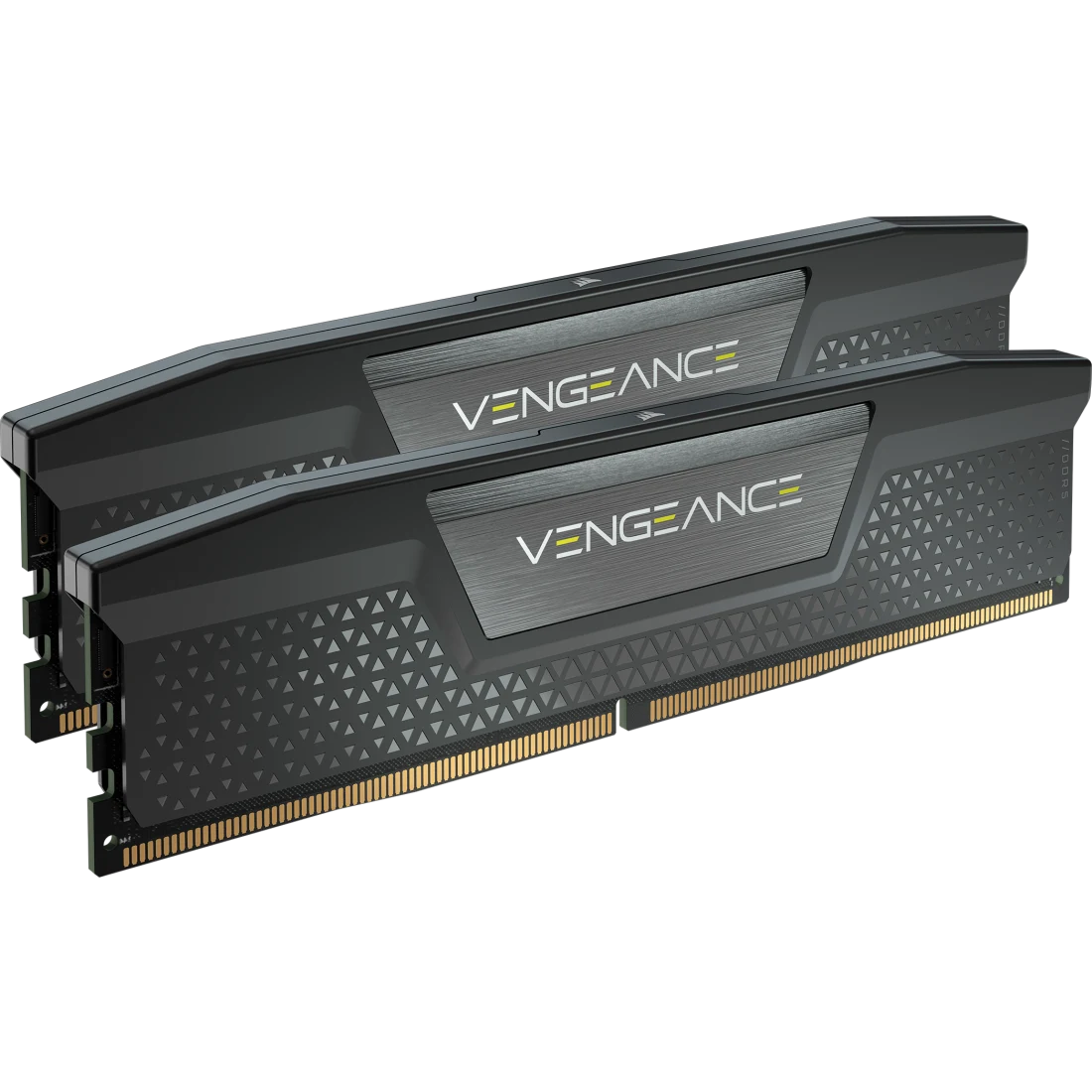
Corsair VENGEANCE DDR5 32GB (2x16GB) 5200 MT/s CL40 Black
A 32 GB (2 x 16 GB) DDR5 UDIMM kit rated 5200 MT/s at CL40 and 1.25 V with an Intel XMP profile, onboard voltage regulation, a low-profile aluminum heat spreader and a limited lifetime warranty.
Full Specification Sheet
| Part Number | CMK32GX5M2B5200C40 |
|---|---|
| Capacity | 32 GB kit (2 x 16 GB) |
| Type | DDR5 UDIMM, 288-pin |
| Tested Speed / Latency | 5200 MT/s / CL40 |
| Speed Rating | PC5-41600 (DDR5-5200) |
| Tested Voltage | 1.25 V |
| SPD Speed / Latency / Voltage | 4800 MT/s / CL40 / 1.1 V |
| Profile | Intel XMP |
| PMIC | Overclock PMIC |
| Heat Spreader | Aluminum |
| Color | Black |
| Compatibility | Intel 600, 700 and 800 Series |
| Software | iCUE |
| Warranty | Limited lifetime |
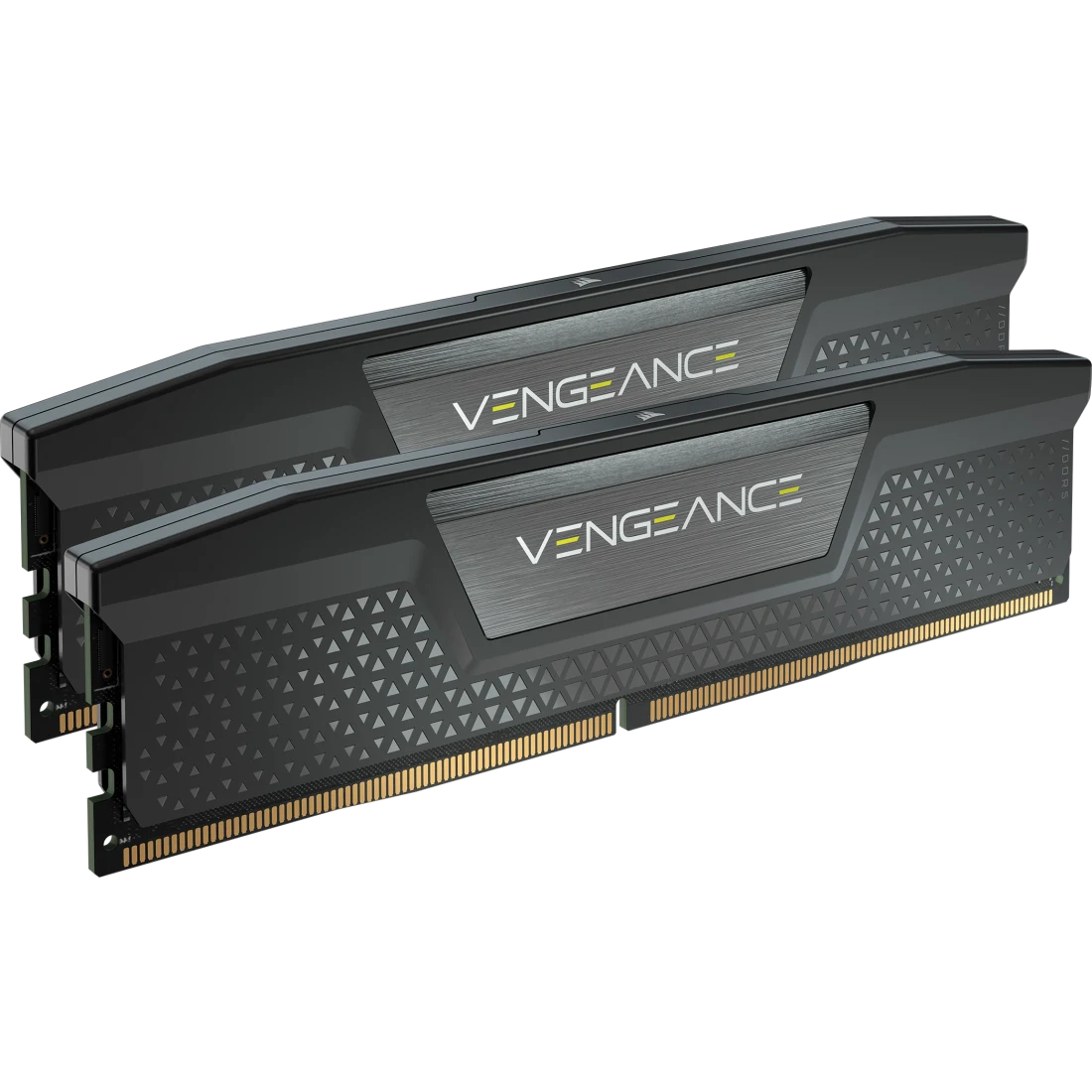
The Corsair VENGEANCE DDR5 32GB (2x16GB) 5200 MT/s CL40 kit, part number CMK32GX5M2B5200C40, is a plain, unlit DDR5 memory kit in black. Corsair describes the VENGEANCE DDR5 line as optimized for Intel motherboards, bringing the higher frequencies and greater capacities of DDR5 in a high-quality, compact module. This is the entry point of the family, which makes it a useful reference kit: it shows what a modest DDR5 rating looks like, and it is a sensible target when capacity and compatibility matter more than headline speed. The manufacturer page shows a price, but the price sits beside a selector with many capacities, speeds and colours, so we cannot tie it to this exact kit and leave the price empty. Nothing here is a benchmark; all figures are the manufacturer's, apart from arithmetic that is marked as such.
The rating in plain terms
The tech spec lists a 32 GB kit made of two 16 GB modules, a tested speed of 5200 MT/s, a tested latency of 40 and a tested voltage of 1.25 V. The speed rating is given as PC5-41600, which is simply the data rate in mega-transfers per second multiplied by eight bytes (5200 times 8 is 41600), the way module names on the DDR5 label encode bandwidth per module. The default profile stored on the module, the SPD, is 4800 MT/s at CL40 and 1.1 V, which is the baseline every DDR5 board can use without any overclocking setting. The kit becomes a 5200 MT/s kit only when you enable the Intel XMP profile in the BIOS. Corsair also lists an overclock PMIC, the power-management chip that DDR5 modules carry on the module itself. Because DDR5 moves voltage regulation onto the module, the platform no longer supplies it directly, which Corsair frames as easier, finely tuned output. If the language of profiles is new to you, our explainer on XMP versus EXPO memory profiles covers it.
Latency in nanoseconds
A CL number alone does not tell you how quick a kit is, because cycles get shorter as the data rate rises. The first-word latency is the CL number multiplied by 2000 and divided by the data rate. For this kit, 40 multiplied by 2000 and divided by 5200 is about 15.4 ns. At the SPD default of 4800 MT/s and CL40 the same calculation gives about 16.7 ns, so enabling the profile trims roughly 1.3 ns. Set that against the Corsair VENGEANCE DDR5 32GB 6000 MT/s CL30 in our database: its 6000 MT/s at CL30 works out at 10.0 ns, a clear step ahead on paper, and with about 15 percent more bandwidth (6000 divided by 5200). Both numbers are arithmetic from the listed ratings, not measured results, and real application gains are usually much smaller than the paper gaps. Our guide on how RAM speed and latency interact explains why.
Bandwidth and capacity
In a dual-channel arrangement, two modules at 5200 MT/s give a theoretical peak of 5200 times 8 bytes times two channels, which is 83.2 GB/s (arithmetic; real throughput is lower). The capacity of 32 GB is the sensible target for a general-purpose gaming or productivity machine today, with two modules filling both channels on a typical board. If you are deciding whether to go to 16 GB, 32 GB or more, our page on 16 GB versus 32 GB of RAM sets out the reasoning. Corsair's page also lists other capacities for the VENGEANCE DDR5 range, including 16 GB, 48 GB, 64 GB, 96 GB and larger kits, and other speeds up to 7800 MT/s on the selector, but this entry describes only the 32 GB 5200 kit.
Design and features
The module has an aluminum heat spreader in black with what Corsair calls refined VENGEANCE styling and a compact, low-clearance form factor intended to fit nearly any DDR5 build, including systems with large air coolers where tall modules can collide. The page says the memory chips are hand-sorted and tightly screened for consistent high-frequency behaviour with aggressive timing options, and that a high-performance PCB gives signal quality and stability for overclocking. There is no lighting on this version. The iCUE software integration lets you monitor temperature, frequency and onboard voltage regulation and save custom XMP profiles, according to the page; the tech spec confirms no fan is included. Lifetime limited warranty is stated as the support policy. The kit is a 288-pin unbuffered DIMM, the desktop standard, so it fits desktop DDR5 sockets and not laptop SO-DIMM slots or server registered modules.
Compatibility
Compatibility is where this kit differs most from the newer dual-profile kits. Corsair lists Intel 600 Series, 700 Series and 800 Series motherboards, and the performance profile is Intel XMP only. AMD platforms are not listed, and there is no EXPO profile mentioned. In practice DDR5 modules can often be run on AMD boards at their default speed, but without an EXPO profile you would be setting the speed and timings manually, which Corsair neither advertises nor supports on this page. If you build on AM5 you will normally want a kit that lists EXPO. For the broader generational picture, see our DDR5 versus DDR4 buying guide, although this entry is about the DDR5 platform only. Always check the motherboard maker's memory support list for your exact board and BIOS version, because the real limit of a platform depends on the board, the processor and the number of modules installed.
Where it sits in our database
Within the memory category, this kit is the low-speed DDR5 reference point. The 6000 MT/s kit linked above is the faster neighbour, and our side-by-side comparison of the 5200 CL40 and 6000 CL30 kits lines up the SPD values, voltages and compatibility lists. Our memory category collects every kit we cover, including DDR4 and higher-end DDR5 families with lighting. For a build where you want the lowest cost per gigabyte and wide Intel compatibility, a modest rating like this one can be the better value, but if you intend to use higher frequencies later, a faster kit is a better starting point.
What the page does not say
The page does not list a weight (the field shows zero), the exact module dimensions, the memory IC maker, the number of ranks or an exact height. It carries text about a keyboard in the middle of the memory description, which is clearly an error on the page and is ignored here. The price is tied to a selector with many variants and is not used. Check physical clearance against your CPU cooler before ordering.