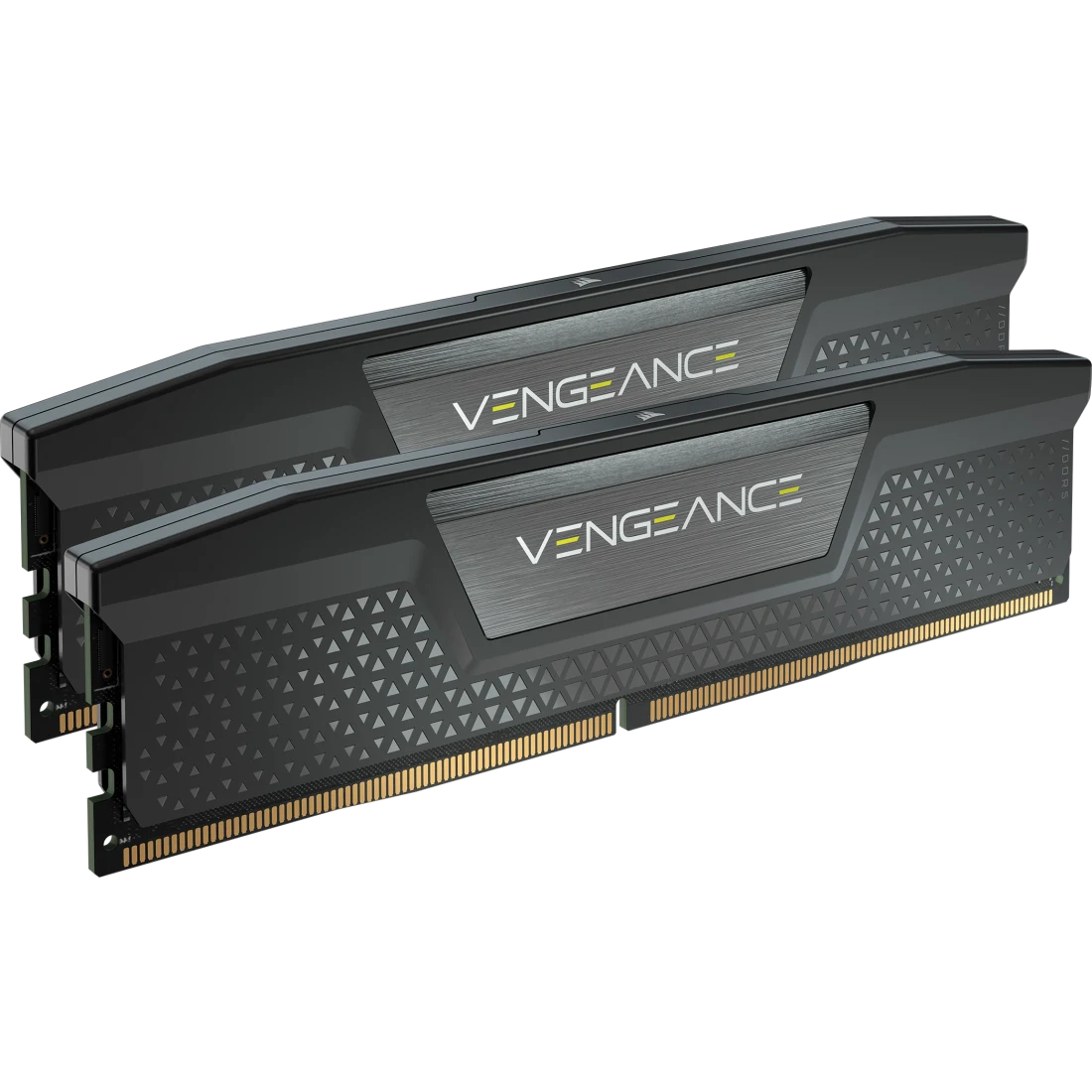
Corsair VENGEANCE DDR5 32GB (2x16GB) 5600 MT/s CL36 Black
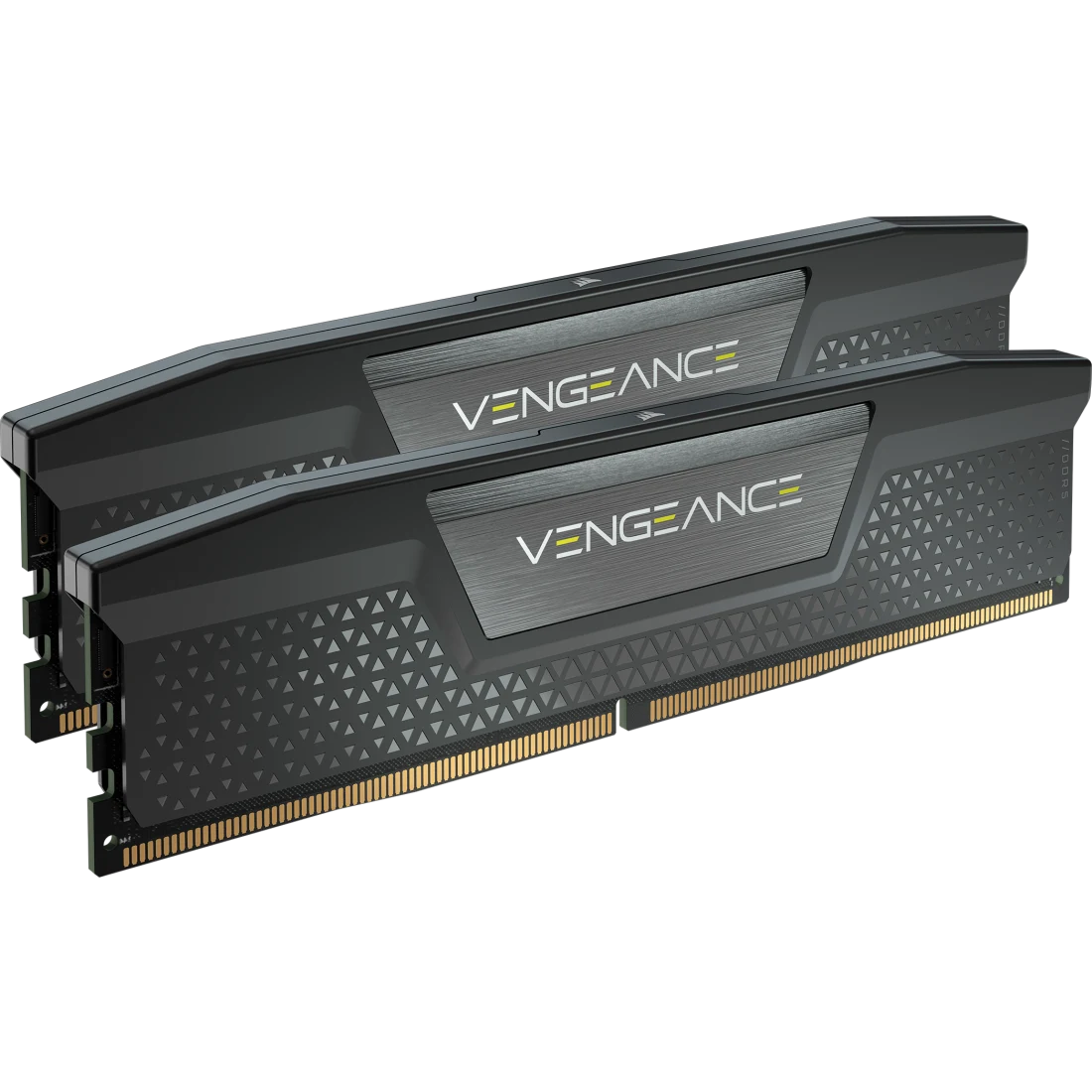
A 32 GB (2 x 16 GB) DDR5 UDIMM kit rated 5600 MT/s at CL36 and 1.25 V with an Intel XMP profile, a plain aluminum heat spreader and a low-profile module for wide compatibility.
Full Specification Sheet
| Part Number | CMK32GX5M2B5600C36 |
|---|---|
| Capacity | 32 GB kit (2 x 16 GB) |
| Type | DDR5 UDIMM, 288-pin |
| Tested Speed / Latency | 5600 MT/s / CL36 |
| Speed Rating | PC5-44800 (DDR5-5600) |
| Tested Voltage | 1.25 V |
| SPD Speed / Latency / Voltage | 4800 MT/s / CL40 / 1.1 V |
| Profile | Intel XMP |
| PMIC | Overclock PMIC |
| Heat Spreader | Aluminum |
| Lighting | None listed |
| Color | Black |
| Compatibility | Intel 600 Series, Intel 700 Series, Intel 800 Series |
| Software | iCUE (onboard voltage regulation, custom XMP profiles) |
| Warranty | Limited lifetime |
The Corsair VENGEANCE DDR5 32GB (2x16GB) 5600 MT/s CL36 is a two-module DDR5 memory kit with the part number CMK32GX5M2B5600C36. Corsair describes the VENGEANCE DDR5 family as memory optimized for Intel motherboards that delivers higher frequencies and greater capacities in a high-quality, compact module. This particular kit is a mid-range configuration: 32 GB split over two 16 GB modules, a tested speed of 5600 MT/s with a CAS latency of 36, and a plain black aluminum heat spreader with no lighting. Corsair's page lists no price for this exact kit that we can separate from its option selectors, and no launch date, so this entry gives neither. What follows is a reading of the published specification table, with a few labelled calculations. We have not tested the kit ourselves.
Speed, timing and voltage
The tech-spec table lists a tested speed of 5600 MT/s, a tested latency of CL36 and a tested voltage of 1.25 V. The speed rating is PC5-44800, which is the same speed written as module bandwidth, and Corsair labels it DDR5-5600. The kit also carries the default SPD profile used when no overclocking profile is enabled: 4800 MT/s at CL40 and 1.1 V. In practice that means the kit starts at the standard DDR5 speed and reaches 5600 MT/s only when the Intel XMP profile is switched on in the BIOS. Two quick calculations help with perspective. First-word latency in nanoseconds is the CAS latency times 2000 divided by the transfer rate, so CL36 at 5600 MT/s is about 12.9 ns, while the default CL40 at 4800 MT/s is about 16.7 ns. Peak theoretical bandwidth for two modules in dual channel is 5600 times 8 bytes times two, or 89.6 GB/s, compared with 76.8 GB/s at the 4800 MT/s default. Our guide on RAM speed versus latency explains why both numbers matter.
Intel XMP and the memory voltage regulator
The performance profile is Intel XMP, and the page lists compatibility with Intel 600, 700 and 800 Series platforms. There is no AMD EXPO profile listed, so owners of AMD AM5 boards should read our explainer on XMP versus EXPO profiles before assuming that a kit will run at its rated speed on their platform. Corsair's copy adds that the kit has built-in voltage regulation with iCUE software control, which it says makes for easier, finely tuned output and more stable overclocking, and the technical table lists an Overclock PMIC. Corsair also describes custom Intel XMP 3.0 profiles that can be saved through iCUE, with a note that the feature was coming later in 2023 to select motherboards. Because that note is dated, we treat custom-profile support as depending on your board and software version.
Physical design
Corsair calls the module a compact form factor with low clearance that ensures wide compatibility with nearly any DDR5 build. The heat spreader is solid aluminum with what Corsair calls refined VENGEANCE styling, and its job is to conduct heat away from the memory chips quickly. The memory format is UDIMM with 288 pins, the same format used in ordinary desktop boards. The kit has no fan, no integrated lighting and a black colour. Corsair also advertises hand-sorted, tightly screened memory chips for consistent high-frequency performance and a high-performance PCB for signal quality and stability. The page lists a weight of zero kilograms, which is clearly a missing value rather than a real figure, so we leave weight out. The warranty is limited lifetime. Low clearance matters mainly when you also plan to use a large air cooler over the first memory slot; measure before you buy if your cooler is close to the modules.
About the page text
One quirk of the product page deserves a mention. Part of the description copy was clearly pasted from a keyboard product: it talks about dedicated volume and multimedia controls, six macro keys, a detachable palm rest, quiet keys, a Windows key lock, anti-ghosting and Stream Deck integration. None of that applies to a memory kit, and we ignore it. Everything we describe here comes from the genuine memory sections and the technical table. The same page also contains a configurator for the whole VENGEANCE DDR5 family, with colour, latency, speed and size options, many of them marked out of stock, so any statement about a speed or latency that is not in the table above belongs to a different kit.
Where it sits in our database
The nearest entry is the VENGEANCE DDR5 32GB 5200 MT/s CL40, which lists the same capacity, module count, format, 4800 MT/s default profile, PMIC and Intel-only XMP profile, but a tested speed of 5200 MT/s at CL40. Compared with it, the 5600 kit is about 7.7 percent faster in transfer rate (5600 over 5200) and has a first-word latency of about 12.9 ns against 15.4 ns for the 5200 kit, which is arithmetic from the two pages. Another neighbour is the VENGEANCE DDR5 Black 32GB 6000 CL30, which lists a faster rating and tighter timings. You can read the 5600 kit against that one in our comparison of the two VENGEANCE kits, and the whole memory category is available for wider browsing.
Choosing between DDR5 kits
For most buyers the question is not whether 5600 is fast, but whether it is the right trade-off between cost, stability and platform support. A kit with a lower rated speed is usually easier to run at its profile on a wide range of boards, while higher-rated kits depend more on the board and the processor's memory controller. If you are still deciding between DDR4 and DDR5 for a new build, our DDR5 versus DDR4 buying guide covers the cost and performance trade-off. Use this entry to check the facts that matter for fit: two 16 GB modules, 288-pin UDIMM, an Intel XMP profile, 1.25 V in use and 1.1 V at default, and a limited lifetime warranty. Then compare against independent memory testing if you care about measured performance in your own applications.
Practical selection notes
Before installation, it is worth reading the motherboard manual: place the two modules in the slots the board maker designates for a pair, update the BIOS if the board needs it, and switch on the rated profile only after the first successful start. If the system is not stable afterwards, test the default setting first and then step back up one change at a time. A memory kit is only meaningfully compared with another when capacity, module count and speed match, otherwise the picture shifts. These notes are general buying advice and add no technical claims about the product.