G.Skill Trident Z5 CK DDR5 CU-DIMM (48GB 2x24GB)
A CU-DIMM DDR5 family with an on-module clock driver, launched for Intel Core Ultra 200 K-series and Z890 boards at speeds up to DDR5-9600.
Full Specification Sheet
| Type | DDR5 CU-DIMM (built-in clock driver) |
|---|---|
| Capacity | 48 GB (2x24 GB) launch kits |
| Launch Kits | DDR5-9000 CL42-56-56-144 (Gear 2); DDR5-9600 CL46-58-58 (Gear 4) |
| Speed Range | up to DDR5-9600 (rated overclock) |
| Profile | Intel XMP 3.0 |
| Target Platform | Intel Core Ultra 200 K-series, Intel Z890 |
| Heatspreader | Mirrored black; piano-black bar (CK) or semi-translucent RGB bar (CK RGB) |
| Variants | Trident Z5 CK / Trident Z5 CK RGB |
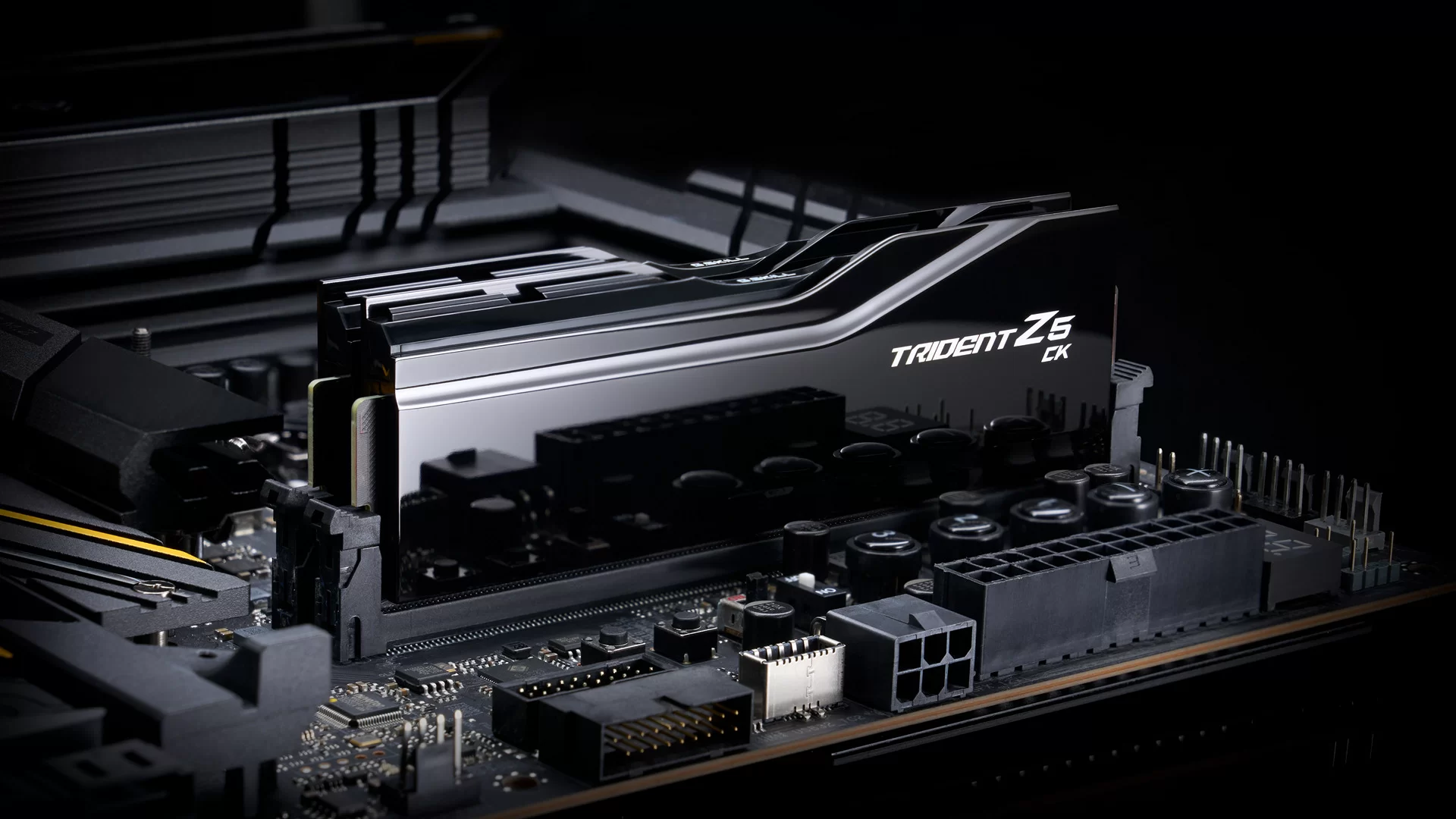
The G.SKILL Trident Z5 CK series is a family of DDR5 memory kits built on the new CU-DIMM standard, announced in October 2024 as an extreme-overclocking product for Intel's Core Ultra 200 K-series desktop processors and Intel Z890 motherboards. The family comes in two versions: the Trident Z5 CK, which has a piano-black top bar, and the Trident Z5 CK RGB, which has a semi-translucent RGB light bar. G.SKILL states that the kits are available up to a rated overclock speed of DDR5-9600. This page explains what makes a CU-DIMM different, what the launch specification says, and how to think about such extreme kits before you buy.
What a CU-DIMM changes
A conventional unbuffered DIMM (UDIMM) receives its clock signal directly from the processor's memory controller. As data rates climb, keeping that signal clean across the slot and along the module becomes one of the hardest parts of the design. A CU-DIMM, short for clocked unbuffered DIMM, adds a clock driver (CKD) chip on the module itself. G.SKILL explains that this chip is designed to strengthen the signal between the CPU and the memory ICs, which helps stability during very high-speed operation. It does not remove the need for a capable processor, board and BIOS; it gives the module a cleaner timing reference so that the whole memory channel has more headroom. The Trident Z5 CK series is built on this standard, and the specification of your motherboard must explicitly support it: for example, the ASUS ROG Strix Z890-E Gaming WiFi lists clocked unbuffered DIMM support and rated overclock speeds of 9200+ MT/s.
The launch kits
G.SKILL's announcement lists two headline configurations, both with 48 GB in a dual-channel 2x24 GB arrangement. The first is DDR5-9000 with timings of CL42-56-56-144, running in Gear 2 mode. The second is DDR5-9600 with timings of CL46-58-58, running in Gear 4 mode. Gear modes describe the ratio between the memory clock and the memory controller clock on Intel platforms: in Gear 2 the controller runs at half the memory clock, and in Gear 4 at a quarter, which allows a very high memory speed at the cost of a slower controller. This is why the two kits list different timings and why they are separate products rather than one profile.
The 24 GB module capacity is worth a note. It is not a power of two, and it is a capacity that only DDR5 designs make practical, using memory chips of 24 gigabit density. Such modules provide more memory than 16 GB kits without moving to 32 GB modules, and they are common in current enthusiast DDR5 kits. All kits use Intel XMP 3.0 profiles, so enabling the rated speed means loading the XMP profile in the BIOS. Our comparison of XMP and EXPO profiles explains how profiles work.
Reading the timings
The numbers after the speed are CAS latency and related timings, counted in memory clock cycles. Because DDR memory transfers twice per clock, a rough conversion from CAS latency to real time is: latency in nanoseconds equals CL multiplied by 2000 and divided by the data rate in MT/s. Applying that to the stated figures, CL42 at 9000 MT/s works out to about 9.3 ns, and CL46 at 9600 MT/s to about 9.6 ns. These are our own arithmetic from the published numbers, not measurements, but they show why higher speed with higher CL can still be equal to or better than a slower kit with lower CL. Our explainer on RAM speed versus latency covers the idea in depth.
The DDR5-10000 demonstration
G.SKILL also reported that a Trident Z5 CK kit reached DDR5-10000 in dual-channel mode on air cooling, on both an ASUS ROG Maximus Z890 Apex and an ASRock Z890 Taichi OCF, after additional BIOS tuning of CPU and memory settings including voltage and advanced timings. The company showed Memtest stability on the ASUS board and an AIDA64 bandwidth result on the ASRock board. Two other demonstrations in the announcement used a Core Ultra 9 285K on the ASUS board for the DDR5-9000 result and a Core Ultra 7 265K on the ASRock board for the DDR5-9600 result. It is important to read these as manufacturer demonstrations by an overclocking team: they show the potential of the modules, not a guarantee that any given processor, board and cooling setup will reproduce them. Real results depend heavily on the quality of the individual memory controller in the CPU.
Design
Both variants use heatspreaders in a mirrored black finish, continuing the design language of the Trident Z5 family. The Trident Z5 CK has a piano-black top bar, while the Trident Z5 CK RGB has a semi-translucent RGB light bar. The finish is reflective, so it shows fingerprints and dust more readily than a brushed surface, and the tall heatspreader may interfere with some large air coolers, so check clearance in your build. G.SKILL does not publish module height in the launch announcement, so consult the product specification page before buying.
Compatibility and cautions
These kits are designed for Intel platforms and use XMP, not AMD EXPO, so they are not marketed for Ryzen systems. They also need a CU-DIMM-capable board. If you are shopping for a more conventional high-speed kit for AMD or Intel, see how this family compares with a mainstream premium kit such as the Dominator Titanium RGB 64GB DDR5-6000 comparison, or with the older Corsair Vengeance RGB DDR5-6000 32GB already listed here. Because G.SKILL states that specifications and appearance may change without notice and that products may not be available in all markets, confirm the exact model number, timings and platform support with your retailer, and browse the wider memory category for alternatives.
A short buying checklist
Before ordering a kit like this, check that your motherboard lists CU-DIMM support and note the maximum memory speed it states; update to the latest BIOS; confirm that your CPU cooler leaves room above the modules; and decide whether you want the plain Trident Z5 CK or the RGB version, which has a light bar. Two-module kits are the usual choice for the highest speeds, because populating four slots puts more electrical load on the memory controller. If you intend to run at the rated speed with a single XMP profile, ask the retailer for the full model number so that you receive the exact launch specification.
Summary
The Trident Z5 CK series is aimed at people who want to push DDR5 on Intel's newest desktop platform. Its defining feature is the on-module clock driver of the CU-DIMM standard, and its launch kits are 48 GB dual-channel sets rated up to DDR5-9600. Everything in this article comes from G.SKILL's announcement, and figures for overclocking results are the manufacturer's own.
Product image: G.SKILL press material.