AMD Ryzen 9 9950X
A 16-core, 32-thread Zen 5 desktop processor for AM5 with 64 MB of L3 cache, a 170 W default TDP and boost clocks up to 5.7 GHz.
Full Specification Sheet
| Architecture | Zen 5 (Granite Ridge) |
|---|---|
| Cores / Threads | 16 / 32 |
| Base / Max Boost | 4.3 GHz / up to 5.7 GHz |
| L2 + L3 Cache | 16 MB + 64 MB |
| Default TDP | 170 W |
| Process | TSMC 4nm CPU dies, 6nm I/O die |
| Socket | AM5 |
| Memory | DDR5, 2 channels, up to 256 GB, DDR5-5600 (2 DIMMs) |
| PCIe | PCIe 5.0, 28 lanes (24 usable) |
| Integrated Graphics | Radeon Graphics, 2 CUs, 2200 MHz |
| Max Temperature | 95 C |
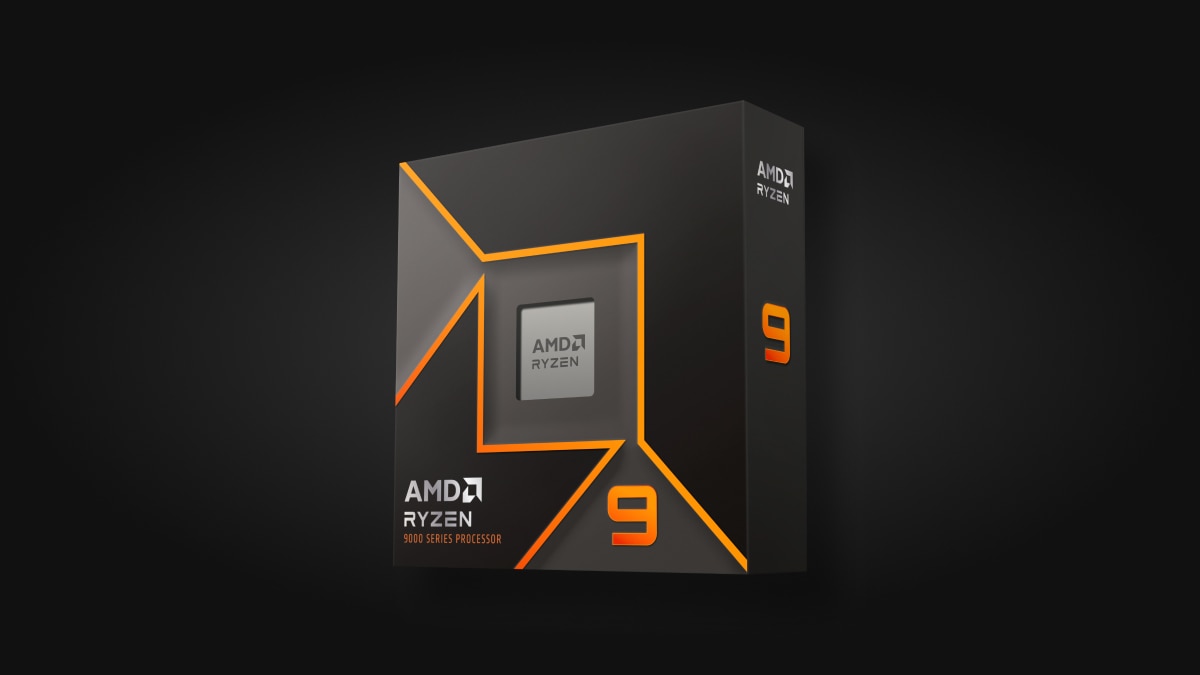
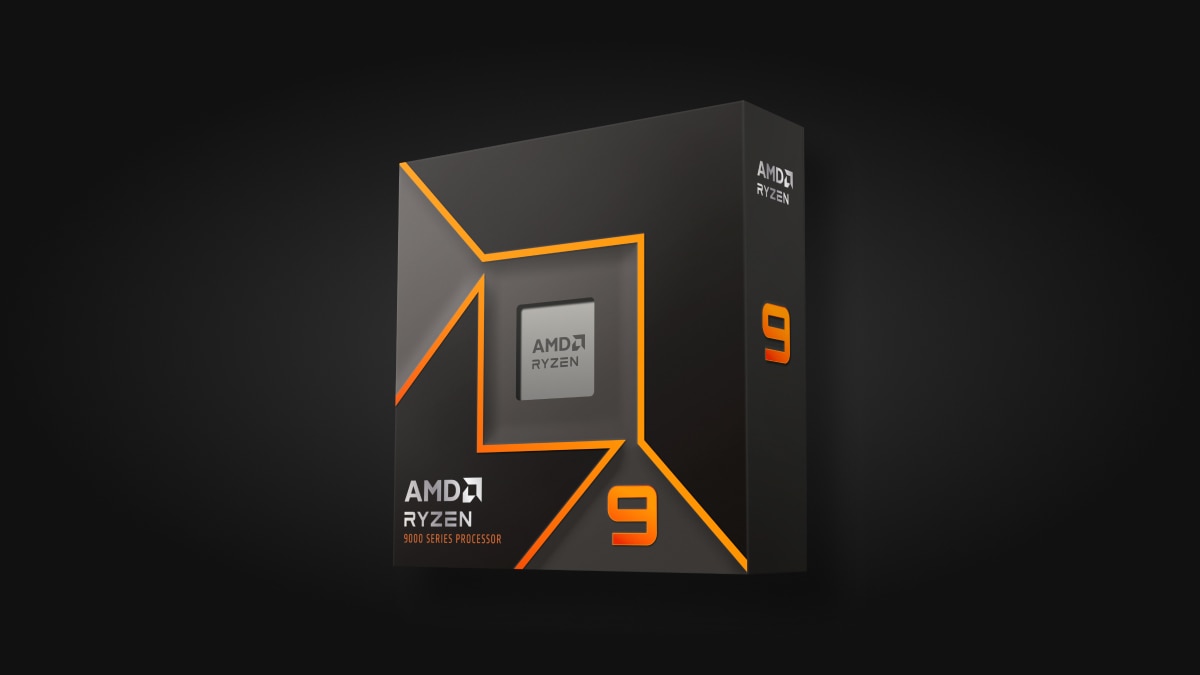
The AMD Ryzen 9 9950X is the top model of the standard Ryzen 9000 desktop family, built on the Zen 5 architecture and released on 15 August 2024. AMD lists it in the enthusiast desktop segment under the former codename Granite Ridge, and it drops into the AM5 socket that the company has used since the Ryzen 7000 generation. With 16 cores and 32 threads it is aimed at people whose work scales with core count: video encoding, 3D rendering, software compilation, virtual machines and heavy multitasking, while still offering the boost clocks that gaming and everyday responsiveness depend on. This page collects the specification AMD publishes, explains what the numbers mean in practice and describes where the chip sits in the range.
Cores, threads and clocks
The 9950X has 16 Zen 5 cores with simultaneous multithreading, which gives 32 threads. AMD specifies a base clock of 4.3 GHz, described as the average effective base frequency of all cores, and a maximum boost clock of up to 5.7 GHz. That maximum is defined by AMD as the highest frequency a single core can reach in a bursty single-threaded workload, so it is a ceiling for light loads rather than a sustained all-core figure. All-core behaviour under a long render sits between the base and boost numbers and depends on cooling, motherboard power delivery and the power limit in use. The instruction set support listed by AMD includes AVX2 and AVX-512 alongside the usual SSE family, AES, SHA and virtualisation extensions.
Structurally the processor is a multi-chip package. AMD lists a package die count of three: two CPU dies made on TSMC's 4 nm FinFET process, each carrying eight cores, and a separate I/O die made on TSMC's 6 nm process. Splitting the cores across two dies is how AMD reaches 16 cores in a desktop socket, and it is also why cross-die latency matters for a small number of latency-sensitive workloads. For most software the operating system scheduler handles this transparently.
Cache and memory
AMD lists 1,280 KB of L1 cache, 16 MB of L2 cache and 64 MB of L3 cache. The L2 figure corresponds to 1 MB per core, and the L3 is shared within each core complex. This is the conventional cache configuration for the range: the 3D V-Cache variants carry a much larger L3 pool, while the 9950X keeps the standard layout. The company positions Zen 5 as an architectural step over Zen 4 and has published an average instructions-per-clock uplift for the generation; that is a manufacturer figure derived from AMD's own selected workloads, so treat it as a guide to direction rather than a promise for any specific program.
On the memory side the processor supports DDR5 in a dual-channel arrangement, with a maximum of 256 GB. AMD's specified speeds are DDR5-5600 for two single-rank or two dual-rank modules and DDR5-3600 when four modules are fitted, single- or dual-rank. Those are the officially supported rates; faster kits run through the EXPO overclocking profile, which the processor supports, and many boards validate considerably higher speeds. ECC is listed as supported when the motherboard also supports it. The rule of thumb for four-module builds is to accept lower speeds or to choose two larger modules instead, and our explainer on RAM speed versus latency covers how much the trade-off matters.
Platform, PCIe and integrated graphics
The 9950X uses socket AM5 and AMD lists compatibility with A620, B650, B650E, X670, X670E, B840, B850, X870 and X870E chipsets. That breadth means an owner of an early AM5 board can usually move to this processor after a BIOS update, while new buyers can pair it with any current chipset tier. The processor provides PCIe 5.0 with 28 native lanes, of which 24 are usable, and AMD notes additional usable Gen4 lanes from the chipset depending on the board: 8 on X870E and B650E, 12 on X670E and X670, 4 on X870. Four native USB 3.2 Gen 2 (10 Gbps) ports and one USB 2.0 port are provided by the processor itself, and USB Type-C DisplayPort alternate mode is supported. NVMe boot and RAID 0, 1, 5 and 10 support are listed for the platform.
Integrated graphics are included: a Radeon Graphics engine with two graphics cores running at up to 2,200 MHz. It is intended for display output, troubleshooting and office use rather than gaming, but it is valuable because it lets a build boot without a discrete card and drives extra monitors. If you are choosing between an integrated solution and a card, the guide to integrated versus discrete graphics sets out when the small iGPU is enough.
Power, cooling and overclocking
The default TDP is 170 W and the maximum operating temperature (Tjmax) is 95 degrees Celsius. AMD does not include a cooler in the box and recommends a liquid cooler for optimal performance, which is consistent with a chip that can draw well above its nominal rating when Precision Boost Overdrive is active. The processor is unlocked for overclocking, supports Precision Boost Overdrive and Curve Optimizer voltage offsets, and works with the Ryzen Master utility. AMD notes that its warranty does not cover damage caused by overclocking, even when the feature is enabled through AMD hardware or software, so undervolting through Curve Optimizer is the more conservative route to efficiency gains. If you are weighing radiators and fans, the air versus liquid cooling guide explains the practical differences.
Because the package can run hot under all-core load, motherboard choice matters more than it does for the 65 W models. A board with a strong voltage regulator section keeps clocks stable during long renders, which is the point of our VRM quality explainer. A premium chipset is not mandatory, though: the socket is shared across tiers, and a mid-range B850 board is a reasonable pairing for many builders.
Positioning and where to go next
Within the Ryzen 9000 line the 9950X is the flagship of the non-3D range, above the 12-core Ryzen 9 9900X and the eight-core Ryzen 7 9700X. Its practical rival on the same socket is the previous-generation Ryzen 9 7950X, which shares the 16-core, 32-thread layout and the 170 W rating; you can read our Ryzen 9 9950X versus Ryzen 9 7950X comparison for the earlier generation's data. AMD's own launch price for the 9950X was 649 US dollars; street prices vary by region and time. For a broader view of the current range, browse the processor category.
All figures on this page come from AMD's official product specifications. Availability, retail pricing and bundled items vary by market, so confirm details with your retailer before buying.
Product image: AMD product image.