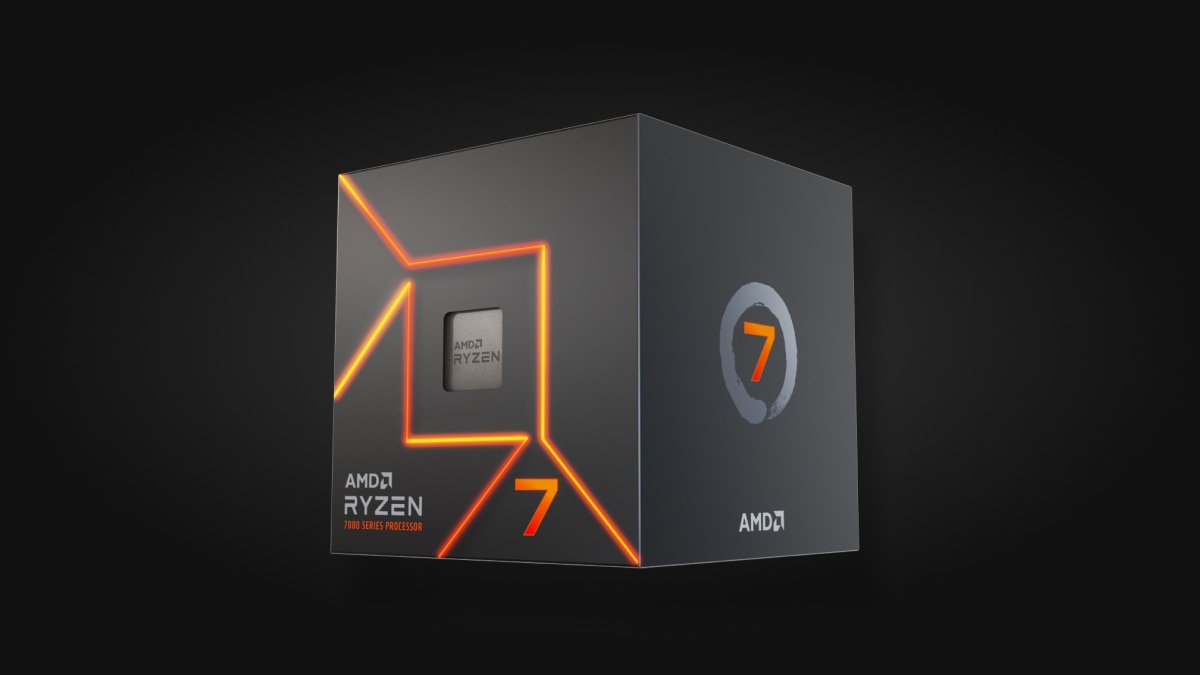
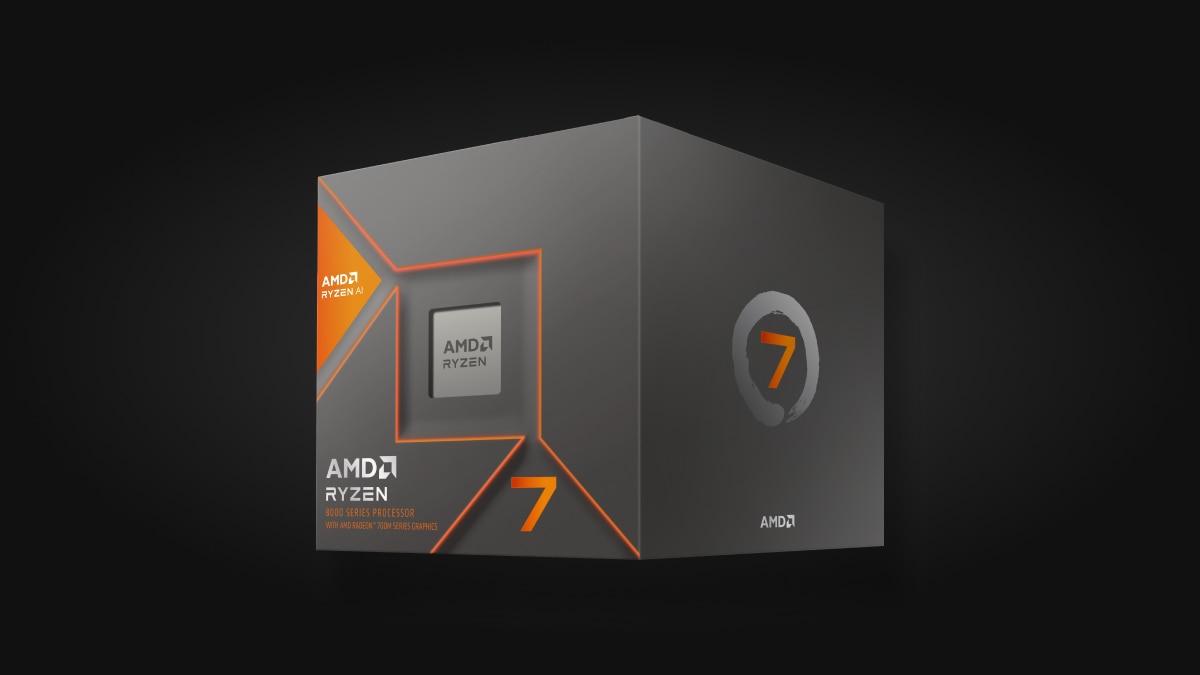
AMD Ryzen 7 8700G
An 8-core, 16-thread AM5 processor with a 4.2 GHz base clock, up to 5.1 GHz boost, 16 MB of L3 cache, a 65 W default TDP and a 12-core Radeon 780M integrated graphics unit.
Full Specification Sheet
| Architecture | Zen 4 (codename Phoenix) |
|---|---|
| Cores / Threads | 8 / 16 |
| Base Clock | 4.2 GHz |
| Max Boost Clock | Up to 5.1 GHz |
| L2 Cache | 8 MB |
| L3 Cache | 16 MB |
| Default TDP | 65 W (configurable 45-65 W) |
| Process | TSMC 4nm FinFET |
| Socket | AM5 |
| Memory | DDR5, 2 channels, up to 256 GB, DDR5-5200 (2 x 1R) |
| PCIe | PCIe 4.0, 20 lanes (16 usable) |
| Integrated Graphics | AMD Radeon 780M, 12 cores, 2900 MHz |
| AI Engine | Up to 16 TOPS |
| Max Operating Temperature | 95 C |
| Launch | Q1 2024 |
The AMD Ryzen 7 8700G is an eight-core desktop processor for the AM5 socket with a much larger integrated graphics unit than most desktop chips. It belongs to the Ryzen 8000 Series, is built on the Zen 4 architecture (former codename Phoenix) and is launched, according to AMD's product page, in the first quarter of 2024. AMD describes it as the ultimate all-in-one desktop processor with AMD Radeon 780M graphics, and it also carries the Ryzen AI label because it includes an AI engine. This page walks through the specification AMD publishes, explains what each figure means for someone choosing parts, and leaves out anything the manufacturer page does not state. There are no benchmarks and no test results here, and every number is a manufacturer specification unless it is marked as simple arithmetic. AMD's page gives no exact launch day and no price, so this page gives neither.
Cores, threads and clocks
AMD lists eight CPU cores with simultaneous multithreading, so the operating system sees sixteen threads. The base clock is 4.2 GHz, the average effective base frequency of all cores according to AMD, and the maximum boost clock is up to 5.1 GHz. As with every AMD boost figure, AMD says it is the highest frequency a single core can reach on a bursty single-threaded workload and varies with thermal paste, cooling, motherboard design, BIOS, the chipset driver and operating-system updates. The gap between base and boost is 0.9 GHz (arithmetic from AMD's two figures). Compared with the Ryzen 7 7700X, which AMD lists at 4.5 GHz base and 5.4 GHz boost, the 8700G has lower clocks, which is consistent with its lower power target. For a wider look at how cores and clocks trade off, see our guide to core count versus clock speed.
Cache and the 65 W power target
The page lists 8 MB of L2 cache and 16 MB of L3 cache, and it gives no L1 figure, so none is quoted here. Dividing the totals across eight cores gives 1 MB of L2 and 2 MB of L3 per core (arithmetic from AMD's totals). The L3 is half the size of the 32 MB on the desktop Ryzen 7 7700X, a trade that comes with the integrated graphics and the single-die design. The default TDP is 65 W, and AMD also lists a configurable TDP (cTDP) of 45 to 65 W, which lets system builders and small-form-factor designers cap the power. The maximum operating temperature is 95 degrees Celsius. The processor is unlocked for overclocking, and AMD lists support for AMD EXPO memory overclocking, Precision Boost Overdrive, Curve Optimizer voltage offsets and AMD Ryzen Master, with the usual note that the AMD warranty does not cover damage caused by overclocking.
Process and package
The processor is built on TSMC's 4nm FinFET process, and AMD gives a compute die size of 178 mm squared with a package die count of one. That means the CPU cores, the graphics unit and the input and output logic all sit on a single piece of silicon, which is a different design from the two-die Ryzen 7000 desktop processors. AMD lists Zen 4 as the architecture, so the CPU cores share their generation with the Ryzen 7000 series, while the graphics unit is listed separately as the Radeon 780M. The instruction set is x86-64 with the extensions AES, AMD-V, AVX, AVX2, AVX512, FMA3, MMX-plus, SHA, SSE, SSE2, SSE3, SSE4.1, SSE4.2, SSE4A and SSSE3.
Integrated graphics: Radeon 780M
This is the reason to consider the 8700G. AMD lists the graphics model as AMD Radeon 780M with 12 graphics cores at 2,900 MHz, compared with two cores at 2,200 MHz on a standard Ryzen 7000 processor. The display side is capable: DirectX 12, DisplayPort 2.1 with Adaptive-Sync, HDR metadata and UHBR10, and HDMI 2.1 with HDCP 2.3. AMD's maximum DisplayPort refresh rates are 7680x4320 at 60 Hz, 3840x2160 at 240 Hz, 3440x1440 at 360 Hz, 2560x1440 at 480 Hz and 1920x1080 at 600 Hz, the same figures for standard and HDR output. Up to four displays are supported, along with AMD FreeSync, Miracast wireless display and AMD Smart Access Memory. For video, the page lists hardware AV1 encode and decode alongside H.264, H.265 and VP9 decode; the encode ratings include 2160p at 240 frames per second for AV1 and 4320p at 60. These are AMD's bandwidth ratings and not measured frame rates in any game. Whether the graphics unit is enough for a game depends on the game, the resolution and the memory speed, and this page cannot tell you that; our guide to integrated versus discrete GPUs explains how to think about the decision, and the note on memory speed and APU graphics performance covers why the memory matters so much for a chip like this.
Ryzen AI engine
AMD's page lists an AI engine with performance of up to 16 TOPS. TOPS stands for trillions of operations per second, and AMD gives this figure as the peak performance of the dedicated engine, not of the CPU or graphics unit combined. The page does not describe software support, so this page does not either; whether an application uses the engine depends on the application.
Memory
The processor supports DDR5 in two channels, up to 256 GB, with UDIMM modules. AMD's maximum memory speeds are DDR5-5200 with two modules of one rank each, DDR5-5200 with two modules of two ranks each, and DDR5-3600 with four modules of either rank. As arithmetic, DDR5-5200 gives a theoretical peak of about 41.6 GB/s per 64-bit channel and 83.2 GB/s across two channels. That bandwidth is shared between the CPU cores and the integrated graphics, which is why memory choice matters here more than on a chip paired with a graphics card. ECC support is listed as yes, with the condition that the platform supports it.
Platform, PCIe and connectivity
The socket is AM5, and AMD lists supporting chipsets A620, X670E, X670, B650E, B650, X870E, X870, B840 and B850. Unlike the Ryzen 7000 desktop chips, the 8700G's PCIe support is PCIe 4.0 with 20 native lanes, of which 16 are usable. AMD lists native USB as two USB4 (40 Gbps) ports, two USB 3.2 Gen 2 (10 Gbps) ports and one USB 2.0 port, and NVMe support includes boot, RAID 0 and RAID 1. The consequence for board choice is that features such as a PCIe 5.0 graphics slot or M.2 slot on a motherboard do not apply to this processor: a board that advertises them will run those connections at PCIe 4.0 speed with an 8700G. The ASUS PRIME B650M-A WIFI in our database, a compact AM5 board with DisplayPort, HDMI and VGA outputs, is the kind of board that suits a build like this.
Where it fits
The 8700G is the option for a compact system without a graphics card, or for a first build to be upgraded later, and its limits are the smaller L3, the PCIe 4.0 lane count and a lower boost clock than the Ryzen 7 7700X, which you can see next to it in our side-by-side comparison. For all the processors in our database, browse the processor category. Every value on this page comes from AMD's product page and is a specification and not a measurement.
What the page does not say
AMD's page does not state a price, an exact launch day, a maximum L1 cache, a bundled cooler for this listing or any test result, so this page does not either. AMD's product-ID notes mention a change in the cooler supplied with some multi-pack models starting in August 2025, which is a reminder to check exactly what is in the box of the listing you buy.