AMD Ryzen 7 5800X3D
An eight-core AM4 chip whose 96 MB of stacked L3 cache is aimed squarely at gaming.
Full Specification Sheet
| Cores / Threads | 8 / 16 |
|---|---|
| Base / Boost Clock | 3.4 GHz / up to 4.5 GHz |
| Cache | 96 MB L3 (3D V-Cache) + 4 MB L2 + 512 KB L1 |
| TDP | 105 W |
| Socket | AM4 |
| Architecture | Zen 3 (TSMC 7nm cores, 12nm I/O die) |
| Memory | DDR4, dual-channel, up to DDR4-3200 |
| PCIe | PCIe 4.0 (24 lanes, 20 usable) |
| Integrated Graphics | None (discrete GPU required) |
The AMD Ryzen 7 5800X3D is one of the more unusual desktop processors of the DDR4 era. On paper it is an eight-core, sixteen-thread Zen 3 part with a 3.4 GHz base clock and a boost ceiling of up to 4.5 GHz, which is actually a little lower than the boost rating of its ordinary Ryzen 7 5000 siblings. What sets it apart is the cache: 96 MB of L3, three times the 32 MB that a standard single-chiplet Zen 3 processor carries. That extra memory is the entire point of the product, and it explains why the chip is a favourite for anyone extending the life of an AM4 gaming build.
How the extra cache is built
The additional 64 MB is not simply a bigger block of silicon on the same die. AMD manufactured a separate cache die on the same TSMC 7nm process as the compute chiplet and bonded it on top of the eight-core chiplet using a direct copper-to-copper connection, a technique the company markets as 3D V-Cache. Stacking the memory vertically keeps it physically close to the cores, so the larger pool does not add much latency: the L3 keeps behaving like a normal L3, only three to four cycles slower. Alongside the compute chiplet sits the familiar 12nm I/O die, which makes the package a two-die design, with the compute die measuring 74 mm² and the I/O die 125 mm².
The remaining cache hierarchy is conventional for Zen 3: 512 KB of L1 in total and 4 MB of L2 across the eight cores. Because games tend to hammer the same working sets of data repeatedly, a much larger last-level cache can keep more of that data close to the cores and reduce trips to system memory. Workloads that stream through enormous data sets, or that are limited purely by clock speed and core count, see far less benefit, which is why this processor should be judged by the kind of software you run rather than by headline core counts.
Platform and compatibility
The 5800X3D drops into the AM4 socket, so it is compatible with a wide range of existing motherboards. The supported chipset list on the product page covers X570, X470, B550, B450 and A520. As with any AM4 upgrade, the practical rule is to check the motherboard maker's compatibility list and update the BIOS before swapping the processor, because older boards need a firmware revision to recognise newer Ryzen 5000 parts. Our platform guide covering AM4, AM5 and LGA1700 explains how the sockets differ and where an AM4 processor still makes financial sense.
Memory is DDR4 in dual-channel mode, with a maximum capacity of 128 GB. The official memory speed ratings depend on how the modules are populated: DDR4-3200 with two single-rank or two dual-rank modules, DDR4-2933 with four single-rank modules and DDR4-2667 with four dual-rank modules. ECC memory is supported when the motherboard also supports it. In practice this means two well-chosen DDR4 modules are the simplest route to the rated speed, and a large four-module kit is a small trade-off for stability. The processor offers PCIe 4.0 with 24 native lanes, of which 20 are usable, and on an X570 board an additional 16 Gen 4 lanes come from the chipset.
There is no integrated graphics engine, so a discrete graphics card is required. That is a normal situation for a gaming-focused chip, but it does matter if you were planning to build a temporary system without a graphics card. The processor also carries the usual Zen 3 feature set, including Precision Boost 2 and the AES, AVX2 and SHA extensions, with four USB 3.2 Gen 2 ports and two SATA ports provided natively by the processor, plus NVMe boot and RAID 0, 1 and 10 support.
Power, thermals and cooling
The default TDP is 105 W and the maximum operating temperature (Tjmax) is 90 °C, which is lower than the 95 °C found on several other Ryzen desktop chips. The cache stack adds a thermal layer on top of the compute die, and the lower ceiling is part of how the design stays within its safe envelope. AMD does not include a cooler in the box and recommends a liquid cooler for the best sustained performance, so budget for a capable cooler when you buy. A good tower air cooler is often enough for real-world gaming loads, but do not treat cooling as an afterthought with this model. Power supply headroom is rarely a concern at this power level, and our guide to choosing PSU wattage shows how to size a supply for the whole system instead of just the processor.
Who should buy it
The 5800X3D makes the most sense for people who already own an AM4 board and DDR4 memory and want a substantial gaming upgrade without replacing their platform. Swapping the processor, updating the BIOS and reusing the memory and board is far cheaper than moving to a newer socket, and it keeps the existing cooler mounting hardware usable. It is also a sensible choice for a new budget-conscious build assembled from DDR4 parts, provided you can find it at a fair price on the retail market.
It is a less convincing pick for heavy content-creation work, video encoding or code compilation, where a processor with a higher clock speed or more cores will finish jobs sooner. If you want the largest multi-threaded throughput, browse the full processors catalogue for alternatives, and put two chips side by side on a comparison page such as the 5800X3D against the Core i9-14900K to see exactly how core counts, cache size and power limits differ.
Where it sits in AMD's lineup
The processor launched on 20 April 2022, well into the lifetime of the Zen 3 generation and shortly before AMD moved to the AM5 socket with the Ryzen 7000 series. It was later followed by lower-priced 3D V-Cache models on AM4 and succeeded on the newer platform by the Ryzen 7000 X3D family. That timeline matters for buyers: the 5800X3D is essentially the end of the road for AM4, which means an upgrade to it is a one-time step rather than the start of a longer upgrade path. If you expect to change platforms within a couple of years anyway, the money might be better spent on a newer board and memory. To see how the newer generation differs, open the Ryzen 9 7950X page, and read the Ryzen 9 7950X review for a benchmark-driven look at what the AM5 platform offers.
Quick verdict
For a specific job, a gaming machine on the AM4 platform, the Ryzen 7 5800X3D is a specialised tool that does what it was designed for. Its cache-heavy design, modest clocks, 105 W rating and lack of integrated graphics all point in the same direction. Check that your motherboard has a compatible BIOS, plan for a good cooler, use two DDR4 modules for the simplest path to the rated memory speed, and pair it with a capable discrete graphics card. Treat multi-core productivity as a secondary use rather than a reason to buy, and compare it against the alternatives above before committing. Once it is installed, remember that the specification sheet describes the processor at stock settings: real behaviour still depends on the cooler, the motherboard's power delivery and the memory you pair it with, so it is worth checking each of those before you blame the chip for an unexpected result.
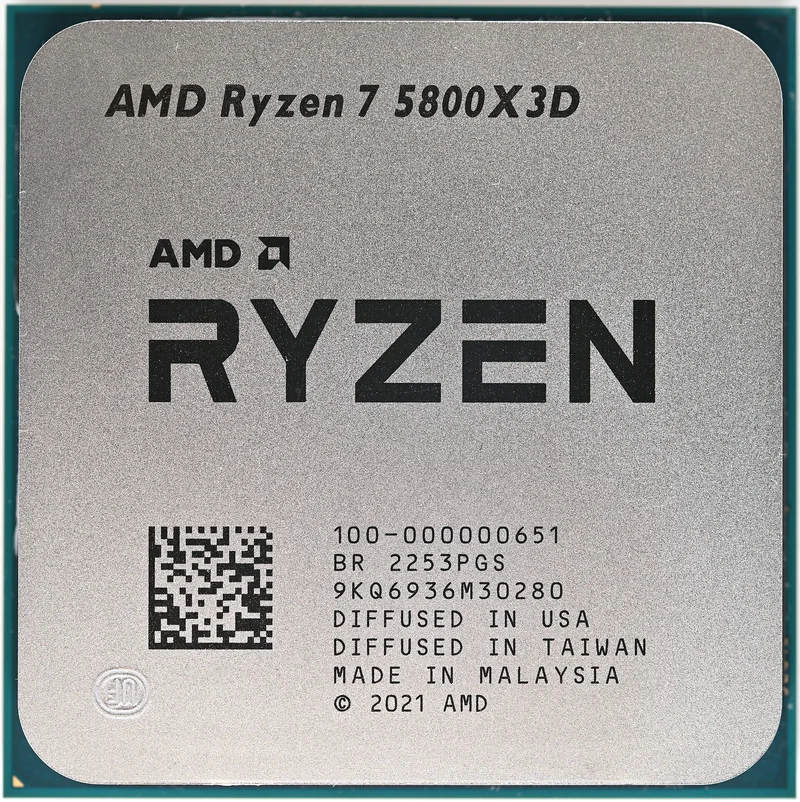
Photo: Phiarc / Wikimedia Commons, CC BY-SA 4.0.