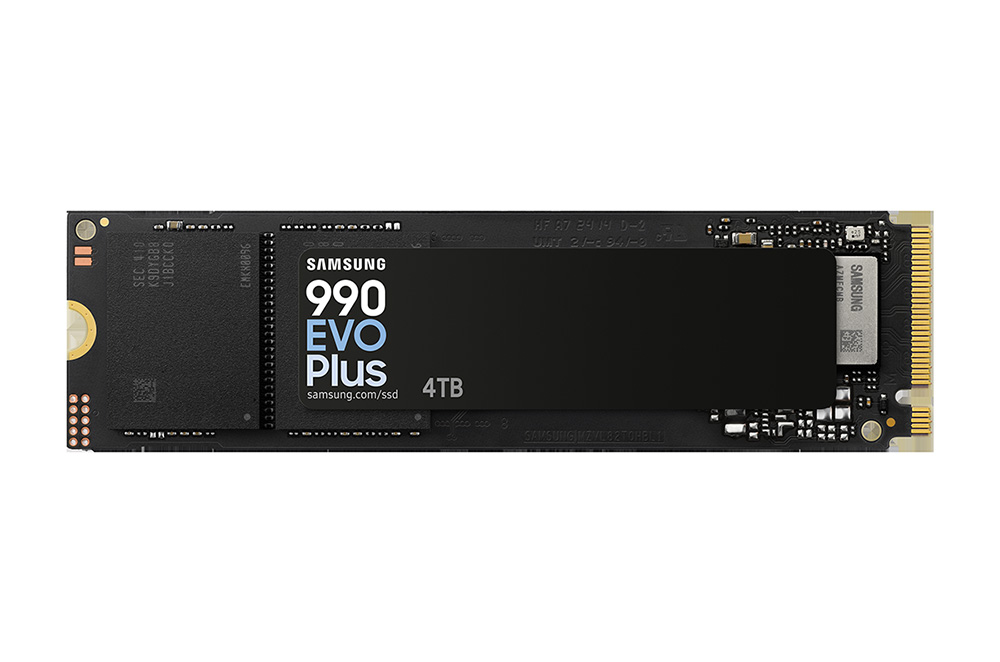
Samsung 990 EVO Plus
A DRAM-less PCIe 4.0 M.2 drive from Samsung with capacities up to 4 TB, rated at up to 7,250 MB/s sequential read.
Full Specification Sheet
| Interface | PCIe 4.0 x4 / PCIe 5.0 x2, NVMe 2.0 |
|---|---|
| Capacity | 1 TB / 2 TB / 4 TB |
| Sequential Read | up to 7,150 MB/s (1 TB), 7,250 MB/s (2 TB, 4 TB) |
| Sequential Write | up to 6,300 MB/s |
| Random Read / Write (QD32) | up to 850K-1,050K / 1,350K-1,400K IOPS |
| NAND | Samsung V-NAND TLC (8th generation) |
| Cache | Host Memory Buffer (DRAM-less) |
| Endurance (TBW) | 600 / 1,200 / 2,400 TB |
| Form Factor | M.2 2280 |
| Warranty | 5 years limited |
The Samsung 990 EVO Plus is a consumer NVMe solid-state drive in the M.2 2280 format. Samsung Electronics America announced its availability on 22 October 2024 as a refinement of the earlier 990 EVO, adding a higher capacity tier, faster rated speeds and a nickel-coated heat shield. It sits below the 990 PRO in Samsung's range: it is aimed at buyers who want a fast, efficient drive for gaming, creative work and general use without paying for the most extreme controller and cache design. This page walks through the published specification, explains what the numbers mean and points out where the design makes trade-offs.
Interface and compatibility
The drive uses the NVMe 2.0 protocol over either a PCIe 4.0 x4 link or a PCIe 5.0 x2 link. That second option is easy to overlook. A PCIe 5.0 x2 connection carries roughly the same raw bandwidth as PCIe 4.0 x4, so the drive is designed to reach its rated speeds both in a conventional Gen4 slot and in a Gen5 slot that has been split or limited to two lanes, which is common on laptops and compact boards. Samsung's data sheet also states that the drive is backward compatible with PCIe 4.0 x4 and PCIe 3.0 x4 hosts, so it can be installed in older systems, although the top rated speeds need a Gen4 or faster link. The physical format is M.2 2280, with maximum dimensions of 80.15 x 22.15 x 2.38 mm, and the low profile makes it usable in most notebooks and small-form-factor builds. A motherboard with a heatsink over the M.2 slot is fine, but check the clearance if you plan to add a thicker aftermarket cooler.
Speeds as stated by Samsung
Samsung lists sequential read speeds of up to 7,150 MB/s for the 1 TB model and up to 7,250 MB/s for the 2 TB and 4 TB models, with sequential write of up to 6,300 MB/s across the range. Random performance at a queue depth of 32 is given as up to 850K read and 1,350K write IOPS for 1 TB, 1,000K and 1,350K for 2 TB, and 1,050K and 1,400K for 4 TB. Samsung says the drive is up to 50 percent faster than the previous 990 EVO. These are manufacturer-stated figures, measured with IOmeter 1.1.0 on a test system built around a Ryzen 9 7950X, DDR5-4800 memory and an ASRock X670E Taichi board, and Samsung notes that write results were measured with its Intelligent TurboWrite technology active and that real performance varies with firmware, host hardware and configuration. Treat them as a ceiling under favourable conditions rather than a promise for every workload.
Controller, NAND and the DRAM-less design
Inside the drive is a Samsung in-house controller, which the company's announcement describes as a 5 nm design, paired with Samsung V-NAND TLC flash from its eighth generation. The data sheet lists the cache memory as HMB, the Host Memory Buffer. That means the drive has no DRAM chip of its own and instead borrows a small slice of the system's main memory to hold its mapping tables. The approach saves cost and power and keeps the board compact. Samsung argues that the 4 TB model's random results come close to what drives with DRAM achieve, which is a claim about its own tests; the practical point is that HMB designs behave well on modern PCs with plenty of RAM and do best when the workload is not a long, sustained random-write storm. If that distinction matters to you, our explainer on DRAM cache versus DRAM-less SSDs covers when it does and does not.
Samsung also cites its Intelligent TurboWrite 2.0 technology, a dynamic caching scheme in which part of the TLC flash temporarily behaves like faster single-bit storage so that bursts of writes complete quickly. As with all such schemes, the cache is finite, so very large continuous writes eventually fall back to the native speed of the flash. Samsung describes the revised version as improving file-transfer speed and reducing lag when handling large files, but it does not publish cache sizes for this model in the material we reviewed, so we do not quote one.
Capacities, endurance and warranty
The drive is sold in 1 TB, 2 TB and 4 TB capacities. The rated endurance is 600 TB written for the 1 TB model, 1,200 TB for 2 TB and 2,400 TB for 4 TB, backed by a five-year limited warranty that ends at whichever of the time or written-data limit comes first. It helps to turn those totals into something tangible. Spread over five years, 600 TBW works out to about 329 GB of writes every single day for the 1 TB drive, about 657 GB per day for the 2 TB drive and about 1.3 TB per day for the 4 TB drive. Typical home use is far below that, so the endurance rating is unlikely to be the limiting factor for gaming and office workloads, while heavy video or data-processing use is where the larger capacities make sense. Our guide to SSD endurance and TBW ratings describes how to read these numbers and when to worry about them.
Samsung lists the mean time between failures as 1.5 million hours, an operating temperature range of 0 to 70 degrees Celsius as measured by the drive's SMART temperature, and a non-operating range of minus 40 to 85 degrees Celsius. The data sheet also states that proper airflow is recommended, which is sensible advice for any NVMe drive that sits under a graphics card or in a poorly ventilated notebook.
Security, software and features
The drive supports AES 256-bit full-disk encryption, TCG/Opal V2.0 and Microsoft's Encrypted Drive standard (IEEE 1667), which lets an operating system that supports hardware encryption use the drive's built-in engine. Standard housekeeping features such as TRIM, garbage collection and S.M.A.R.T. reporting are listed. Samsung Magician, the company's management software, handles firmware updates, health monitoring, data migration when you upgrade and optimisation settings. The nickel-coated heat shield built into the label is Samsung's answer to heat on a bare M.2 stick: the company states that it reduces overheating and contributes to a 73 percent improvement in power efficiency compared with the 990 EVO, again a manufacturer figure from its own comparison.
Price and where it fits
Samsung published suggested retail prices of $109.99 for 1 TB, $184.99 for 2 TB and $344.99 for 4 TB at launch, and street prices have moved since then, so check current listings. The 4 TB size is the notable addition, because it exceeds what the 990 EVO offered and gives a single-slot option for large game libraries or media archives. Compared with the 990 PRO 4 TB already covered on this site, the 990 EVO Plus trades a DRAM cache and a higher endurance class for lower cost and power draw. If you are choosing between siblings, use our side-by-side pages: 990 EVO Plus versus 9100 PRO for the step up to PCIe 5.0, and 990 EVO versus 990 EVO Plus for the direct predecessor.
Who should consider it
The 990 EVO Plus suits a desktop or laptop that has a free PCIe 4.0 M.2 slot and needs a large, quick, power-conscious drive for a game library, a working project folder or a boot drive. It is less compelling for someone who writes many hundreds of gigabytes every day, who needs sustained random-write performance under heavy load, or who already has a Gen5 platform and wants the higher sequential ceiling. Browse the wider storage category to see how it compares with other drives on the site.
All specifications on this page are taken from Samsung's launch announcement and product data sheet. Availability, capacities and pricing can differ by region, and Samsung reserves the right to change specifications without notice.
Product image: Samsung Electronics America press material.