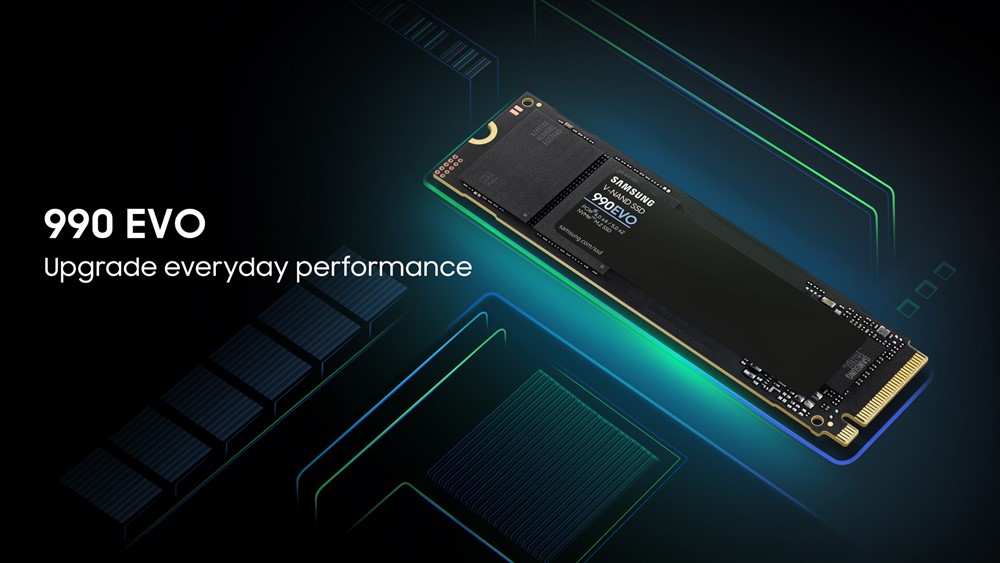
Samsung 990 EVO
A DRAM-less M.2 NVMe drive that runs on either PCIe 4.0 x4 or PCIe 5.0 x2, rated at up to 5,000 MB/s read.
Full Specification Sheet
| Interface | PCIe 4.0 x4 / PCIe 5.0 x2, NVMe 2.0 |
|---|---|
| Capacity | 1 TB / 2 TB |
| Sequential Read | up to 5,000 MB/s |
| Sequential Write | up to 4,200 MB/s |
| Random Read / Write (QD32) | up to 680K-700K / 800K IOPS |
| NAND | Samsung V-NAND 3-bit TLC |
| Cache | Host Memory Buffer (DRAM-less) |
| Endurance (TBW) | 600 / 1,200 TB |
| Form Factor | M.2 2280 |
| Warranty | 5 years limited |
The Samsung 990 EVO is a mainstream NVMe solid-state drive in the M.2 2280 format, announced by Samsung Electronics on 24 January 2024. Samsung describes it as the newest addition to its consumer SSD lineup at that time, designed for everyday computing such as gaming, office work and photo or video editing. It replaced the well-known 970 EVO Plus as the value-oriented EVO model, and it was later followed by the faster 990 EVO Plus. This page sets out the published specification, explains the unusual interface arrangement and describes where the drive fits.
The dual-mode interface
The most distinctive feature is the interface. The 990 EVO supports both PCIe 4.0 x4 and PCIe 5.0 x2 with the NVMe 2.0 protocol. The reason is bandwidth arithmetic: a PCIe 5.0 lane carries about twice the data of a PCIe 4.0 lane, so two Gen5 lanes give roughly the same raw bandwidth as four Gen4 lanes. Samsung's pitch is that the drive suits today's PCs with PCIe 4.0 M.2 slots, while also working with the Gen5 arrangements that laptops and compact boards use when they give an SSD only two lanes, with thermal control and power savings for those systems. For a desktop with an ordinary Gen4 slot, the practical result is a drive limited by its own controller rather than by the slot.
Speeds as stated by Samsung
Samsung lists sequential read speeds of up to 5,000 MB/s and sequential write of up to 4,200 MB/s. Random performance at a queue depth of 32 is given as up to 680K read and 800K write IOPS for the 1 TB model and up to 700K read and 800K write IOPS for the 2 TB model. Samsung says this is up to 43 percent better than the 970 EVO Plus, and that power efficiency improves by up to 70 percent over that earlier drive. These are manufacturer-stated figures, based on IOmeter measurements on a Ryzen 9 7950X test system, and the company notes that real performance depends on firmware, hardware and configuration. Treat 5,000 MB/s as the top of the range: it is well below what the fastest Gen4 drives reach, and the drive is deliberately aimed at everyday performance rather than benchmark leadership.
DRAM-less design with Host Memory Buffer
The 990 EVO uses Samsung's in-house controller and V-NAND 3-bit TLC flash, and it has no DRAM cache of its own. Instead it uses Host Memory Buffer technology, in which the SSD links directly to a small portion of the host processor's system memory to store the tables it needs. Samsung says this allows optimised performance even with a DRAM-less design. The benefit is lower cost, lower power use and a simpler board; the trade-off is that behaviour under long, sustained random writes can be less consistent than on a drive with dedicated DRAM. Our explainer on DRAM cache versus DRAM-less SSDs explains when that difference is noticeable and when it is not. For a typical desktop or laptop it rarely is.
Power and thermal design
Power efficiency was a headline goal. The drive supports Modern Standby, the Windows low-power state that allows an instant on and off and keeps network connectivity and notifications alive, which is relevant mostly for laptops. The heat spreader label is described by Samsung as effectively regulating the temperature of the NAND so the drive can keep running at its top level without compromising integrity. There is no separate heatsink option in the launch announcement, so on a desktop board rely on the motherboard's own M.2 cover, and in a laptop rely on the chassis airflow. Our guide to NVMe thermal throttling and heatsinks explains when extra cooling matters for a drive of this class.
Capacity, endurance and warranty
The 990 EVO is sold in 1 TB and 2 TB capacities. Rated endurance is 600 TB written for the 1 TB model and 1,200 TB for the 2 TB model, and the drive is covered by a five-year limited warranty that ends at the earlier of the time or written-data limit. Averaged across five years, 600 TBW is about 329 GB of writes a day, and 1,200 TBW is about 657 GB a day. Those figures are far above the write volume of typical home use. The drive also supports AES 256-bit full-disk encryption, TCG/Opal V2.0 and Microsoft's Encrypted Drive standard, and Samsung Magician software covers data migration, health monitoring and firmware updates. For background on how to interpret endurance ratings, read our guide to SSD endurance and TBW.
Compatibility checks before you buy
Before choosing any M.2 drive, confirm three things. First, the slot must be M.2 with a Key M connector and must accept the 2280 length, which means an 80 mm long, 22 mm wide module; some compact laptops and handheld devices use shorter formats. Second, check whether the slot is wired for PCIe and NVMe rather than SATA only, because a few older boards use M.2 slots that support only SATA drives. Third, read the motherboard or laptop manual to see how many lanes the slot receives and whether it shares them with other connectors, since a drive that supports both PCIe 4.0 x4 and PCIe 5.0 x2 is only as fast as the link it is given. The 990 EVO is backed by Samsung Magician, which can also help you check the drive's health after installation and keep its firmware current, and the software includes migration tools if you are replacing an existing system drive.
Price and where it fits
Samsung published suggested retail prices of $124.99 for 1 TB and $209.99 for 2 TB at launch; street prices have moved since then. Today the 990 EVO sits between older SATA and low-end NVMe drives and the faster 990 EVO Plus, which adds a 4 TB tier and higher rated speeds. If you are weighing the two, our 990 EVO versus 990 EVO Plus comparison lays out the differences side by side. For a high-end alternative with DRAM, the 990 PRO 4 TB is also listed on this site, and the full range is in the storage category.
Who should consider it
The 990 EVO suits a mainstream desktop or laptop that needs a quick boot and application drive, a game library up to 2 TB or an upgrade from a SATA SSD or older NVMe drive, and it is particularly reasonable in systems with limited power or thermal headroom. It is less suited to sustained heavy writing, to workstations that move very large files continuously, or to anyone who wants the highest Gen4 or Gen5 speeds. All specifications here come from Samsung's launch announcement, and availability and pricing differ by region.
Product image: Samsung Electronics press material.