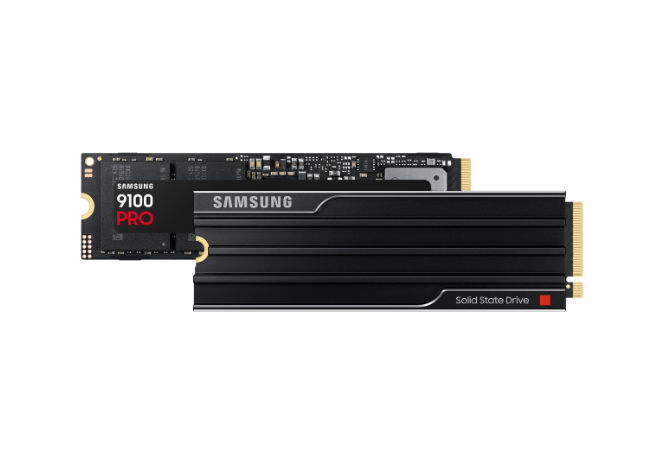
Samsung 9100 PRO
Samsung's first full PCIe 5.0 consumer NVMe drive, rated at up to 14,800 MB/s read with LPDDR4X cache and capacities up to 8 TB.
Full Specification Sheet
| Interface | PCIe 5.0 x4, NVMe 2.0 |
|---|---|
| Capacity | 1 TB / 2 TB / 4 TB / 8 TB |
| Sequential Read | up to 14,700 MB/s (1-2 TB), 14,800 MB/s (4-8 TB) |
| Sequential Write | up to 13,300 MB/s (1 TB), 13,400 MB/s (2-8 TB) |
| Random Read / Write | up to 1,850K-2,200K / 2,600K IOPS |
| NAND | Samsung V-NAND TLC (8th generation) |
| Cache | 1 / 2 / 4 / 8 GB LPDDR4X |
| Endurance (TBW) | 600 / 1,200 / 2,400 / 4,800 TB |
| Form Factor | M.2 2280, also with heatsink |
| Warranty | 5 years limited |
The Samsung 9100 PRO is the company's first consumer NVMe drive built around a full PCIe 5.0 x4 interface. Samsung Electronics America announced availability of the 9100 PRO series on 18 March 2025, in two variants: a bare M.2 2280 drive and a version with an integrated heatsink. It succeeds the 990 PRO at the top of the range, and Samsung positions it for AI workloads, 8K video editing, data analysis and gaming. This page summarises the published specification, explains how to read the numbers and describes the practical limits you should know about before buying.
A PCIe 5.0 drive, with the caveats
The interface is PCIe 5.0 x4 with the NVMe 2.0 protocol. A Gen5 x4 link offers roughly double the raw bandwidth of Gen4 x4, and Samsung says the drive moves data up to twice as fast as the previous generation. To use that link, the motherboard slot must be a Gen5 M.2 socket connected directly to the processor. Many boards provide only one such slot, and on some platforms a Gen5 M.2 socket shares lanes with the main graphics slot, so it is worth reading the board manual before planning a multi-drive build. Samsung's data sheet states that the drive is backward compatible with PCIe 4.0 x4 and PCIe 3.0 x4, so it will work in an older slot, but it will then be limited by that slot's bandwidth and you would be paying for capability you cannot use. Our Gen4 versus Gen5 upgrade guide helps decide whether the step up is worthwhile for your workload. The data sheet also lists PlayStation 5 among the supported hosts.
Speeds as stated by Samsung
Samsung lists sequential read speeds of up to 14,700 MB/s for the 1 TB and 2 TB models and up to 14,800 MB/s for the 4 TB and 8 TB models. Sequential write is up to 13,300 MB/s for 1 TB and up to 13,400 MB/s for the larger capacities. Random performance is quoted as up to 1,850K read IOPS for 1 TB and 2 TB and 2,200K for 4 TB and 8 TB, with up to 2,600K write IOPS across the range. The company says random performance is also a large step over the 990 PRO. These are manufacturer figures obtained with the FIO 3.33 tool on a Ryzen 9 7950X test system running Ubuntu, with Intelligent TurboWrite active for the write tests, and Samsung notes that results vary with firmware and system configuration. They describe a best case, not a guarantee for every transfer.
Controller, NAND and cache
The drive uses an in-house Samsung controller built on a 5 nm process, which Samsung credits for a power-efficiency gain of up to 49 percent over the 990 PRO, together with Samsung V-NAND TLC flash from its eighth generation. Unlike the 990 EVO Plus, which relies on the host's memory, the 9100 PRO carries its own DRAM-class cache: the data sheet lists 1 GB of LPDDR4X for the 1 TB model, 2 GB for 2 TB, 4 GB for 4 TB and 8 GB for 8 TB. That is roughly one gigabyte per terabyte, the conventional ratio for holding a drive's full mapping table in fast memory. Having the table on the drive helps keep random access consistent under sustained load, and it is a main reason the PRO line costs more than the EVO line. Intelligent TurboWrite 2.0 provides an additional dynamic write cache, listed at 114 GB, 226 GB and 442 GB for the 1 TB, 2 TB and 4 TB models.
Heat, power and the heatsink version
PCIe 5.0 SSDs run hotter than earlier generations, and Samsung addresses that in two ways. The standard 9100 PRO is a bare M.2 stick that expects a motherboard heatsink, while the 9100 PRO with Heatsink adds an integrated cooling layer, which Samsung says brings lower energy consumption and a cooler, longer-lasting drive. Choose the heatsink version for a board without a good M.2 cover or for a PlayStation 5 slot that needs a heatsink; choose the bare drive if your motherboard already provides one, since a double heatsink can clash with covers and clearances. Samsung specifies an operating temperature range of 0 to 70 degrees Celsius as measured by the SMART sensor and recommends proper airflow. Active power draw is listed at around 7.6 W to 9.0 W depending on capacity, which is a reminder that a Gen5 drive under load is a real thermal source in a small case. Our NVMe thermal throttling and heatsink guide explains how throttling works and how to avoid it.
The physical size is the same M.2 2280 footprint, with maximum dimensions of 80.15 x 22.15 x 2.38 mm for the 1 TB, 2 TB and 4 TB models. The 8 TB model is thicker, at up to 3.88 mm according to the data sheet, and Samsung notes that it follows the PCI-SIG D5 specification, so check the host device's clearance before installing it.
Capacity, endurance and security
The capacity range runs from 1 TB to 8 TB, and Samsung describes the 8 TB version as its first NVMe consumer drive of that size. At launch the 8 TB model was announced for the second half of 2025. Rated endurance is 600 TB written for 1 TB, 1,200 TB for 2 TB, 2,400 TB for 4 TB and 4,800 TB for 8 TB, with a five-year limited warranty that expires at the earlier of the time or written-data limit. Spread across five years, 1,200 TBW for the 2 TB drive equals about 657 GB of writes every day, well above typical desktop use. If you want to understand what these ratings measure, read our guide to SSD endurance and TBW. The mean time between failures is listed as 1.5 million hours. Security features include Class 0 AES 256-bit encryption, TCG/Opal V2.0 and Microsoft eDrive (IEEE 1667), and Samsung Magician provides firmware updates and health monitoring.
Pricing and positioning
Samsung listed suggested retail prices of $199.99 for 1 TB, $299.99 for 2 TB and $549.99 for 4 TB, with the heatsink versions at $219.99, $319.99 and $569.99 respectively; the 8 TB price was not stated at launch. Street prices change, so treat these as launch figures. The 9100 PRO is a specialised purchase: it makes most sense for a workstation or high-end desktop where sequential bandwidth or large-file handling is a real bottleneck, such as 8K video, big data sets or local AI model files. For general gaming and office work the difference from a good Gen4 drive is less visible, and the 990 PRO 4 TB remains a strong Gen4 option on this site. For a direct look at the two lines, see the 990 EVO Plus versus 9100 PRO comparison, or browse the whole storage category.
Summary
The 9100 PRO combines PCIe 5.0 bandwidth, LPDDR4X caching, eighth-generation V-NAND and capacities up to 8 TB, with the usual costs of a fast Gen5 design: higher power draw, more heat and a price premium. All figures here come from Samsung's announcement and data sheet, and availability and prices differ by region.
Product image: Samsung Electronics America press material.