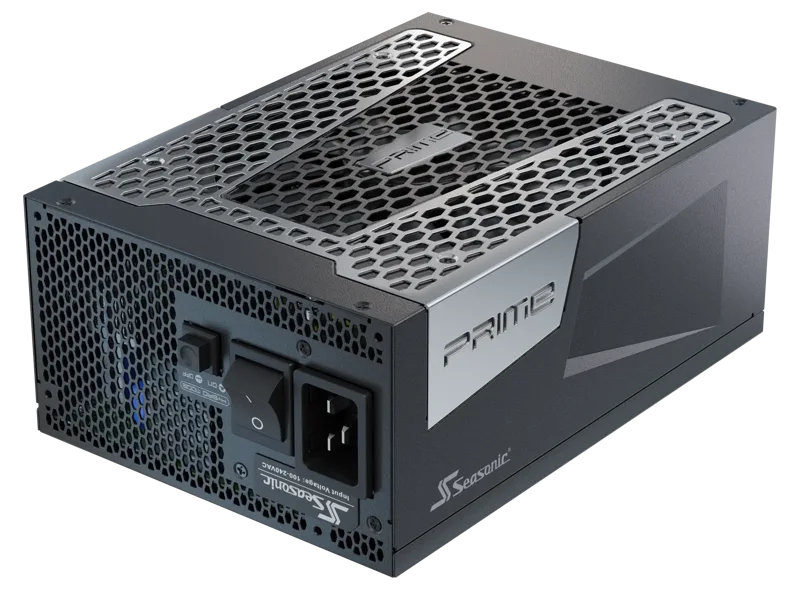
Seasonic PRIME TX ATX 3.1 (1300 W / 1600 W)
A fully modular ATX 3.1 power supply in 1300 W and 1600 W with 80 PLUS Titanium efficiency, native 12V-2x6 connectors, digital hybrid fan control, under 0.5 percent load regulation and a 12-year warranty.
Full Specification Sheet
| Wattage | 1300 W or 1600 W |
|---|---|
| Form Factor | ATX/EPS, 210 x 150 x 86 mm |
| Standard | ATX 3.1 and PCIe 5.1, native 12V-2x6 connectors |
| Efficiency | 80 PLUS Titanium, 94% at 50% load; Cybenetics Titanium |
| Noise Rating | Cybenetics Noise Level Lambda A |
| Fan | 135 mm fluid dynamic bearing, digital hybrid fan control |
| Rails (1600 W) | +12V 133.3 A (1600 W), +3.3V 25 A, +5V 25 A (125 W combined), +5Vsb 3 A |
| Load Regulation | Under 0.5% |
| Modularity | Fully modular, individual black braided cables |
| Protection | OPP, OVP, UVP, OCP, OTP, SCP |
| MTBF | 100,000 hours at 25 C (excl. fan) |
| Warranty | 12 years |
The Seasonic PRIME TX ATX 3.1 is a fully modular power supply built for very high-power desktops and workstations, sold in 1300 W and 1600 W versions. Seasonic states that it is built on the great features of the PRIME TX platform with added ATX 3.1 and PCIe 5.1 compatibility, and that it achieves the highest level of 80 PLUS certification on the market, Titanium, with 94 percent efficiency at 50 percent system load. The manufacturer also gives it a twelve-year warranty. This page reports the published specification and the features Seasonic describes, marks the manufacturer's own claims as claims, and leaves out anything the product page does not say, including a price.
Capacities and rails
Seasonic's specification table is written for the 1600 W model and shows 25 A on the +3.3 V rail, 25 A on the +5 V rail, 133.3 A on the +12 V rail, 0.5 A on the -12 V rail and 3 A on the +5 V standby output. The maximum power figures are 125 W for the combined 3.3 V and 5 V rails, 1600 W for the 12 V rail, 6 W for -12 V and 15 W for standby. The total continuous power is listed as 1600 W at 115 to 240 V AC for the larger model and 1300 W at 100 to 240 V AC for the smaller model, and the AC input current is 15 to 10 A at 50 to 60 Hz. The distinction between 115 V and 100 V input for the two versions is a practical detail to check if you plan to run the unit in a region with lower mains voltage. As with most modern supplies, essentially all of the capacity sits on the 12 V rail, where processors and graphics cards draw their power. For help judging how much capacity a system actually needs, our guide on how much PSU wattage you need is a good starting point, because a 1300 W or 1600 W unit is aimed at very demanding configurations.
Titanium efficiency
The 80 PLUS Titanium tier is the highest of the 80 PLUS efficiency levels, and Seasonic pairs it with a Cybenetics Efficiency Level of Titanium. Seasonic's headline figure is 94 percent efficiency at 50 percent system load. Efficiency is the fraction of the power taken from the wall that reaches the components, and the remainder is dissipated as heat, so a higher tier means less waste at the same output. The tiers are defined at specific load points and mains voltages, and the number depends on the testing conditions. For a plain-language look at what moving between tiers means, see our article on 80 PLUS Bronze versus Platinum efficiency, which explains the concept that also applies to Titanium.
Electrical design
Seasonic highlights three design features. First, micro tolerance load regulation: the company says the design keeps the output voltage within a very tight range, achieving under 0.5 percent load regulation, and describes this as an electrical-performance and stability benefit. Its FAQ is careful to add that this does not mean the PC will automatically run faster. Second, digital hybrid fan control, which the company calls a state-of-the-art digital fan control that keeps overall fan noise at the lowest possible level and even provides fanless operation at low load, with the note that the fan-curve chart is for reference only. Third, 105 degrees Celsius rated Japanese electrolytic capacitors, which Seasonic ties to long-term reliability. The specification also lists the Intel ATX specification as a compliance point.
ATX 3.1 and the 12V-2x6 connectors
The PRIME TX ATX 3.1 is described as ATX 3.1 and PCIe 5.1 ready, and both capacities are equipped with native 12V-2x6 connectors. Seasonic explains that earlier versions of this platform were released under ATX 3.0 and shipped with 12VHPWR cables, and that the current models use the revised 12V-2x6 connector instead. The cable table lists a 700 mm 12V-2x6 cable with a 12+4-pin connector at each end, two of them for the 1600 W model and one for the 1300 W model. Seasonic gives a specific installation warning: both 12V-2x6 connectors of the cable must always be plugged into the power supply and the graphics card, fully inserted, click-locked and tight, and the cable should not be bent or forced after it is plugged in. Read our explainer on the 12VHPWR connector for the background to that advice.
Fan, construction and durability
The fan is 135 mm with a fluid dynamic bearing, controlled by the digital hybrid system, and the listed life expectancy is 50,000 hours at 40 degrees Celsius and 15 to 65 percent relative humidity. Seasonic's page explains that fluid dynamic bearings use oil to absorb impact and lubricate the shaft, which reduces friction and vibration and, in the company's words, makes them extremely reliable and quieter than ball-bearing fans. The Cybenetics noise level is Lambda A. The operating temperature is 0 to 50 degrees Celsius and the MTBF is 100,000 hours at 25 degrees Celsius excluding the fan. The housing measures 210 by 150 by 86 mm, and Seasonic itself points out that ATX power supplies vary in depth and that drive cages or limited cable-routing space can reduce the room available in some cases, so the length needs to be checked against the case before purchase.
Cables
The unit is fully modular with individual black cables in a braided pattern. For the 1600 W version the cable table lists one 610 mm 24/20-pin motherboard cable, three 700 mm CPU 8/4-pin cables, six 750 mm PCIe 8/6-pin cables with one connector each, four 950 mm SATA cables with four connectors each, one 550 mm SATA cable with two 3.3 V connectors, one 690 mm Molex cable with three connectors and two 700 mm 12V-2x6 cables. The 1300 W version has a single 12V-2x6 cable. That many PCIe and SATA leads mean careful routing matters, and our guide to modular power supply cable management describes how to keep a build tidy.
Protection and certification
Listed protections are over-power, over-voltage, under-voltage, over-current, over-temperature and short-circuit protection, and the input is full range. Safety and EMC certifications include cTUVus, TUV, CB, CCC, BSMI, EAC and CE, and the environmental compliance list names RoHS, WEEE, ErP Lot 6 and REACH. Seasonic offers a datasheet, quick installation guide and user manual as downloads. Its FAQ notes that the 1300 W and 1600 W models can make sense for content creation or professional workstations as well as gaming PCs, but that the supply should be chosen by the complete system, including the number and type of GPU power connections.
Where it fits
This is a high-capacity, high-efficiency unit with a long warranty, so it suits builds where the load is large and steady enough to justify the cost. For a smaller efficient unit from another maker, see the comparison with the be quiet! Straight Power 12 1200W, and browse the whole power supply category. Every number on this page is a manufacturer specification or claim; none of it is a test result.