80 PLUS Explained: Bronze vs. Platinum PSU Efficiency
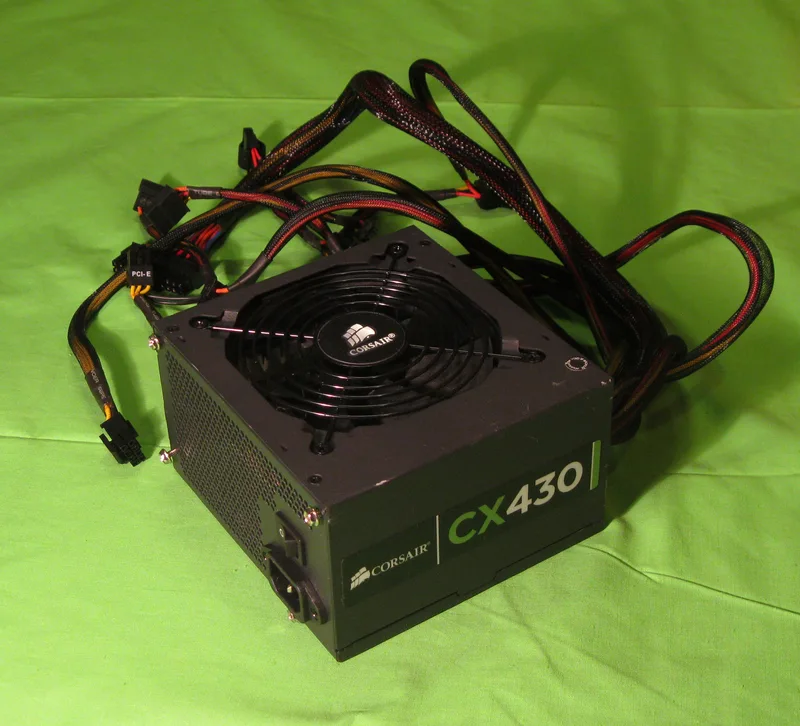
The 80 PLUS badge on a power supply box is one of the most misunderstood ratings in PC hardware. It's not a build-quality score, a wattage indicator, or a durability guarantee — it's a specific, tested measurement of how efficiently a PSU converts wall power into the DC power your components actually use. Comparing the entry-tier Corsair CX430 (80 PLUS Bronze) against the premium be quiet! Straight Power 12 1200W (80 PLUS Platinum) shows exactly what that efficiency tier difference means in practice, in dollars, and in heat.
What 80 PLUS actually measures
Every 80 PLUS tier — White, Bronze, Silver, Gold, Platinum, and Titanium — certifies a minimum efficiency percentage at three load points: typically 20%, 50%, and 100% of the PSU's rated capacity. 80 PLUS efficiency ratings guarantee the unit converts at least that percentage of the AC power it draws from the wall into usable DC power for your components; the rest is lost as heat. A Bronze-rated unit like the Corsair CX430 is certified around 82-85% efficient at typical loads, while a Platinum-rated unit like the Straight Power 12 1200W must hit roughly 90-92% efficiency across the same load points — a meaningfully smaller slice of wasted energy per watt delivered.
What that gap actually costs you in electricity
The efficiency difference sounds small as a percentage, but it compounds over the life of a PSU that's running essentially every hour your PC is on. A system drawing 400W of actual component power from a Bronze unit at roughly 85% efficiency pulls close to 470W from the wall; the same system on a Platinum unit at roughly 91% efficiency pulls closer to 440W. That 30W gap, multiplied across thousands of hours of use per year, adds up to a real, measurable electricity cost difference — one that can partially or fully offset the higher upfront price of a Platinum unit over several years of ownership, especially for systems that run near-constantly, like home servers or workstations.
Heat, noise, and fan behavior
Wasted energy from lower efficiency doesn't just vanish — it becomes heat inside the power supply, which the unit's fan has to remove. A less efficient PSU running under sustained load generates more internal heat and typically needs to spin its fan faster and louder to manage it, while a higher-efficiency unit produces less waste heat in the first place and can often run its fan slower, or not at all under light loads if it has a semi-passive "zero RPM" mode, which most Platinum and Titanium units include. If a quiet build matters to you, efficiency tier is one of the more overlooked levers for reducing case noise, alongside case fans and CPU cooler choice.
How the certification is actually earned
80 PLUS certification isn't self-reported by manufacturers — it's administered by an independent testing program that measures a submitted unit's efficiency at multiple load points, on multiple input voltages (since PSUs sold globally need to perform on both 115V and 230V mains), and publishes the results publicly. This is worth knowing because it means the badge on the box reflects a real, third-party-verified measurement rather than marketing language, and you can look up the actual published test data for a specific PSU model rather than relying on the manufacturer's own claims. Counterfeit or mislabeled units do occasionally surface in grey-market retail channels, which is one more reason to buy power supplies from established brands and reputable retailers rather than unfamiliar budget listings with suspiciously aggressive pricing.
Efficiency isn't the only quality signal on a PSU
It's worth being clear that 80 PLUS tier measures efficiency specifically, not overall build quality. Two other characteristics matter just as much for a genuinely good power supply: voltage regulation, meaning how stable the output stays under varying load and transient spikes, and ripple suppression, meaning how clean the DC output is. A unit can technically hit Gold or Platinum efficiency while still using mediocre capacitors and a less refined internal design than a well-engineered Bronze unit from a reputable brand. Efficiency certification tier is a genuinely useful shorthand, but it's not a complete substitute for reading a full component-level review before buying, especially for a PSU that's going to run expensive components for years.
Wattage tier and efficiency tier are separate decisions
It's easy to conflate "bigger PSU" with "better PSU," but wattage and efficiency certification answer two different questions. Wattage tells you the maximum load the unit can safely supply; efficiency tier tells you how much of the power it draws gets wasted as heat at a given load. We cover choosing the right wattage for your specific build in our PSU wattage guide, which pairs directly with this efficiency comparison — you genuinely need both numbers to pick the right unit, and neither one substitutes for the other.
Where Bronze remains the right, sensible choice
None of this makes Bronze-tier units a bad purchase. For a budget build, a secondary PC, or any system where the PSU won't be under sustained heavy load for years on end, a well-reviewed Bronze unit like the CX430 delivers safe, stable power at a price point that makes sense — the extra cost of jumping to Gold or Platinum simply won't pay itself back through electricity savings on a lightly-used system before the PSU is retired anyway. Efficiency tier matters most as a multi-year cost consideration for systems that run heavy, near-constant loads.
Where paying up for Platinum genuinely makes sense
Platinum and Titanium tiers earn their premium on systems that draw significant, sustained power for years — high-end gaming rigs paired with power-hungry CPUs and GPUs, workstations doing long render or compute jobs, or always-on home servers. On these systems, the electricity savings compound fast enough to matter, the reduced heat output helps overall case thermals, and many Platinum units include longer warranties that reflect the higher-grade components used to hit that efficiency target in the first place. Compare wattage and efficiency tiers side by side across the full power supply lineup before deciding which combination actually fits your build and how you plan to use it.