Corsair CX430 Review: The Sensible Budget PSU Pick
7.7/10
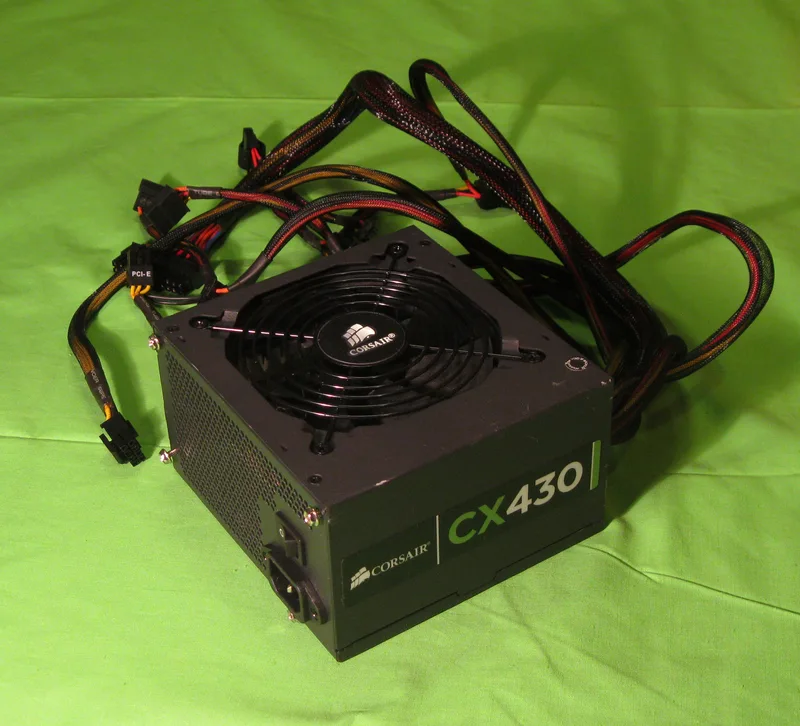
Corsair's CX430 is about as entry-level as a reputable-brand PSU gets: 430W, 80 PLUS Bronze certified, non-modular, and priced around $50. For a genuinely budget build — an office PC, a light gaming build without a power-hungry GPU, or a first-time build where the PSU line item needs to stay small — it's a straightforward, no-drama choice from a brand with a real reputation to protect, which is worth more in the PSU category specifically than in almost any other PC component.
Why brand reputation matters more for PSUs than most components
A PSU failure is uniquely dangerous among PC component failures — a failing GPU or a dead stick of RAM typically just stops working, but a PSU failing badly enough can send out-of-spec voltage to every component connected to it simultaneously, potentially damaging the motherboard, GPU, storage, and RAM all at once. This is why buying PSUs specifically from established, reputable manufacturers matters more than optimizing for the absolute lowest price in the category — a no-name budget PSU saving $10-15 over something like the CX430 is a real false economy if it lacks proper protection circuitry. Corsair's CX line has been a mainstay budget recommendation for years precisely because it delivers the protection and quality-control standards of a major brand at genuinely entry-level pricing.
What 430W actually covers
430W is enough headroom for a genuinely budget build: an entry-to-midrange CPU, no discrete GPU or a low-power one, a couple of storage drives, and standard system fans. It is not enough capacity for a current flagship or even upper-midrange GPU — modern high-end graphics cards alone can draw 300W+ under load, which leaves uncomfortably little headroom on a 430W total budget once the rest of the system is factored in. Buyers should check their intended GPU's recommended PSU wattage (published by every GPU manufacturer) against this unit's 430W ceiling before assuming it fits their build; for a build without a power-hungry discrete GPU, though, 430W is a comfortably sized, not undersized, budget.
80 PLUS Bronze: the entry-level efficiency tier
Bronze certification requires at least 82% efficiency at 20% and 100% load, and 85% at 50% load on 230V input — the baseline tier for a "properly certified, not embarrassing" PSU, sitting below Silver, Gold, Platinum, and Titanium in the 80 PLUS hierarchy. For a budget build where the PSU rarely runs near its rated capacity anyway (this unit sized for a build that doesn't need anywhere close to 430W under typical load), the efficiency difference between Bronze and a higher tier translates into a genuinely small amount of money over the system's lifetime — a few dollars a year in most home-use scenarios — which is exactly why Bronze remains the sensible default for budget-focused builds rather than a corner cut that matters.
Non-modular cabling: the real tradeoff at this price
Unlike this site's higher-tier PSUs, the CX430 ships with a fixed cable bundle rather than modular connectors — every cable is permanently attached whether your build uses it or not. For a simple budget build with modest cable needs (one GPU or none, a couple of drives), this is a minor inconvenience rather than a real problem; the unused cables can be tucked away or zip-tied out of the primary airflow path without much difficulty in most budget cases. It becomes more of a genuine annoyance in smaller cases with tighter cable-routing space, where unused fixed cables have fewer places to hide. For the straightforward builds this PSU is actually aimed at, it's a reasonable tradeoff for keeping the price this low.
Who should buy this, and who shouldn't
The right buyer is building or upgrading a genuinely budget-focused system — office use, light productivity, or gaming without a demanding discrete GPU — where PSU capacity needs are modest and every dollar of the budget matters elsewhere in the build. It's the wrong choice for anyone planning a current mid-range-or-better GPU, anyone who wants headroom for future GPU upgrades without replacing the PSU too, or anyone who specifically wants modular cabling for a clean, glass-panel-visible build.
How it compares to the top of this site's PSU category
Set directly against this site's own Straight Power 12 1200W, the gap illustrates the full range of the PSU category: the CX430 delivers roughly a third of the wattage at a fifth of the price, at a lower efficiency tier and without modularity. That isn't a knock against the CX430 — it's a reminder that PSU shopping should start from what the rest of the build actually needs, not from assuming more capacity or a higher efficiency tier is automatically the better purchase. A 1200W Platinum unit in a build that will never draw more than 250W is paying for headroom and efficiency gains the system can't use; a 430W Bronze unit in a build that needs 600W+ is a genuine risk. Matching PSU capacity to the actual build, with a modest safety margin rather than a large one, is the right way to shop this category at any price point.
Basic installation notes
As a standard ATX PSU, the CX430 fits any ATX-compliant case without special consideration, and installation follows the same universal steps as any PSU: mount it in the case's PSU bay (typically bottom-rear on modern cases), connect the 24-pin motherboard cable, 4/8-pin CPU power cable, and whichever SATA or peripheral power cables the build's drives and components need, then route the unused fixed cables away from airflow paths as neatly as the case allows. No configuration or driver installation is required — a PSU is entirely passive from the operating system's perspective.
Verdict
At roughly $50, the Corsair CX430 delivers exactly what a genuinely budget-focused build needs from its power supply: adequate wattage for a modest system, real Bronze-tier efficiency, and the protection circuitry and quality control that come with buying from an established brand rather than an unknown one. It's not the PSU for anyone building around a serious GPU, but for the budget systems it's actually sized for, it remains one of the more sensible, low-risk ways to check the power-supply box without overspending.
Related reading: be quiet! Straight Power 12 1200W review, more power supply reviews.