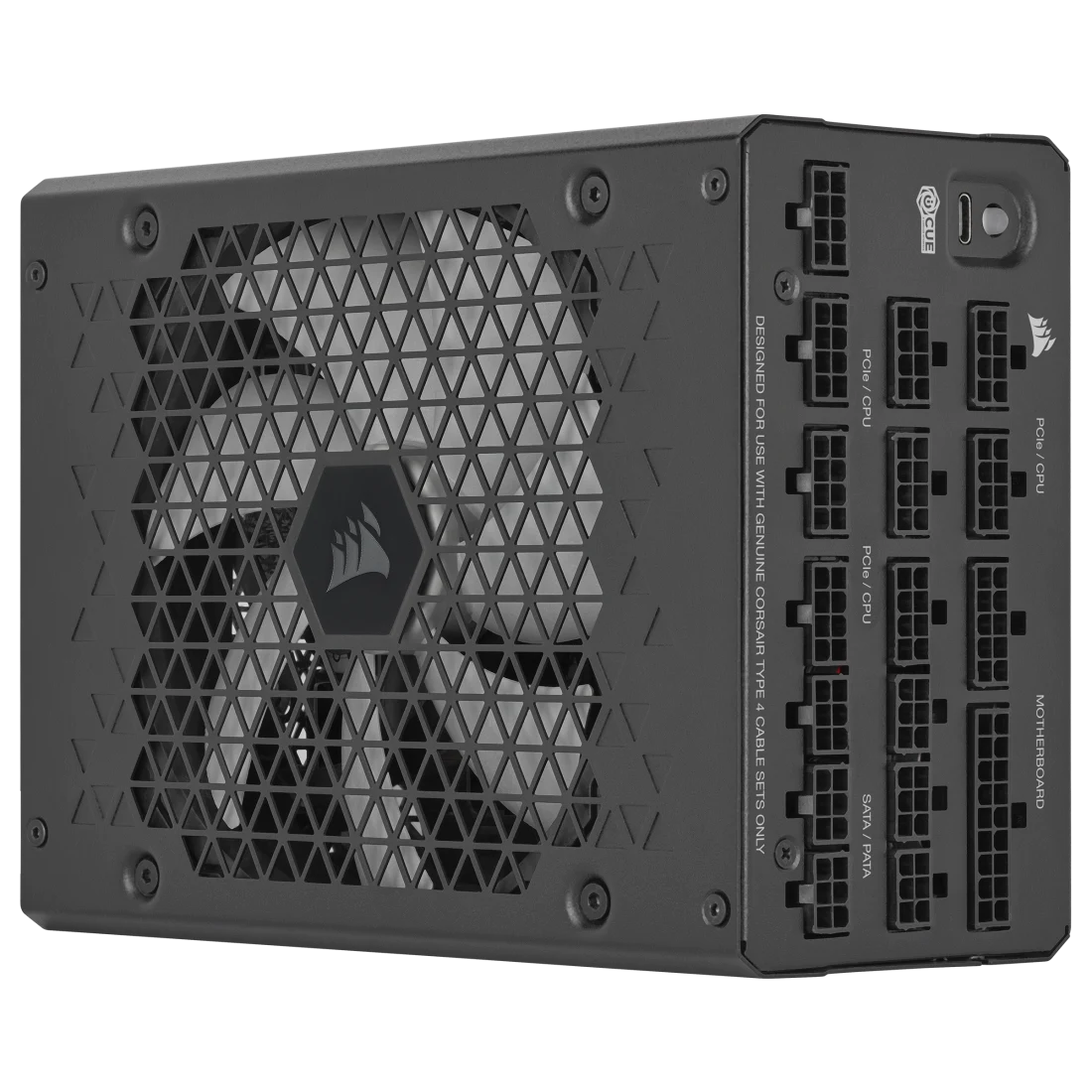
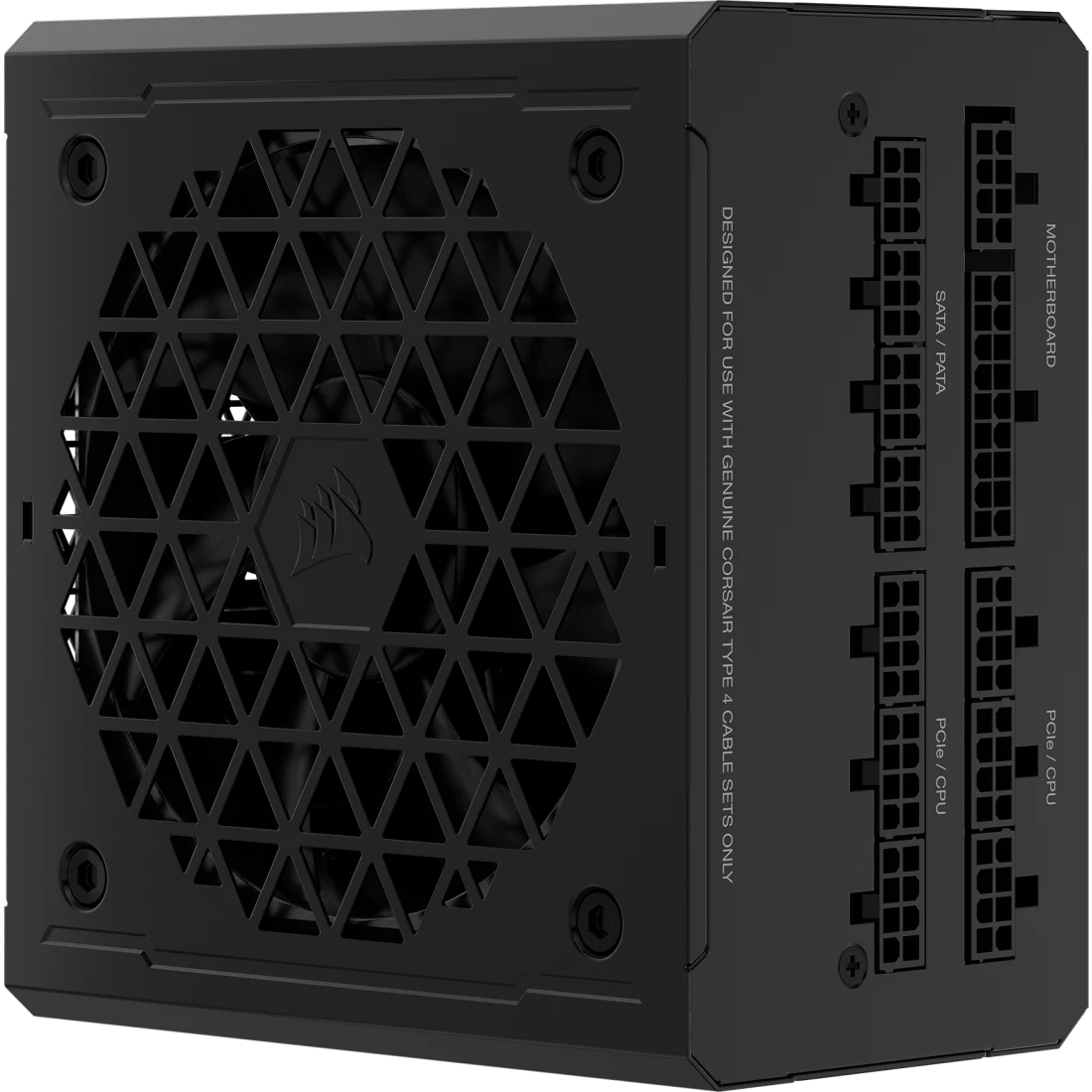
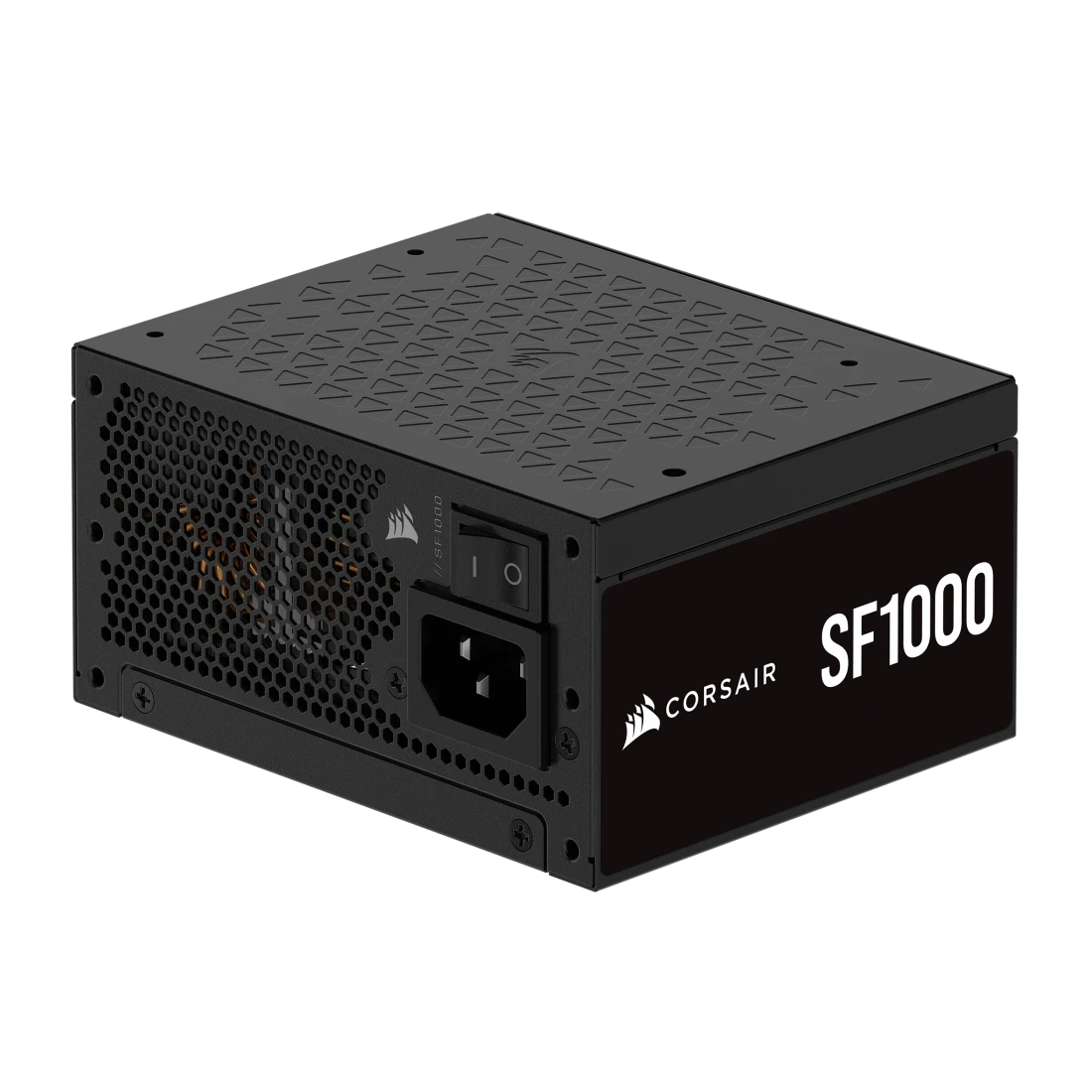
Corsair HX1000i Fully Modular Platinum ATX 1000 W
A 1000 W fully modular ATX 3.1 power supply with 80 PLUS Platinum efficiency, a native 12V-2x6 cable, a zero-RPM 140 mm fan, iCUE monitoring and a ten-year warranty.
Full Specification Sheet
| Wattage | 1000 W |
|---|---|
| Form Factor | ATX |
| Standard | ATX 3.1 and PCIe 5.1 certified, EPS12V 2.92 |
| Efficiency | 80 PLUS Platinum, up to 92% at typical load; Cybenetics Platinum |
| Noise Rating | Cybenetics Noise Level A |
| Modularity | Fully modular (Type 4 cables) |
| Fan | 140 mm fluid dynamic bearing, Zero RPM mode |
| Rails | +12V 83.3 A (999.6 W), +3.3V 25 A, +5V 25 A (150 W combined), +5VSB 3 A; single or multi rail via iCUE |
| GPU Cable | 12V-2x6 (12+4 pin) cable included, 650 mm |
| MTBF | 100,000 hours |
| Warranty | 10 years |
The Corsair HX1000i is a 1000-watt, fully modular ATX power supply from the HXi Series, which the manufacturer describes as digital, Platinum-rated power supplies for demanding PC upgrades. It is formally certified to the ATX 3.1 standard and to PCIe 5.1, and it ships with a 12V-2x6 graphics-card cable, so it is aimed at builders who plan to run a modern high-power graphics card without an adapter. The unit also connects to a computer through a USB cable so that Corsair's iCUE software can monitor and control it. This page collects the specification Corsair publishes, explains what each figure means in practice and leaves out anything the manufacturer's page does not state.
Rated power and rails
The unit is rated at 1000 W in total. Corsair's power table lists the +12 V rail at 83.3 A, which corresponds to a maximum of 999.6 W, the +3.3 V rail at 25 A and the +5 V rail at 25 A with a combined limit of 150 W for the two, and the +5 V standby output at 3 A or 15 W. The AC input rating is 100 to 240 V at 47 to 63 Hz with an input current of 13 A to 6.5 A, so the supply works on both 115 V and 230 V mains. Almost all of the capacity is on the 12 V rail, which is where modern processors and graphics cards draw their power, so the practical ceiling for those components is very close to the full label rating. Through iCUE the unit can be toggled between single-rail and multi-rail mode, a setting that decides whether the over-current protection of the 12 V output is shared or split. If you are unsure how much capacity a build needs, our guide to modular power supplies and cable management covers the cabling side, while the rating itself is explained below.
Efficiency, certifications and noise
The HX1000i carries the 80 PLUS Platinum certification, and Corsair states an efficiency of up to 92 percent at typical load. It is also Cybenetics certified, with a Platinum efficiency rating and a Cybenetics Noise Level A rating, which Corsair cites as confirmation of low-noise operation. Efficiency describes how much of the power drawn from the wall reaches your components rather than being lost as heat; at the same output, a Platinum unit wastes less than a Gold or Bronze one, which lowers heat and, indirectly, fan noise. Our explanation of 80 PLUS Bronze versus Platinum efficiency shows how the tiers differ and what the difference is worth on an electricity bill. The manufacturer also lists a rated operating temperature of 50 degrees Celsius for continuous output and a mean time between failures of 100,000 hours, which is a statistical figure and not a promise of lifetime.
ATX 3.1, PCIe 5.1 and the 12V-2x6 cable
The ATX 3.1 standard raises the requirements for reliability and efficiency, and while the manufacturer notes that many of its power supplies meet those requirements, HXi Series units are formally certified for ATX 3.1 compliance. The PCIe 5.1 12V-2x6 cable in the box is intended for modern graphics cards such as the GeForce RTX 40 series, and Corsair says the cable delivers up to 600 W directly to the card. Corsair's use-case notes add that ATX 3.1 certification covers transient loads, which are the short power spikes graphics cards can produce, and quote handling of spikes up to 200 percent of the card's rated power. Those are the manufacturer's statements. For the connector itself, including why it must be seated fully, read our explanation of the 12VHPWR power connector.
Connectors and cable set
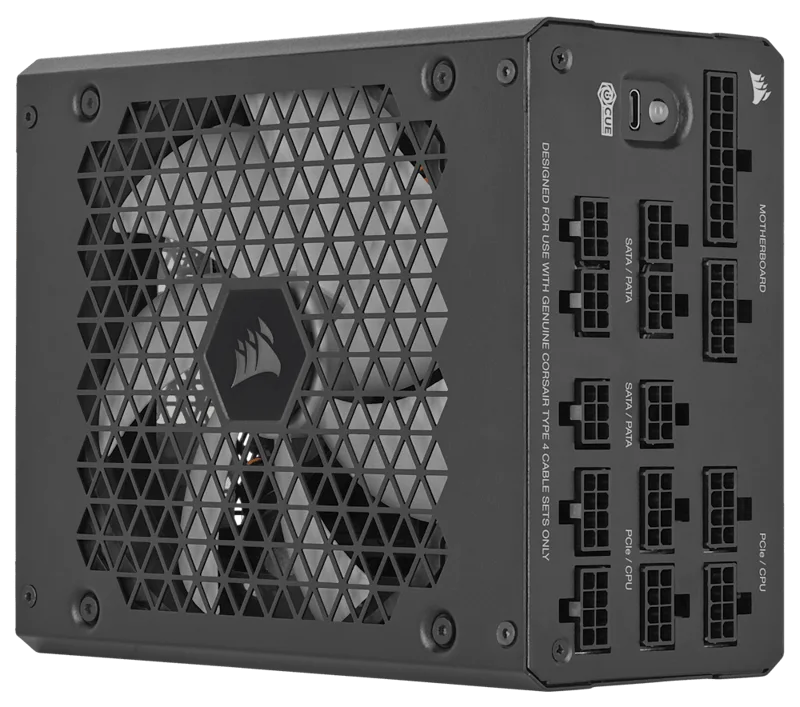
All cables are detachable, and Corsair says the unit is compatible with its Type 4 premium sleeved cable sets. The included set lists one 24-pin ATX cable of 610 mm with sleeving, two EPS or ATX 12V 8-pin (4+4) cables of 650 mm, two PCIe 8-pin (6+2) cables of 775 mm each with two connectors spaced 100 mm apart for a total of four, one 12V-2x6 cable of 650 mm, two SATA cables with four connectors each for eight in total, two four-pin PATA cables with four connectors each for eight in total, and a USB Type-C to internal 10-pin cable of 525 mm for iCUE. The marketing text speaks of three EPS12V connectors on the unit, while the cable list shows two EPS cables, so check the socket panel of the unit in your hands if you plan a dual-CPU board. Most cables are flat, which helps routing in tight cases; the main ATX cable is sleeved.
Fan and cooling
The cooling fan is a 140 mm fluid dynamic bearing model, a bearing type chosen for long life and quiet running, and the unit supports Zero RPM mode. In that mode the fan stops entirely at low and medium loads and starts to spin only as fast as needed, which makes the unit silent in idle and light use. Corsair also mentions a low-noise fan mode that can be selected through the software. Inside, the primary electrolytic capacitors are described as industrial-grade, 105 degree Celsius-rated Japanese parts, and the design is fully digital, which Corsair says gives clean, consistent power with minimal coil whine. The unit supports the Modern Standby sleep mode, with fast wake-from-sleep times.
Protections and software
Corsair lists over-voltage, under-voltage, over-current, over-power, short-circuit and over-temperature protections. With iCUE running and the USB cable connected, you can monitor power-supply performance, switch between single-rail and multi-rail operation and control fan speed from the desktop. The USB connection is optional, and the supply works without it, but the monitoring features need it. Software features and their availability depend on your operating system, so check compatibility before you rely on them.
Physical details and warranty
The unit is an ATX form factor with a listed weight of 3 kg. Corsair backs it with a ten-year warranty, one of the longest in the category and a useful signal for a component you may carry across several system rebuilds. The company's page also lists EPS12V version 2.92 and ATX12V version 3.1 as the supported standards. The product page states no price, so check the current price and availability with a retailer.
Where it fits
With 1000 W and a native 12V-2x6 cable, the HX1000i is sized for a high-end gaming or workstation build with a large graphics card and a power-hungry processor, while still leaving headroom so that the unit rarely works near its limit. For a smaller build, compare it with the HX1000i versus RM850x comparison, or look at the larger be quiet! Straight Power 12 1200W if you need more capacity, and browse the full power supply category. None of the statements above is a test result; they are the manufacturer's published specifications.
Product image: Corsair product image.