AMD Radeon RX 7600
A Radeon RX 7000 Series card built on AMD RDNA 3 with 32 compute units, 8 GB of GDDR6 on a 128-bit bus, a 165 W typical board power and a single 8-pin power connector.
Full Specification Sheet
| Series | Radeon RX 7000 Series (AMD RDNA 3) |
|---|---|
| Compute Units | 32 |
| Stream Processors | 2048 |
| Ray Accelerators | 32 |
| AI Accelerators | 64 |
| Boost Clock | Up to 2655 MHz |
| Game Clock | 2250 MHz |
| Memory | 8 GB GDDR6, 128-bit |
| Memory Speed | Up to 18 Gbps |
| Memory Bandwidth | Up to 288 GB/s |
| Infinity Cache | 32 MB |
| Typical Board Power | 165 W |
| Power Connectors | 1 x 8-pin |
| Minimum PSU Recommendation | 550 W |
| Outputs | DisplayPort up to 2.1 (depends on board design), HDMI 2.1 |
| Length / Slots | 204 mm / 2 slots |
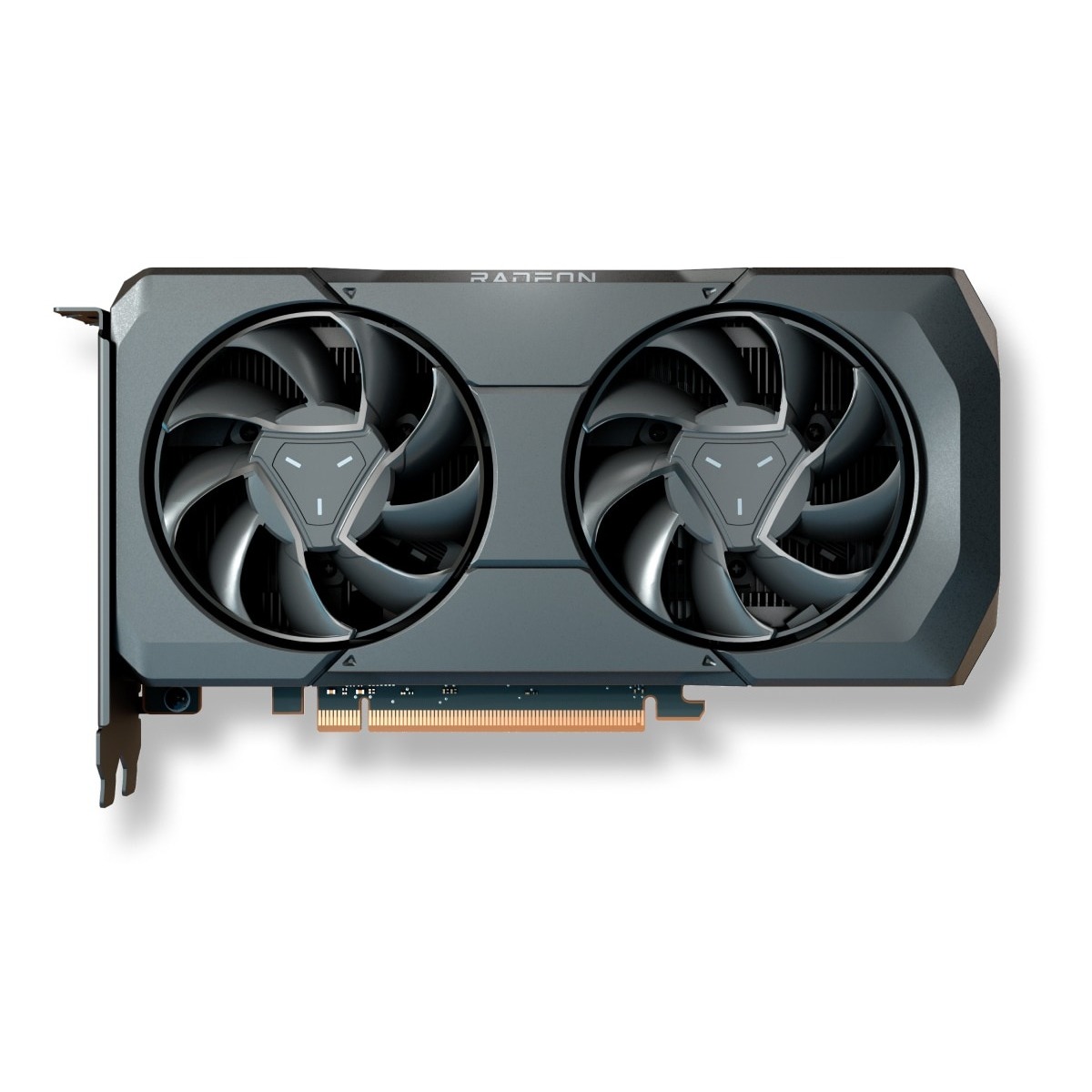
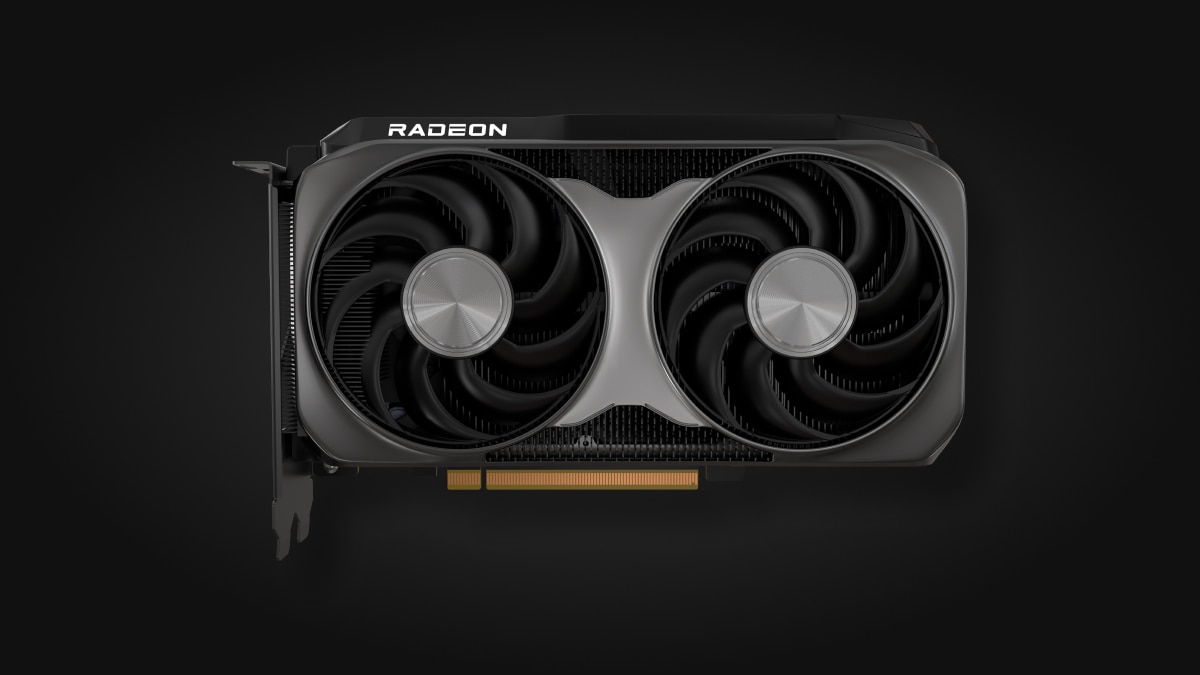
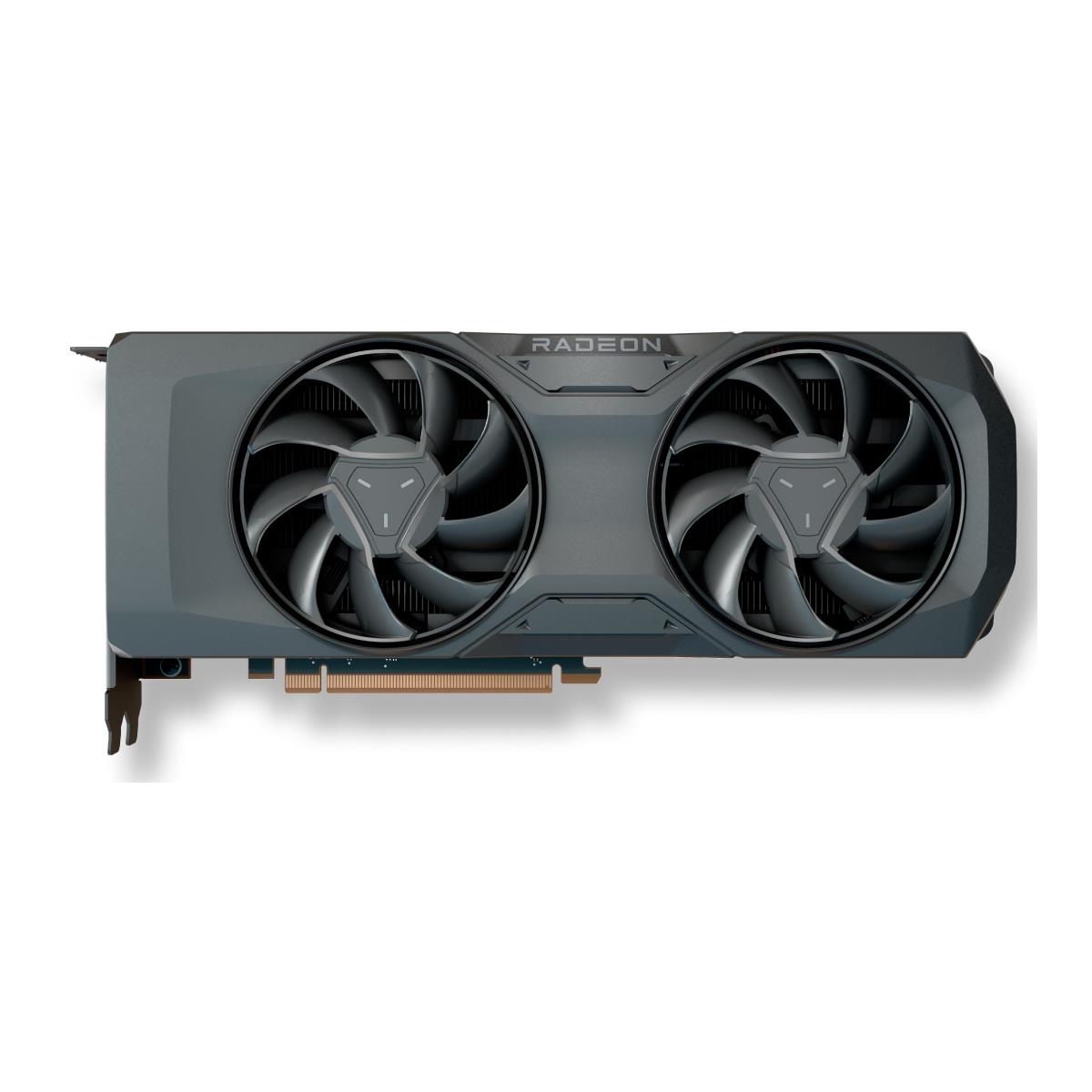
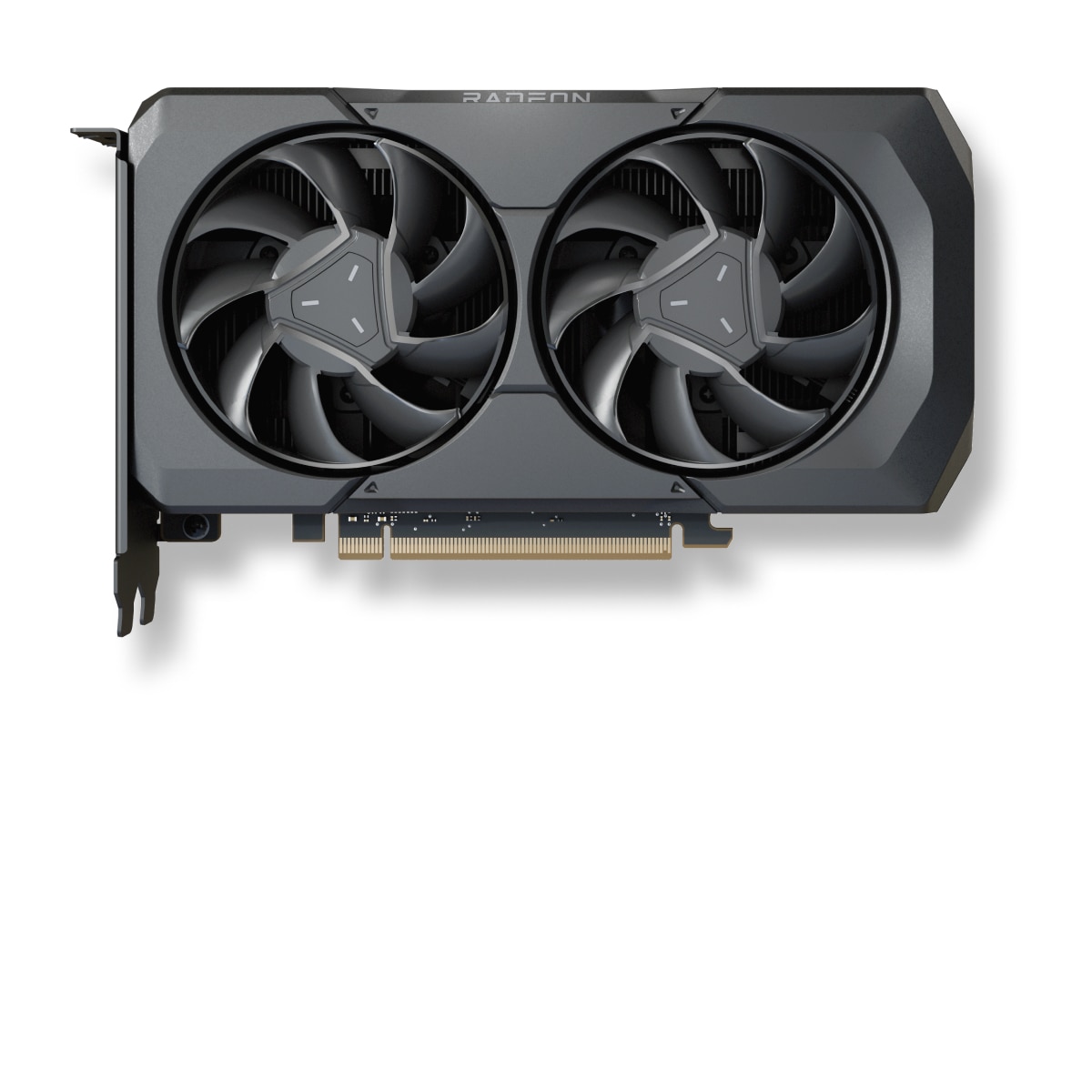
The AMD Radeon RX 7600 is a desktop graphics card in the Radeon RX 7000 Series. AMD's own product text describes it as built on the AMD RDNA 3 architecture, with 32 compute units, second-generation ray tracing accelerators and new AI accelerators, together with up to 8 GB of GDDR6 memory. It is a compact card by modern standards: the reference dimensions are 204 mm long and two slots wide, and it needs only a single 8-pin power connector. This page goes through the specification AMD publishes, explains what each line means when you are choosing a card, and leaves out whatever the manufacturer page does not state. There are no benchmark claims: every figure is a manufacturer specification unless it is marked as simple arithmetic. AMD's page gives neither a launch date nor a price, so this entry shows neither.
Compute units, accelerators and clocks
The GPU has 32 compute units. AMD lists 2,048 stream processors, 128 texture units, 64 render output units (ROPs), 32 ray accelerators and 64 AI accelerators. Dividing by the 32 compute units gives 64 stream processors, 4 texture units, 1 ray accelerator and 2 AI accelerators per compute unit; that is arithmetic from AMD's figures, and the same per-unit ratios apply to the larger RX 7800 XT, which makes cross-card comparison straightforward. Clocks are given as two numbers. The boost clock is up to 2655 MHz, which AMD defines as the maximum frequency the GPU can reach on a bursty workload and which varies with thermal conditions and the application. The game frequency is 2250 MHz, the expected clock in typical gaming applications at typical total graphics power. As always, the boost figure is a ceiling rather than an everyday value. The transistor count is given as 13.3 billion.
Peak rates AMD publishes
AMD lists theoretical peak figures rather than measured results: peak pixel fill rate up to 169.9 GP/s, peak texture fill rate up to 339.8 GT/s, peak single-precision (FP32 vector) performance of 21.7 TFLOPs, the same 21.7 TFLOPs for half-precision (FP16 vector) and 43.5 TFLOPs for FP16 matrix work. The integer figures are 43.5 TOPs for 8-bit matrix work and 87 TOPs for 4-bit matrix work. These describe what the hardware could do in ideal conditions and say nothing about how a particular game behaves. They are useful for comparing hardware on paper, not for predicting frame rates.
Memory: capacity, bus and bandwidth
The card carries 8 GB of GDDR6 on a 128-bit interface, with memory speed up to 18 Gbps. AMD lists memory bandwidth as up to 288 GB/s, which you can verify: 18 Gbps per pin across 128 pins is 2,304 Gbit/s, and dividing by eight gives 288 GB/s. AMD Infinity Cache adds 32 MB of on-GPU cache, and AMD lists an effective memory bandwidth of up to 477 GB/s that accounts for the cache; the page does not describe the method beyond the name, so treat it as AMD's own effective-bandwidth metric rather than a physical bus speed. Eight gigabytes is the point where the capacity question becomes important, and our guide on VRAM capacity from 8 GB to 24 GB explains when a bigger frame buffer matters and when it does not, without claiming results for any specific game.
Power and cooling requirements
The typical board power is 165 W, and the card uses one 8-pin additional power connector. The minimum power supply recommendation is 550 W with a 12 V output of 40 A. AMD says this is based on a PC configured with an AMD Ryzen 9 5900X processor plus typical requirements from other components, and that your own system requirements may differ, so if your build differs, work out your own total. Our guide on how much PSU wattage you need shows the reasoning. Board partners may ship the card with their own coolers, lengths and clocks; the 204 mm, two-slot dimensions here are the figures on AMD's page, so check the specific partner model's data sheet before you rely on them for a small case.
Display and media capabilities
For display outputs, AMD lists HDMI 2.1 and DisplayPort up to 2.1. A footnote on the page explains that DisplayPort 2.1 support on the Radeon RX 7600 depends on the add-in-board card design, which means that not every RX 7600 you find in a shop is guaranteed to expose the newest DisplayPort standard; check the specific model. USB Type-C output is listed as not available. The media section lists 4K support over HDMI plus H.264 and H.265/HEVC decode and encode, and AV1 decode and encode, all as supported. AMD adds that certain technologies or features may not be enabled in all operating-system environments.
Software and supported technologies
The supported-technology list includes AMD Software: Adrenalin Edition, AMD FSR, AMD Noise Suppression, Radeon FRTC, Radeon Super Resolution, AMD Smart Access Memory, AMD Smart Access Video, AMD Privacy View, Radeon Boost, Radeon Anti-Lag, Radeon Image Sharpening, Enhanced Sync, AMD FreeSync, Radeon Chill and Virtual Super Resolution. Supported operating systems are Windows 11 and Windows 10 in 64-bit editions, Ubuntu and Linux x86 64-bit. AMD's marketing text describes the card as delivering remarkable performance while maximising graphical fidelity; that is a claim from AMD, not something this page tests. AMD also lists footnotes about its own laboratory testing against other cards at 1080p and 1440p, and this site does not reproduce or endorse those results.
How the numbers scale against the larger RX 7800 XT
AMD publishes the Radeon RX 7800 XT on a page of the same layout, which makes a direct reading of the two tables possible. The RX 7600 lists 32 compute units against 60, 8 GB of memory against 16 GB, a 128-bit bus against 256-bit, 32 MB of Infinity Cache against 64 MB, a typical board power of 165 W against 263 W and a minimum supply recommendation of 550 W against 700 W. Put as simple ratios, that is about 53 percent of the compute units, half the memory capacity, half the bus width, half the cache and roughly 63 percent of the board power (arithmetic from the two AMD tables). Notice that the ratios are not uniform: the memory and cache figures are exactly halved, while the compute units and power are not. That pattern is why a specification sheet is more informative than a single headline number, and why this page keeps returning to the listed figures rather than to a summary claim. It is also a reminder that the RX 7600 asks for one 8-pin connector where the larger card lists two.
Reading the specification sensibly
For someone choosing a card, the details that stand out are the modest 165 W board power, the single 8-pin connector and the 550 W supply recommendation, which together point to a card that is easy to fit into an ordinary build. The other detail is 8 GB of memory on a 128-bit bus, which is where it differs most from the higher cards. For context, the older Radeon RX 6600 XT and the GeForce RTX 3060 12GB are on this site too, with their own manufacturer specifications, and the side-by-side comparison puts two AMD entries next to each other. The whole graphics card category lists every card we cover. A specification describes hardware, not how a specific game will run on it, and real-world behaviour depends on your processor, memory, resolution, settings and drivers.