NVIDIA GeForce RTX 3060 12GB
A 170 W Ampere card whose 12 GB of memory gives it more headroom than its price tier usually offers.
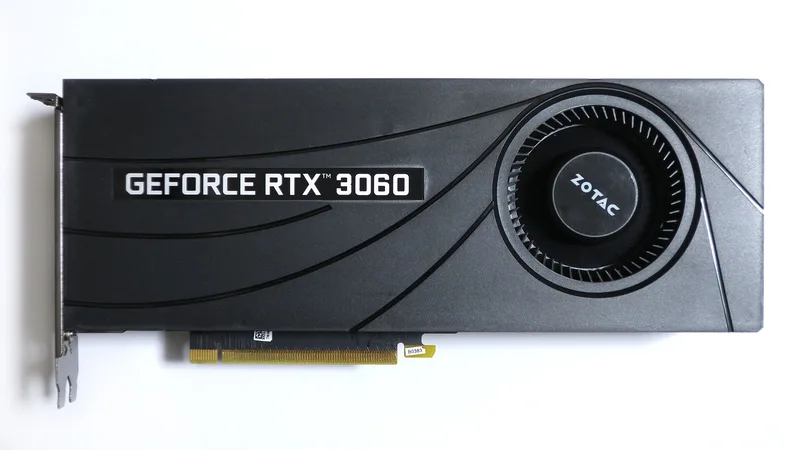
Full Specification Sheet
| CUDA Cores | 3,584 |
|---|---|
| Memory | 12 GB GDDR6 |
| Memory Bus | 192-bit |
| Boost / Base Clock | 1.78 GHz / 1.32 GHz |
| TDP | 170 W |
| Required System Power | 550 W |
| Architecture | Ampere (2nd-gen RT Cores, 3rd-gen Tensor Cores) |
| Outputs | 1x HDMI 2.1, 3x DisplayPort 1.4a |
The NVIDIA GeForce RTX 3060 12GB was released on 25 February 2021 at a launch price of $329. It sits in the mainstream tier of the GeForce RTX 30 series, built on the Ampere architecture, and its most distinctive attribute is the memory: 12 GB of GDDR6 on a 192-bit bus, which is more than several faster cards of the same generation carried. That combination makes it an interesting option for 1080p and 1440p gaming, for creative work that likes a large frame buffer and for buyers who want the ray tracing and DLSS features of the RTX family without paying for a high-end model.
Specifications in context
The GPU has 3,584 CUDA cores with a base clock of 1.32 GHz and a boost clock of 1.78 GHz. The memory subsystem pairs the 12 GB of GDDR6 with a 192-bit interface, which gives a bandwidth of 360 GB/s. Total graphics power is 170 W, and NVIDIA lists a required system power of 550 W, based on a test system with a Core i9-10900K processor; a lower power rating may work depending on the configuration. The reference design draws power through one 8-pin PCIe connector, and board makers sometimes use different connector arrangements on their own designs, so check the exact model.
The Ampere architecture brings second-generation RT cores for ray tracing and third-generation Tensor cores for AI workloads such as DLSS. Alongside these are NVIDIA Reflex latency reduction, NVIDIA Broadcast for microphone and camera effects, DirectX 12 Ultimate support, Resizable BAR, and the Game Ready and Studio driver branches. The card connects over PCI Express Gen 4, and its media engine has a seventh-generation encoder and a fifth-generation decoder, which is useful for streaming and video editing. Maximum GPU temperature is listed as 93 °C.
Display outputs
The reference outputs are one HDMI 2.1 port and three DisplayPort 1.4a ports, supporting up to four displays and a maximum digital resolution of 7680 by 4320. In practice, this card is best suited to monitors up to 1440p at high refresh rates or 4K at moderate settings. HDCP 2.3 is supported for protected content. As always, partner cards may change the port mix, so confirm the layout if you use a particular monitor arrangement.
Why the 12 GB matters
Video memory is an increasingly common limit. Modern games at higher texture settings, and creative applications that hold large images, models or video timelines in memory, can exceed the capacity of an 8 GB card and start swapping data over the PCIe bus, causing stutters. The 12 GB on this model provides headroom that cards with a similar performance level often lack. That does not make it faster: the number of CUDA cores and the clock speed determine peak throughput, and the 192-bit bus limits bandwidth compared with wider designs. But it does mean that when a game asks for a lot of memory, the card is less likely to run into a hard wall.
Watch out for variants
The name RTX 3060 was used for more than one configuration over the life of the product. The original version with 12 GB and a 192-bit bus is the one described here. NVIDIA later introduced a version with 8 GB of memory on a narrower 128-bit bus, with correspondingly lower memory bandwidth, and another variant based on a different GPU die appeared from partners. Because the marketing name stays the same, the memory size printed on the box and the product page is the most reliable way to tell them apart. If you want the 12 GB behaviour described in this article, verify the capacity and bus width before you buy. Some cards were also produced with a lite hash rate limiter, which is not relevant to gaming but sometimes appears in model names.
Cooling, size and power supply
Board partners offer many cooler designs, from compact dual-fan cards that fit small cases to larger triple-fan models with higher factory clocks. Because the card's power draw is a modest 170 W, even compact designs can keep noise low. Check the card's length and thickness against your case; the reference specification for this family lists a two-slot design, but partner models vary. For the power supply, 550 W is a sensible starting point, but do not treat it as a minimum for every system; a build with a power-hungry processor, several drives and lots of peripherals may need more. Our guide to PSU wattage shows how to estimate the total load.
Who it is for
The RTX 3060 12GB suits gamers who play at 1080p or 1440p and want the option to enable ray tracing and DLSS, people building a first gaming PC on a budget, and creators who want CUDA acceleration and extra memory without stepping up to a more expensive card. It is less appropriate for 4K gaming at high settings, where a higher-end card will make a real difference. To see what the top of the range looks like, browse the GeForce RTX 4090 page, and to see what a competing midrange card offers, compare it on the RTX 3060 12GB against the Radeon RX 6600 XT page. Our value guide comparing a flagship and a midrange card explains how to think about paying more or less for performance. The graphics card catalogue lists the rest of the range.
Verdict
The GeForce RTX 3060 12GB is a balanced mainstream graphics card whose main advantage is generous memory. With 3,584 CUDA cores, a 170 W power target, modern RTX features and a straightforward outputs layout, it is a practical choice for 1080p and 1440p gaming and for entry-level creative work. Check that the model you choose lists the 12 GB configuration explicitly, since retailer listings sometimes shorten the name to just RTX 3060. Confirm that the exact model has the 12 GB configuration, choose a cooler and size that fits your case, and use a power supply that comfortably covers the whole system. Do that, and the card offers a sensible mix of features and headroom for its class, backed by a modern software stack and a broad choice of partner designs.
Photo: Qurren / Wikimedia Commons, CC BY-SA 4.0.