AMD Ryzen 5 5600X
A 65 W six-core Zen 3 chip that made the AM4 platform a sensible base for a mainstream gaming PC.
Full Specification Sheet
| Cores / Threads | 6 / 12 |
|---|---|
| Base / Boost Clock | 3.7 GHz / up to 4.6 GHz |
| Cache | 32 MB L3 + 3 MB L2 |
| TDP | 65 W |
| Socket | AM4 |
| Architecture | Zen 3 (TSMC 7nm) |
| Memory | DDR4, up to 3200 MT/s |
| PCIe | PCIe 4.0 |
| Cooler | AMD Wraith Stealth included |
| Integrated Graphics | None (discrete GPU required) |
The AMD Ryzen 5 5600X is a six-core, twelve-thread desktop processor built on the Zen 3 architecture and released on 5 November 2020, alongside the first wave of Ryzen 5000 chips. It runs at a 3.7 GHz base clock and boosts up to 4.6 GHz, with 32 MB of L3 cache and 3 MB of L2 cache. Its 65 W default TDP is the detail that defines its personality: this is a processor built for efficient, straightforward gaming and everyday work rather than for maximum multi-threaded throughput. For a large number of builders, it became the sensible default processor for an AM4 system.
What Zen 3 changed
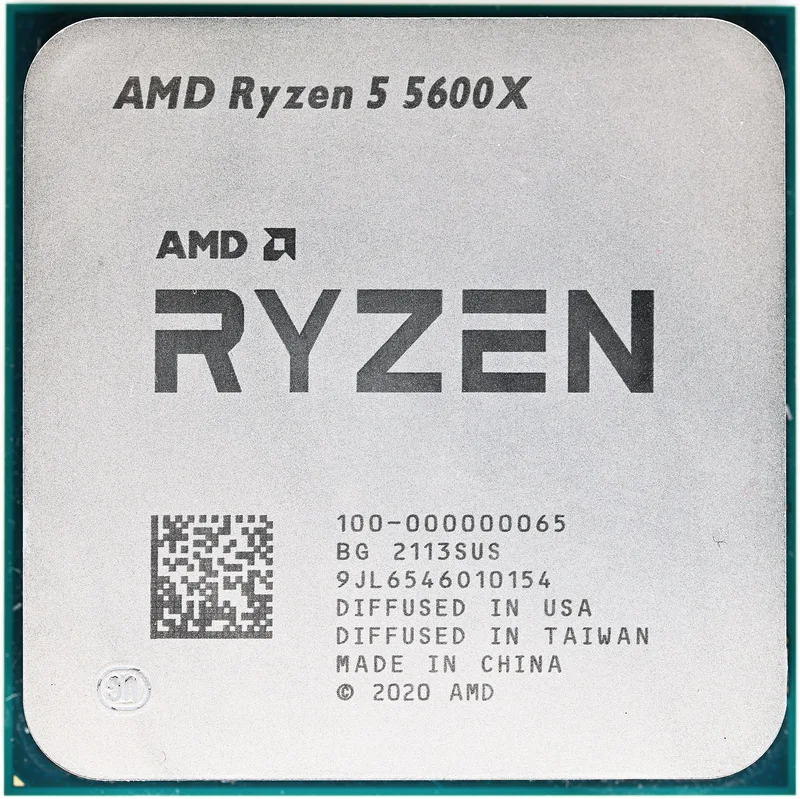
Zen 3 was a significant redesign of AMD's core layout. Earlier Zen generations split their cores into separate groups that each carried their own slice of L3 cache, which meant data sometimes had to travel between groups. Zen 3 unified the cores in a single chiplet so that all of them can reach the same 32 MB pool of L3 directly. For a six-core part such as the 5600X, this matters in a very practical way: every core sees the full cache rather than a fraction of it, which helps lightly threaded and gaming workloads that rely on quick access to shared data. Inspection photos of the processor with the heat spreader removed show a single six-core compute chiplet in the package, with the contacts for a second chiplet left empty, which matches the cost-conscious design of the product.
The compute cores are made on TSMC's 7nm process. AMD lists the processor as a Vermeer-generation part, and it is unlocked for overclocking, so users who enjoy tuning can raise clocks through the vendor's Ryzen Master utility, although the modest cooler that ships with the processor is a limiting factor for anything aggressive. Precision Boost 2, StoreMI storage acceleration and Ryzen VR-Ready Premium certification are listed among the supported technologies.
Specification summary
Cache is split across L2 and L3: 3 MB of L2 in total (512 KB per core) and 32 MB of L3 shared across the chiplet. The maximum operating temperature (Tjmax) is 95 °C. The processor uses the AM4 socket and pairs with DDR4 memory rated up to 3200 MT/s. PCIe 4.0 is supported, so a modern graphics card and a fast NVMe drive can use the full bandwidth of a compatible motherboard. Like every desktop Ryzen 5000 processor without a G suffix, it has no integrated graphics, which means a discrete graphics card is required for the system to output video at all.
One handy extra is the cooler. Unlike many of the higher-end Ryzen 5000 processors, the 5600X ships with the AMD Wraith Stealth cooler in the box. It is a modest low-profile design, but it is enough to run the processor at stock settings, which lets a first build start without an additional purchase. If you plan to overclock, run demanding all-core workloads for hours, or simply want quieter operation, an aftermarket tower cooler is still a worthwhile addition and costs relatively little compared with the platform as a whole.
Platform and motherboard choice
Being an AM4 part, the 5600X works with a wide range of motherboards, but chipset choice affects the feature set. Boards based on B550 and X570 offer PCIe 4.0 for the graphics slot and at least one NVMe slot; older B450 and X470 boards can run the processor after a BIOS update, but PCIe 4.0 support depends on the specific board. Because a BIOS update sometimes requires an older processor to be installed to complete, check whether the board maker offers a flash utility that works without a CPU, or buy a board that already lists Ryzen 5000 support. Our platform guide covering AM4, AM5 and LGA1700 explains how these sockets compare and which generation of motherboard suits which processor.
Memory support is straightforward: dual-channel DDR4 with an official ceiling of 3200 MT/s. The Zen 3 memory controller is happy with mainstream kits, and there is little reason to chase extreme memory speeds on this processor. Two modules in a matched kit are the reliable choice, and 16 GB is an easy starting point for a gaming build, with 32 GB worth considering if you also work with large projects. For a wider look at memory choices, read our DDR5 versus DDR4 buying guide to see where DDR4 still makes sense.
Power and cooling considerations
At 65 W, the 5600X is undemanding on the rest of the system. A modest power supply is enough for the processor itself, and the total requirement is mostly set by the graphics card. That is why the processor pairs well with mainstream and midrange graphics cards; the sizing guidance in our guide to PSU wattage can help you work out the supply for the complete build. Lower power draw also means less heat in a small case, which makes the 5600X appealing for compact systems where a larger, hotter processor would force compromises on noise.
Who it suits
The 5600X is a strong fit for a mainstream gaming PC, a home office machine that occasionally handles photo editing or light video work, and a first build where predictability matters more than peak performance. It is not the right choice for someone who renders video all day or compiles large code bases, where more cores translate directly into saved time. For those workloads, browse the processors catalogue for chips with higher core counts, or examine a head-to-head such as the Ryzen 5 5600X against the Ryzen 7 5800X3D to see how core counts, cache size and TDP differ between two AM4 processors that target quite different buyers.
Where it fits today
Time has moved the platform on. AMD has since introduced the AM5 socket with DDR5 memory, and the AM4 generation is now an established, mature platform with plenty of used and discounted hardware available. The 5600X remains a sensible choice when you already have an AM4 board and want a straightforward performance upgrade from an earlier Ryzen generation, because it needs no new memory and no new board in many cases. If you are starting from scratch and want a long upgrade path, the newer platform offers more headroom, and the Ryzen 9 7950X page shows what that class of processor looks like today.
Verdict
The Ryzen 5 5600X does not try to be the fastest processor in any category. It is a balanced, efficient six-core part with a bundled cooler, PCIe 4.0 support and a very manageable power profile. Check the motherboard's BIOS compatibility, add a matched pair of DDR4 modules, pair it with a discrete graphics card appropriate to your resolution, and it will serve as a dependable core of a mainstream gaming PC. If your usage grows heavier, the AM4 socket leaves room to step up to a higher-core-count chip without changing the rest of the system, which is exactly the type of flexibility that made this processor popular in the first place. Keep the specification limits in mind, especially the lack of integrated graphics, and it is hard to be disappointed by the result.
Photo: Phiarc / Wikimedia Commons, CC BY-SA 4.0.