NVIDIA GeForce RTX 5070
A 12 GB GDDR7 Blackwell graphics card with 6,144 CUDA cores, a 250 W power rating and a $549 starting price.
Full Specification Sheet
| CUDA Cores | 6,144 |
|---|---|
| Architecture | Blackwell (5th-gen Tensor, 4th-gen RT cores) |
| Base / Boost Clock | 2.33 GHz / 2.51 GHz |
| Memory | 12 GB GDDR7, 192-bit, 672 GB/s |
| Total Graphics Power | 250 W |
| Recommended PSU | 650 W |
| Power Connectors | 2x PCIe 8-pin (adapter in box) or a 300 W+ PCIe Gen 5 cable |
| Outputs | 3x DisplayPort 2.1b, 1x HDMI 2.1b |
| Interface | PCIe Gen 5 |
| Founders Edition Size | 242 x 112 mm, 2-slot |
The NVIDIA GeForce RTX 5070 is a mid-range graphics card from the GeForce RTX 50 Series, built on NVIDIA's Blackwell architecture. It was announced with the rest of the 50 Series in early 2025 at a starting price of $549, and NVIDIA's news post says it was out in add-in-card versions on 5 March 2025, with the limited Founders Edition following later in March. It is aimed at gamers playing at 1440p and it is the successor to the GeForce RTX 4070. This page goes through the published specification, explains the features NVIDIA emphasises and sets out the practical requirements around power, size and cooling.
Core specification
NVIDIA lists 6,144 CUDA cores with a base clock of 2.33 GHz and a boost clock of 2.51 GHz. The card carries 12 GB of GDDR7 memory on a 192-bit interface, and NVIDIA states that the total memory bandwidth is 672 GB/s, against 504 GB/s for the GeForce RTX 4070. The memory type explains the increase: GDDR7 raises the per-pin data rate compared with GDDR6X, so the bandwidth grows even though the bus width is unchanged. The card uses fifth-generation Tensor Cores, quoted at 988 AI TOPS, and fourth-generation RT Cores, quoted at 94 TFLOPS. It has one ninth-generation NVENC encoder and one sixth-generation NVDEC decoder, and it supports AV1 encoding and decoding. The interface is PCIe Gen 5, and CUDA capability is listed as 12.0. Our guide to how much graphics memory you need explains what 12 GB means for modern games and creative work.
Power, size and cooling
NVIDIA's total graphics power for the RTX 5070 is 250 W, with a maximum GPU temperature of 85 degrees Celsius, and the required system power is listed as 650 W, based on a PC with a Ryzen 9 9950X processor. NVIDIA recommends a PCIe CEM 5.1 compliant power supply and notes that requirements can differ with system configuration. Power connections are either two 8-pin PCIe cables from the supply, using the adapter included in the box, or a single PCIe Gen 5 cable rated at 300 W or more. The Founders Edition is a two-slot card measuring 242 mm by 112 mm, and NVIDIA describes it as an SFF-ready design; partner cards vary in length, width and slot count, so check your case clearance before you buy a specific model. Our GPU naming tiers guide explains how the xx70 class fits between smaller and larger cards.
Display outputs
The reference outputs are three DisplayPort 2.1b connectors and one HDMI 2.1b connector. NVIDIA lists a maximum digital resolution of 4K at 480 Hz or 8K at 165 Hz with Display Stream Compression, support for up to four monitors and HDCP 2.3. Partner cards may use different port layouts, so if you use several monitors, confirm the connector mix of the model you plan to buy.
Blackwell features
The headline feature is DLSS 4 with Multi Frame Generation, which uses AI to generate additional frames between rendered ones. NVIDIA also lists Super Resolution, DLAA, Ray Reconstruction, Reflex 2 and Frame Generation, plus NVIDIA Broadcast, NVIDIA App, ShadowPlay and G-SYNC support. Multi Frame Generation is the reason NVIDIA's performance claims are expressed with DLSS enabled; the technology requires game support and hardware from the RTX 50 Series. For background on what these upscaling and frame-generation technologies need, see our article on DLSS, FSR and frame generation requirements.
Manufacturer performance claims
NVIDIA states that the GeForce RTX 5070 can play Hogwarts Legacy and S.T.A.L.K.E.R. 2 at over 250 fps at 1440p and demanding titles such as Cyberpunk 2077 and Alan Wake 2 at over 120 fps with full ray tracing at 1440p, all with DLSS 4 Multi Frame Generation. It says the card offers up to a 2x performance jump over the previous generation when Multi Frame Generation is used, along with a 20 percent boost in traditional raster performance, that generative AI tasks run 3 times faster, and that 4:2:2 video export is 6 times faster than on the GeForce RTX 4070 through hardware-accelerated 4:2:2 support. These are NVIDIA's own statements with specific games, settings and hardware; they are not independent test results, and the generational gain without frame generation is smaller than the headline figure.
Memory bandwidth in context
The stated 672 GB/s can be checked with simple arithmetic. A 192-bit bus moves 24 bytes per transfer, so 672 GB/s implies a per-pin data rate of 28 Gbps, which is what GDDR7 at this speed provides. The GeForce RTX 4070's 504 GB/s on the same 192-bit width corresponds to 21 Gbps, so NVIDIA's comparison is an increase of about one third from the memory type alone. That is our own derivation from the published figures, not a separate claim. Bandwidth matters most at higher resolutions and with large textures, while capacity, at 12 GB, matters for how much data a game can keep resident before it has to stream from system memory.
Creators and encoding
The card has a ninth-generation NVENC encoder and a sixth-generation NVDEC decoder, with AV1 encoding and decoding. NVIDIA highlights hardware-accelerated 4:2:2 video support through NVENC, which is relevant for professional camera footage and editing timelines, and it quotes faster generative AI performance from Blackwell's support for FP4 precision. Because these are features of the GPU, they apply to every partner card that uses the chip, and they matter mainly to people who edit video, stream or run AI tools locally rather than to gamers alone.
Installation checklist
Before installing, confirm that your power supply provides either two spare 8-pin PCIe connectors or a 300 W-capable PCIe Gen 5 cable, that the case has room for a card of the chosen length and thickness, and that the power supply capacity meets NVIDIA's 650 W guidance for the whole system. The card uses PCIe Gen 5 but works in older slots at the speed the slot provides. Update the graphics driver from NVIDIA after installation so that DLSS 4 features and game profiles are available.
Price and where it fits
The starting price announced for the card is $549, and actual retail prices vary by model and market. Compared with the GeForce RTX 4070 already listed on this site, the RTX 5070 keeps the same 12 GB capacity but uses faster GDDR7, a newer architecture and a lower-power rating, and our GeForce RTX 5070 versus RTX 4070 comparison lists the differences side by side. If you are shopping among current cards, browse the graphics cards category.
Who should consider it
The RTX 5070 suits a 1440p gaming build that values DLSS 4 support and a modest power requirement of 650 W. Buyers who want more memory for high-resolution textures or heavy creative work should look at the larger cards in the family, and buyers who play at 1080p may not need this much GPU. All specifications on this page come from NVIDIA's product and news pages; availability, prices and partner-card details vary by region.
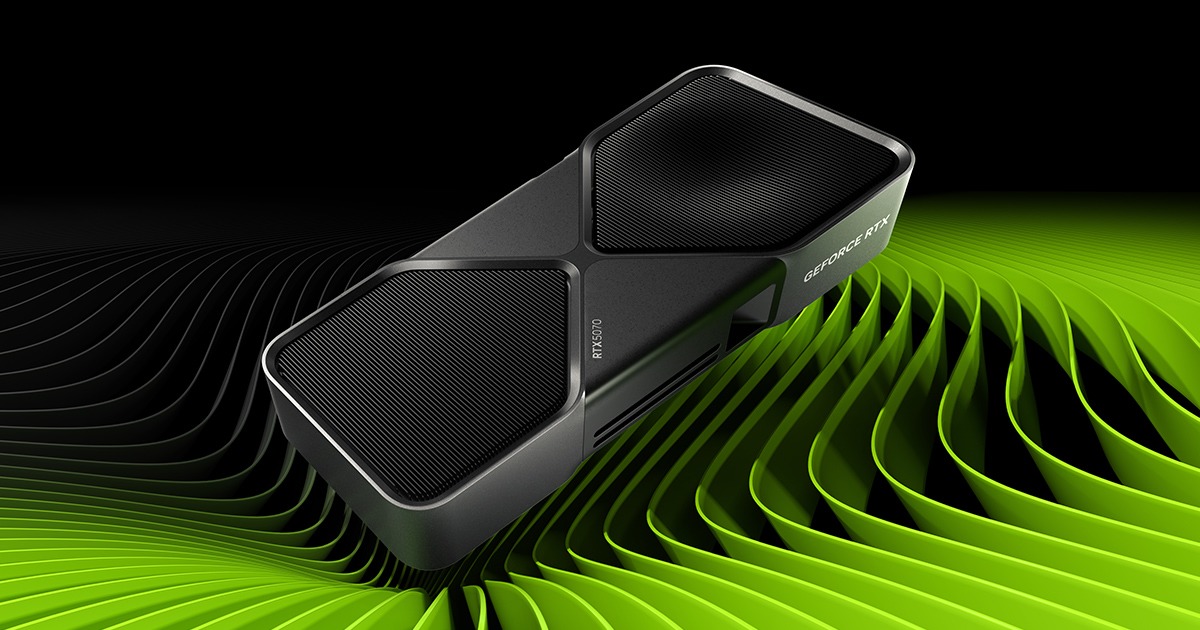
Product image: NVIDIA press image (GeForce RTX 5070 Founders Edition).