NVIDIA GeForce RTX 4070 SUPER
An Ada Lovelace graphics card with 7,168 CUDA cores, 12 GB of GDDR6X on a 192-bit bus, DLSS 3.5, a 220 W board power and a compact two-slot Founders Edition.
Full Specification Sheet
| Architecture | NVIDIA Ada Lovelace |
|---|---|
| CUDA Cores | 7,168 |
| Boost / Base Clock | 2.48 GHz / 1.98 GHz |
| Memory | 12 GB GDDR6X, 192-bit |
| Tensor Cores | 4th generation, 568 AI TOPS |
| RT Cores | 3rd generation, 82 RT TFLOPS |
| Shader Throughput | 36 TFLOPS |
| Interface | PCI Express Gen 4 |
| Total Graphics Power | 220 W |
| Required System Power | 650 W |
| Power Connector | 2x PCIe 8-pin (adapter in box) or 300 W or greater PCIe Gen 5 cable; some partner models use 1x 8-pin |
| Display Outputs | HDMI 2.1a, 3x DisplayPort 1.4a; up to 4 displays |
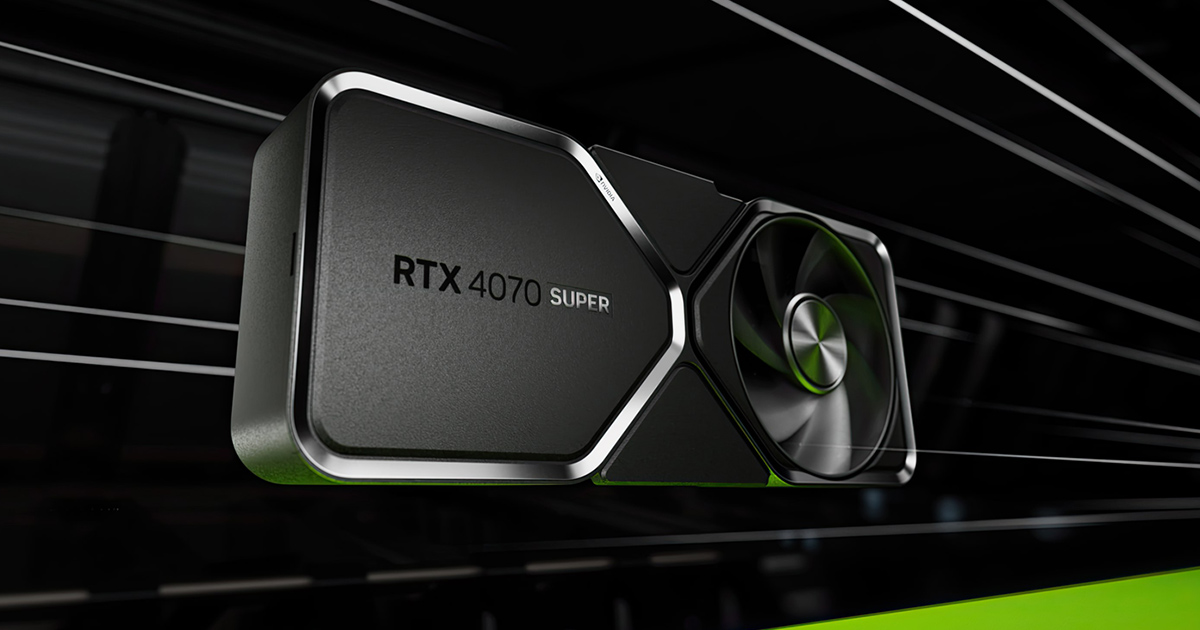
| Founders Edition Size | 244 mm long, 112 mm wide, 2-slot |
The NVIDIA GeForce RTX 4070 SUPER is an upper mid-range graphics card from the GeForce RTX 40 series, built on the Ada Lovelace architecture. NVIDIA lists it on the RTX 4070 family page alongside the RTX 4070 Ti SUPER, the RTX 4070 Ti and the original RTX 4070, and it sits between the original 4070 and the Ti models in core count. This page collects the specification NVIDIA publishes for the Founders Edition and reference design, explains what the numbers mean and marks which claims are NVIDIA's own. The family page states no price for the SUPER model, and we make no benchmark claims.
Cores and clocks
The card has 7,168 CUDA cores, compared with 5,888 on the RTX 4070, 7,680 on the RTX 4070 Ti and 8,448 on the RTX 4070 Ti SUPER. NVIDIA lists a base clock of 1.98 GHz and a boost clock of 2.48 GHz, the same boost figure as the RTX 4070. The listed peak throughput is 36 TFLOPS for the shader cores, 82 TFLOPS for the third-generation RT cores and 568 AI TOPS for the fourth-generation Tensor cores, against 29, 67 and 466 for the RTX 4070. These are theoretical peak rates, and not a prediction of frame rates. The step from the original RTX 4070 is therefore a sizeable increase in core count and throughput at the same boost clock. NVIDIA's marketing for the Ada architecture claims new streaming multiprocessors with up to twice the performance and power efficiency, fourth-generation Tensor cores with up to four times the performance using DLSS 3 compared with brute-force rendering, and third-generation RT cores with up to twice the ray tracing performance; those are the manufacturer's comparative claims against the previous generation.
Memory
The memory configuration is 12 GB of GDDR6X on a 192-bit interface. Twelve gigabytes is the same capacity as the RTX 4070 and the RTX 4070 Ti, while the RTX 4070 Ti SUPER carries 16 GB on a 256-bit interface. Capacity matters for high-resolution textures and for creative applications, and our guide to 8 GB versus 24 GB of video memory explains when it limits performance. The page lists the original RTX 4070 with either GDDR6 or GDDR6X memory, but the SUPER model only with GDDR6X. No memory bandwidth figure is published on the page, so we do not quote one.
DLSS 3.5, ray tracing and Reflex
The card supports DLSS 3.5, which the specification table lists as Super Resolution, DLAA, Ray Reconstruction and Frame Generation. NVIDIA explains that DLSS 3 uses the fourth-generation Tensor cores and the Optical Flow Accelerator to create additional frames with AI and improve image quality. NVIDIA Reflex is supported for latency optimisation, and ray tracing runs through the third-generation RT cores. Whether a game uses these features is up to the developer, and they change image quality and latency rather than the raw shader throughput of the card.
Display and video capabilities
Display outputs are one HDMI 2.1a and three DisplayPort 1.4a connectors. The maximum resolution is listed as 4K at 240 Hz or 8K at 60 Hz with Display Stream Compression and HDR, and NVIDIA notes that with dual DisplayPort 1.4a and DSC, 8K HDR at 120 Hz is possible. Up to four independent displays are supported at 4K and 120 Hz using DisplayPort or HDMI, or two displays at 4K and 240 Hz or 8K and 60 Hz with DSC. HDCP 2.3 is supported. For video, the card has one eighth-generation NVIDIA encoder and a fifth-generation decoder, with AV1 encode and decode. NVIDIA presents AV1 encoding as more efficient than H.264 for streaming at higher resolutions. The NVIDIA Broadcast app, RTX Video Super Resolution, NVIDIA Studio drivers and Omniverse are listed among the supported features.
Power and cooling
Total graphics power is 220 W, against 200 W for the original RTX 4070, and NVIDIA lists a required system power of 650 W, based on a PC configured with a Ryzen 9 5900X processor, adding that requirements can differ with the system configuration. Power arrives through two PCIe 8-pin cables to the included adapter or through a PCIe Gen 5 cable of 300 W or more, and NVIDIA notes that certain manufacturer models may use a single 8-pin cable. If you are unsure whether your supply is large enough, our guide to power supply wattage shows how to check. The maximum GPU temperature is 90 degrees Celsius. NVIDIA also publishes idle power of 11 W, video playback power of 16 W and average gaming power of 200 W, measured across 22 games at 4K, 1440p and 1080p on the Founders Edition or reference design.
Size and compatibility
The Founders Edition is 244 mm long and 112 mm wide and occupies two slots, and NVIDIA marks it as an SFF-ready enthusiast GeForce card, meaning it is designed to fit smaller cases. Partner cards vary in size, so check each one. The card uses a PCI Express Gen 4 interface and supports Resizable BAR, G-SYNC, NVIDIA App or GeForce Experience, ShadowPlay, DirectX 12 Ultimate, Vulkan and OpenGL 4.6. Multi-GPU NVLink is not supported. The card is marked as VR ready.
Founders Edition versus partner cards
NVIDIA states that the figures represent the Founders Edition or reference design, and that clock specifications apply while gaming with medium to full GPU utilisation. Specifications may vary by add-in-card manufacturer, whose own websites hold the shipping specifications of each model. A partner card can therefore have a different factory boost clock, cooler, length and connector arrangement, so compare the partner's own sheet for the exact product you plan to buy.
Where it fits
The GeForce RTX 4070 SUPER targets high-refresh 1440p gaming and lighter 4K use with ray tracing and DLSS. To see how the naming tiers map to positioning, read our explanation of the xx60, xx70 and xx80 tiers. On this site the closest neighbours are the original card in the RTX 4070 SUPER versus RTX 4070 comparison and the newer GeForce RTX 5070, and you can browse all cards in the graphics card category. This page states no price, so check current price and availability with a retailer. None of the statements above is a test result; all values are NVIDIA's published specifications.
Product image: NVIDIA product image.