NVIDIA GeForce RTX 5090
NVIDIA's Blackwell flagship with 21,760 CUDA cores, 32 GB of GDDR7 on a 512-bit bus and a 575 W total graphics power.
Full Specification Sheet
| Architecture | NVIDIA Blackwell |
|---|---|
| CUDA Cores | 21,760 |
| Tensor Cores | 5th generation, 3,352 AI TOPS |
| RT Cores | 4th generation, 318 TFLOPS |
| Base / Boost Clock | 2.01 GHz / 2.41 GHz |
| Memory | 32 GB GDDR7, 512-bit |
| Total Graphics Power | 575 W |
| Recommended PSU | 1000 W |
| Power Connector | 1x 600 W PCIe Gen 5 cable (or 4x 8-pin via adapter) |
| Dimensions (Founders Edition) | 304 x 137 mm, 2-slot |
| Outputs | 3x DisplayPort 2.1b, 1x HDMI 2.1b |
| Encoders | 3x NVENC (9th gen), 2x NVDEC (6th gen) |
The NVIDIA GeForce RTX 5090 is the top model of the GeForce RTX 50 series, built on NVIDIA's Blackwell architecture and announced at CES in January 2025 with an announced price of 1,999 US dollars and availability from 30 January 2025. NVIDIA describes it as the most powerful GeForce GPU ever made, aimed at gamers who want maximum settings at 4K and beyond, and at creators and AI developers who can use its large memory pool and neural-rendering hardware. It is also the largest jump in specification within the generation: roughly twice the CUDA core count of the RTX 5080, double the memory and a 512-bit memory bus. This page collects NVIDIA's published specification, explains the major numbers and discusses the practical requirements of running a card in this class.
The GPU: cores and clocks
NVIDIA lists 21,760 CUDA cores, 3,352 AI TOPS from its fifth-generation Tensor Cores and 318 TFLOPS of ray-tracing throughput from fourth-generation RT Cores. The base clock is 2.01 GHz and the boost clock is 2.41 GHz. Both are lower than on the RTX 5080, which is a typical pattern for very large chips: the performance comes from width, not from clock speed. The AI TOPS figure relates to low-precision (FP4-class) operation supported by the Blackwell Tensor Cores, so it is a theoretical peak for neural workloads rather than a graphics benchmark. As always, NVIDIA's numbers are manufacturer-stated, and real results depend on the game, the settings, the driver and the processor.
The architecture emphasises neural rendering. NVIDIA's DLSS 4 package includes Super Resolution, Ray Reconstruction and Multi Frame Generation, which can generate several additional frames for each rendered frame on GeForce RTX 50 series cards, and the company also lists Reflex technology for latency reduction. These features are software-and-hardware combinations that depend on game support, and it is worth reading our guide to frame-generation hardware requirements to understand what they do and what they do not do for input latency and image quality.
Memory: 32 GB on a 512-bit bus
The RTX 5090 carries 32 GB of GDDR7 memory on a 512-bit bus. The wide interface, combined with the higher data rate of GDDR7, gives a memory bandwidth of about 1.8 TB/s according to NVIDIA's published figures. Thirty-two gigabytes far exceeds the needs of current games, even with the largest texture packs and path tracing at 4K, so the capacity is best understood as headroom for future titles, for creative tasks such as 3D scenes, video editing with heavy effects and simulation, and for running large AI models locally. If you want to understand how much video memory a given workload really needs, our explainer on VRAM capacity is a useful companion.
Video, display and connectivity
For display output, NVIDIA lists three DisplayPort 2.1b connectors and one HDMI 2.1b connector, with support for 4K at up to 480 Hz or 8K at up to 165 Hz using display stream compression. That is aimed at the newest high-refresh monitors, and it means the card will not be the limiting factor for display connectivity. On the video side the card has three ninth-generation NVENC encoders and two sixth-generation NVDEC decoders, with AV1 encode and decode supported, which makes it highly suited to streaming, multi-stream capture and video production. The card uses a PCI Express Gen 5 interface and supports Resizable BAR.
Power, thermal and physical requirements
The total graphics power is 575 W, and NVIDIA recommends a system power supply of at least 1,000 W. Power comes from a single 600 W-capable PCIe Gen 5 (16-pin) cable, or from four 8-pin PCIe cables through the adapter supplied with the card. The maximum GPU temperature is listed as 90 degrees Celsius. Cards drawing this much power through one connector place demands on cable quality and seating, and our explanation of the 12VHPWR connector covers correct installation, the importance of fully seating the plug and why modern ATX 3 power supplies with native cables are the sensible pairing.
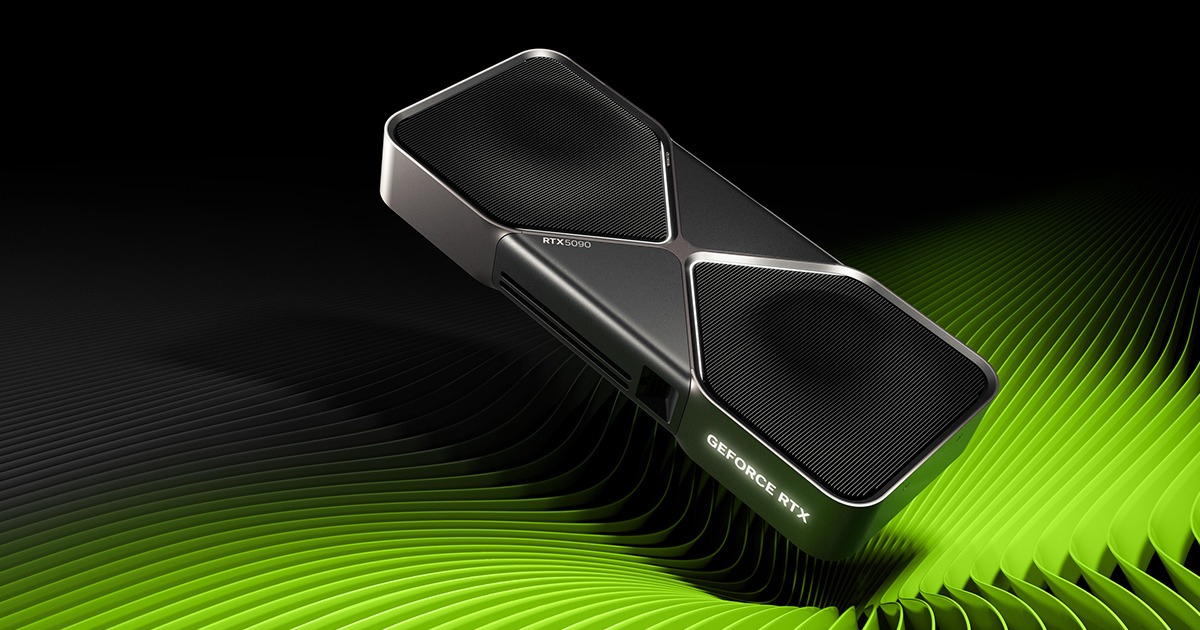
The Founders Edition measures 304 mm in length and 137 mm in width, and it occupies two slots, which NVIDIA describes as SFF-ready, although partner cards are frequently larger and heavier. NVIDIA lists 'two-slot' with allowances for airflow clearance in its specification, so check case dimensions and fan positions before buying. Everyone who fits a card in this class should also plan for the exhaust: a 575 W device puts substantial heat into the case, and good airflow matters more than usual.
Positioning and comparison
Within the current lineup there is no card above the RTX 5090 in the GeForce range. The comparison most buyers make is with the previous flagship, the GeForce RTX 4090, and you can read the GeForce RTX 5090 versus RTX 4090 comparison as well as our GeForce RTX 4090 review for the earlier generation's data. The price gap between the RTX 5090 and everything else in the range is significant, and the card only makes sense if you will actually use the memory, the encoders or the resolution headroom. For most gamers, one of the lower models will deliver a more balanced system. To see what else is available, browse the graphics card category.
Beyond gaming
Because of its memory size and encoder count, the RTX 5090 is as much a workstation-class component as a gaming card. Rendering scenes with large textures, training or running local language and image models, and multi-stream video capture are the cases where the 32 GB and the three NVENC units matter most, and where a card with half the memory would force compromises. For a pure gaming build, the marginal benefit over the RTX 5080 depends on the resolution: at 4K with all settings maximised the difference is most visible, while at 1440p a processor limit often narrows it. The practical advice is to buy the card whose limits you will actually reach, and to treat the RTX 5090 as a tool for people who need everything it offers.
Before buying, budget for the rest of the system: a 1,000 W or larger ATX 3 power supply, a case with strong airflow and enough length and clearance, and a processor that can keep such a card fed at the resolution you intend to use. All figures on this page come from NVIDIA's official specifications; pricing and availability vary by region and retailer, and add-in-board partner models can differ in clocks, dimensions and power connectors from the Founders Edition figures given here.
Product image: NVIDIA product image (Founders Edition).